



German troops in Lithuania face intensifying Russian hybrid war
German soldiers in Lithuania report mysterious phone calls and drone surveillance as officials warn of Russia's growing hybrid warfare tactics in the Baltics.


By Ahmet Taş | Wise News Press
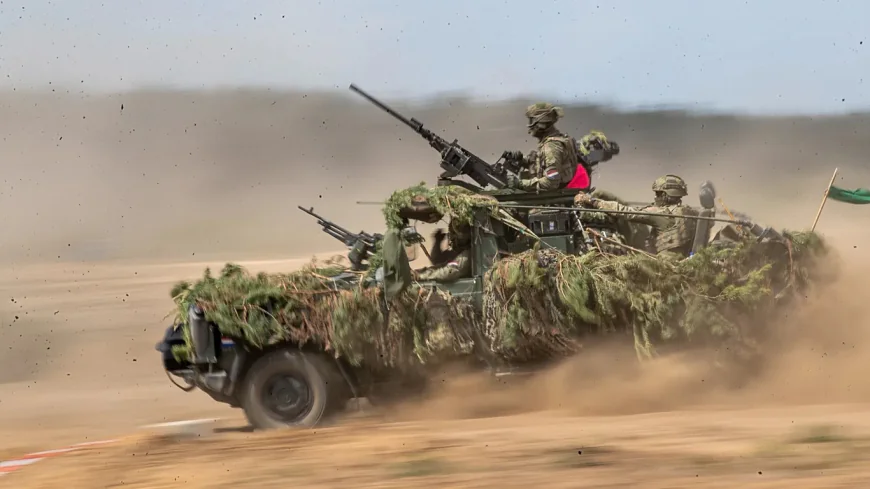
VILNIUS, LITHUANIA — German soldiers stationed in Lithuania are increasingly targeted by Russian hybrid warfare tactics, ranging from psychological intimidation via phone monitoring to drone surveillance of military drills, raising concerns about the security of NATO's eastern flank.
As Russia seeks to penetrate European Union and NATO territories through digital espionage and psychological operations, the Bundeswehr (German armed forces) is grappling with a threat landscape that blurs the lines between peace and conflict. These incidents have prompted high-level discussions in Berlin regarding the appropriate military and diplomatic response to aggression that stops short of conventional war.
Psychological pressure tactics
The hybrid campaign is being felt on a personal level by troops on the ground. In his book Inside Bundeswehr, Joshua Krebs details a disturbing incident involving a German soldier deployed in Lithuania. According to the report, the soldier received a call from an unknown number shortly after finishing a private phone conversation.
"A comrade calls home and talks for half an hour. Then a call comes in from an unknown number. He answers it and listens to a recording of the conversation he just had," Krebs writes. He described these surveillance activities as "eerie," designed specifically to intimidate personnel and sow insecurity within the ranks.
Drones and airspace violations
Beyond digital harassment, physical surveillance has escalated. Unmanned aerial vehicles (UAVs) have reportedly been used to spy on sensitive defense infrastructure, including the Arrow 3 air defense system and military exercises involving Germany's 45th Armored Brigade.


Last year, during the "Iron Wolf" exercise in Lithuania, a Russian reconnaissance aircraft was detected in neighboring Belarusian airspace. General Carsten Breuer, Inspector General of the Bundeswehr, described the incident as "proof of a very real threat to Lithuania."
German Defense Minister Boris Pistorius highlighted that the threat level in the Baltic states is perceived much more acutely than in other parts of Europe. Speaking in Berlin alongside his Lithuanian counterpart, Pistorius noted that provocative airspace violations are a key component of this strategy.
In October 2025, two Russian fighter jets briefly violated Lithuanian airspace. The aircraft, likely originating from the Kaliningrad exclave, remained in the zone for approximately 18 seconds before being escorted away by NATO jets. German Chancellor Friedrich Merz condemned the incident at the time, labeling it a deliberate "provocation" by Moscow.


Political fallout and border tensions
The Baltics remain a focal point for tension due to their proximity to Russian territory. Since Estonia, Latvia, and Lithuania lack their own fighter jets, NATO allies—including Germany, Spain, and the United Kingdom—police the skies. Germany has intensified its involvement, with Pistorius confirming that Berlin is supporting airspace protection with a mobile air force command center from January to March of this year.
However, the threats are not limited to the air. In December, Russian border guards entered NATO territory in Estonia without authorization, prompting a diplomatic standoff. This followed earlier reports of armed groups in military-style uniforms without insignia appearing near the border—a scenario reminiscent of the "little green men" seen prior to Russia's illegal annexation of Crimea in 2014.
The legal gray zone
Responding to these provocations proves difficult because hybrid warfare operates in a legal gray area. Unlike a conventional military invasion, actions such as brief airspace violations, cyber harassment, or the presence of unidentified troops do not automatically trigger Article 5, NATO's collective defense clause.
International law prohibits the use of force under Article 2(4) of the UN Charter, but hybrid activities often fall below the threshold of an "armed attack" required to justify self-defense under Article 51. The intent of these operations remains clear: to provoke, create unrest, and spread fear while maintaining plausible deniability.
Source: EuroNews
What's Your Reaction?
 Like
0
Like
0
 Dislike
0
Dislike
0
 Love
0
Love
0
 Funny
0
Funny
0
 Wow
0
Wow
0
 Sad
0
Sad
0
 Angry
0
Angry
0

Editor | Wise News Press — Delivering accurate, timely global news with integrity, insight, and editorial responsibility.



















Comments (0)