



Turkish firms target Ukraine’s reconstruction market
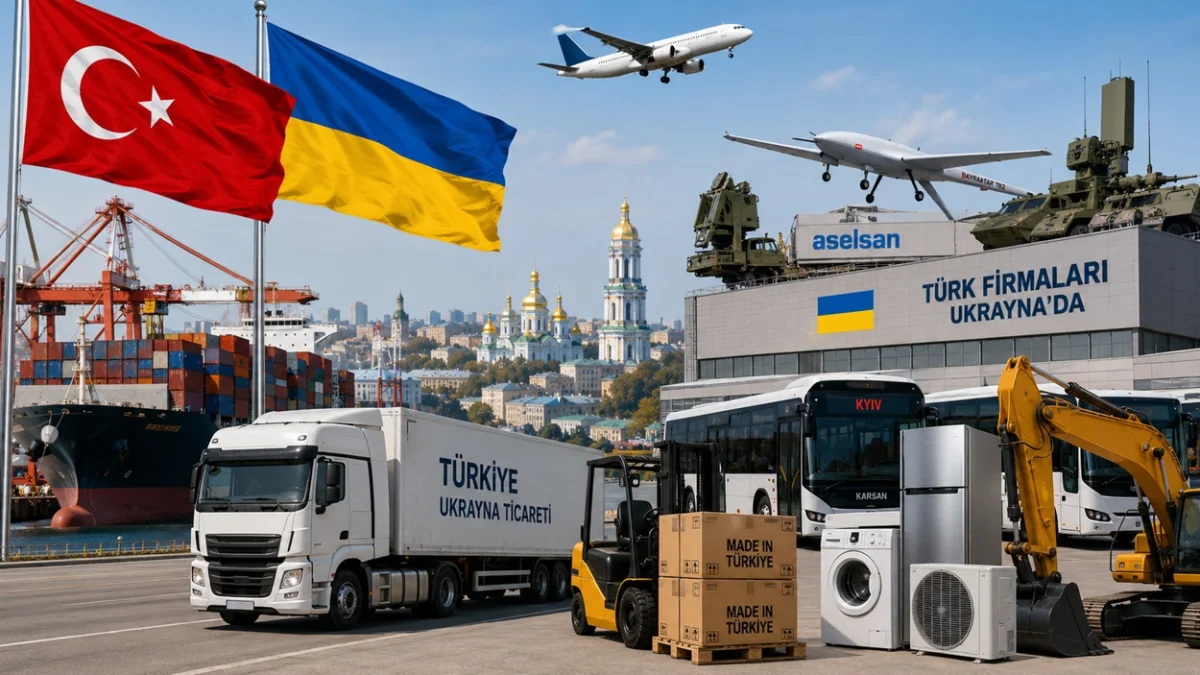
Turkish companies are expanding their focus on Ukraine, targeting opportunities in defense, transport, home appliances, construction materials and industrial equipment.


By Yusuf İnan | Wise News Press
ANKARA, Turkey — Turkish companies are repositioning themselves in Ukraine’s changing economy, targeting opportunities in home appliances, public transport, defense, construction materials, industrial machinery and postwar reconstruction.
A detailed market report on Turkish firms operating in Ukraine shows that economic ties between the two countries are no longer limited to conventional exports. The report reviews companies including Arçelik/Beko, Karsan, Otokar, ASELSAN, Baykar, Hidrolift, Emir Packaging, Polisan, Best Foreign Trade, TMS Triko Makina and Özbek Tekstil, assessing their products, entry channels, logistics routes, certification needs, local partnerships and market strategies.
Ukraine is becoming a strategic market
Ukraine has become a complex but important market for Turkish companies since Russia’s full-scale invasion. The war has disrupted supply chains, municipal procurement, consumer demand and transport routes. At the same time, it has created urgent demand in reconstruction, defense modernization, public transport renewal, energy efficiency, household equipment, logistics systems and industrial machinery.
The report says the most important requirements for Turkish companies entering or expanding in Ukraine include cooperation with local distributors, payment security, Ukrainian-language labeling, certification compliance and reliable logistics planning. These factors show that Ukraine is not simply a nearby export market. It is a high-risk, high-potential economy where companies need local knowledge and long-term operational planning.
Entry channels differ by sector. In home appliances, local offices, retailers and e-commerce platforms are important. In public transport, direct agreements with municipalities play a central role. In defense, state institutions and military procurement channels dominate. In industrial equipment, distributors, trade fairs and B2B networks are often decisive.


Beko relies on local presence
Arçelik’s Beko brand is one of the most visible Turkish consumer brands in Ukraine. According to the report, Beko has been active in the Ukrainian home appliance market since 2013. Its product range includes refrigerators, washing machines, dishwashers, ovens, air conditioners and other household appliances.
Beko’s main advantage is that it is not only exporting products from Turkey. The company has built a local structure in Ukraine through Beko Ukraine Ltd., including a Kyiv-based presence, warehouses and a dealer network. Its products are sold through major electronics and home appliance chains, as well as online platforms such as Rozetka.
This local footprint gives Beko more flexibility in a market exposed to currency volatility, wartime uncertainty and logistical disruption. For home appliance companies, the key risks include exchange-rate pressure, reduced purchasing power and grey-market imports. However, demand for household equipment, stronger digital sales channels and the long-term modernization of Ukrainian homes continue to create opportunities.


The report says Ukrainian-language labeling, energy efficiency documentation, warranty visibility and certification compliance are essential for companies operating in this segment. For Turkish brands, consumer trust and after-sales service may be as important as price.
Karsan and Otokar focus on public transport
Public transport has become one of the clearest areas where Turkish manufacturers have already entered Ukraine. Karsan and Otokar both delivered buses to Ukrainian cities before the war reshaped the country’s infrastructure needs.
Karsan’s agreement with Kharkiv Municipality for 500 buses is one of the most significant examples of Turkish automotive exports to Ukraine. The report says the company delivered 150 Jest+ buses in 2021 as part of a project worth about $50 million. The vehicles were intended for urban transport services in Kharkiv.
Otokar delivered 10 CNG-powered Kent buses to the city of Vinnytsia in late 2021. Although the scale was smaller than Karsan’s Kharkiv project, the delivery showed that Ukrainian municipalities were interested in alternative-fuel and lower-emission public transport vehicles.
For both companies, the long-term opportunity is linked to Ukraine’s postwar reconstruction and the modernization of city transport fleets. Many Ukrainian cities will need to renew damaged or aging transport systems, and Turkish producers can compete with diesel, CNG, electric and accessible bus models.
The biggest risks are logistics, spare parts and maintenance in wartime conditions. The report recommends local service points, spare parts depots and long-term maintenance agreements with municipalities as key steps for Turkish bus manufacturers.
Defense ties carry strategic weight
ASELSAN and Baykar represent the strategic side of Turkish-Ukrainian economic relations. Their activities go beyond ordinary trade because they are directly linked to Ukraine’s defense modernization.
ASELSAN signed a $43.6 million communications systems contract with Ukraine in 2017, according to the report. The company’s expertise in military communications, radar, command-control systems, electronic warfare and electro-optics overlaps with Ukraine’s need to modernize its armed forces.
Defense exports follow a different path from commercial sales. They require government permissions, defense ministry channels, technical protocols and in some cases cooperation with institutions such as Ukroboronprom.
Baykar’s Bayraktar TB2 drones have become one of the most symbolic elements of Turkey-Ukraine defense cooperation. The report says Ukraine purchased 6 TB2 drones and 3 ground control stations, with earlier acceptance and delivery processes completed before the full-scale invasion. Wider procurement and production cooperation have also been discussed.
For Turkish defense companies, the opportunity is large but sensitive. Deliveries, training, maintenance, spare parts, technology transfer and political approval all matter. The report suggests that long-term success will depend not only on product sales, but also on training, repair capacity, technical support and possible local production partnerships.
Industrial equipment and packaging offer niche openings
Beyond large projects, Turkish companies may also find opportunities in more specialized sectors. Hidrolift, which produces forklifts and hydraulic lifting equipment, and Emir Packaging, which operates in agricultural and packaging-related products, are examples of firms that could benefit from Ukraine’s changing industrial needs.
The war has damaged parts of Ukraine’s industrial and warehouse infrastructure. Reconstruction, logistics centers and manufacturing recovery may increase demand for forklifts, pallet trucks and warehouse equipment. Hidrolift’s potential advantage is the price-performance balance of Turkish industrial machinery.
However, success in this segment requires CE compliance, possible UkrSEPRO certification, local distributors and spare parts support. Without after-sales service, industrial equipment exporters may struggle to maintain customer confidence.
Emir Packaging could benefit from Ukraine’s strong agricultural sector. Packaging materials, stretch film, palletizing products and protective materials are important for both domestic distribution and export chains. The report recommends emphasizing recyclable packaging, quality documentation and product safety certificates.
Construction and paint firms look to rebuilding
Polisan and Best Foreign Trade are positioned in sectors that may become more important during Ukraine’s reconstruction. Polisan sells decorative paint in Ukraine through its Kyiv-based distributor B.S. COLORS, according to the report. Ukrainian-language packaging, local dealer networks and product certification are key issues for paint exporters.
Best Foreign Trade, which is linked to construction materials, could benefit from future demand for insulation, building chemicals, cement-based products and interior construction solutions. The war has reduced construction activity in the short term, but reconstruction could create significant demand for schools, hospitals, housing, public buildings, industrial facilities and infrastructure.
For Turkish construction material firms, the opportunity is not limited to exporting individual products. Project-based package solutions may become more attractive. Companies that can offer bundled materials, reliable delivery, technical documentation and financing support may be better positioned.
The report notes that payment security, export credit insurance and cooperation with local construction firms will be critical. In Ukraine’s reconstruction market, trust and delivery reliability may be as important as cost.
Textile and machinery exporters need digital channels
TMS Triko Makina and Özbek Tekstil show another side of Turkey’s export potential. TMS Triko Makina produces knitting and textile machinery, while Özbek Tekstil operates in ready-made clothing and knitwear.
Ukraine’s textile sector may need new machines, spare parts and technical support as production sites recover or reorient supply chains. TMS Triko Makina may benefit from demand for affordable machinery and service packages, especially if Russian-origin equipment becomes less available.
Özbek Tekstil could find opportunities in winter clothing, knitwear and everyday garments. However, the clothing market is highly competitive, and Turkish exporters need more than price advantage. Visibility on e-commerce platforms, cooperation with local wholesalers, fast delivery and Ukrainian or Russian product information can influence sales.
The report recommends that textile companies strengthen digital sales channels and develop partnerships with local importers or online marketplaces.
Certification and logistics are decisive
Across all sectors, two issues appear repeatedly: certification and logistics. Ukrainian-language labeling is required or strongly recommended in many consumer-facing categories. Technical standards, CE documentation, UkrSEPRO-related compliance and product-specific approvals may also be needed.
For logistics, companies use different routes depending on product type and security conditions. Black Sea shipping, road transport through Romania, and routes via Poland, Slovakia or Hungary are all part of the planning. War-related disruption makes flexible logistics partnerships essential.
The report also stresses the importance of payment security. In a high-risk market, companies should use export credit insurance, letters of guarantee, reliable distributors and staged payment structures where possible.
Turkish firms face high risk and high potential
The overall picture is clear: Ukraine remains a difficult but important market for Turkish companies. War has increased risks, but it has also created demand for reconstruction, logistics, defense, municipal transport, home appliances and industrial equipment.
Turkish firms with local partners, certification readiness, after-sales service and reliable logistics can gain an advantage. Those that treat Ukraine only as a short-term export destination may face difficulties.
For Turkey, Ukraine is becoming more than a neighboring market. It is a test ground for reconstruction partnerships, defense cooperation, industrial supply chains and long-term commercial positioning in Eastern Europe.
Source: UA Presa / UAPresa.com
What's Your Reaction?
 Like
0
Like
0
 Dislike
0
Dislike
0
 Love
0
Love
0
 Funny
0
Funny
0
 Wow
0
Wow
0
 Sad
0
Sad
0
 Angry
0
Angry
0

Editor | Wise News Press — Delivering accurate, timely global news with integrity, insight, and editorial responsibility.
















Comments (0)