



Hungary enters post-Orban era as Peter Magyar takes power
Peter Magyar’s new government is preparing to dismantle Viktor Orban’s system, restore rule of law and repair Hungary’s ties with the EU and NATO.



By Ahmet Taş | Wise News Press
BUDAPEST, HUNGARY — Hungary is preparing for a new political era as Peter Magyar’s incoming government moves to replace the Viktor Orban system with a reform agenda focused on rule of law, anti-corruption measures and renewed ties with Europe.
According to a DW report by Thomas Latschan, Magyar and his cabinet are expected to be sworn in during the first session of Hungary’s new parliament on Saturday. Magyar, whose Tisza Party won a historic election victory on April 12, has described the transition as a “celebration of system change,” signaling both symbolic and institutional breaks with the Orban era.
Magyar turns the transfer of power into a symbol
Magyar’s rise has been marked by an unusual ability to use small public gestures to reshape political momentum.
During an election campaign event in southern Hungary, he noticed journalists from a Moscow-based newspaper close to the Kremlin and addressed them directly. He welcomed what he called “Russian propaganda media” and told them to “enjoy freedom and regime change.”
The crowd responded with applause and chants of “Russians, go home.” The moment quickly went viral in Hungary and became one of the symbolic images of Magyar’s campaign.
The episode came after reports about Viktor Orban’s attempts to move closer to Russian President Vladimir Putin in 2025. Media reports claimed Orban had taken a highly deferential tone in a phone conversation with Putin and offered help “in every respect.”


European and Roma symbols at the ceremony
Magyar’s inauguration will not follow the pattern of a standard transfer of power.
In addition to the Hungarian national anthem, the ceremony is expected to include the European anthem, the anthem of the Szekler Hungarians in Transylvania and the unofficial anthem of Hungary’s Roma community.
The inclusion of the Roma anthem is being viewed as an unprecedented gesture of respect toward Hungary’s Roma population, estimated at about 700,000 people.


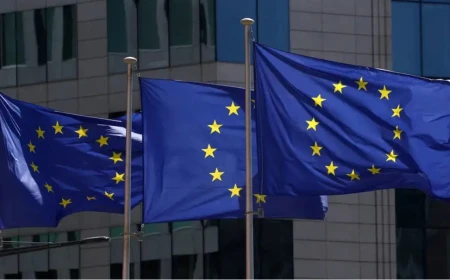
Another symbolic step will be the return of the European Union flag to the Hungarian parliament building after 12 years. Magyar is then expected to deliver his first speech as prime minister in front of parliament.
The ceremony is designed to project a clear message: the new government wants to present itself as European, pluralistic and committed to institutional change.
A cabinet with unusual profiles
Magyar’s cabinet includes several figures from outside traditional political circles.
Anita Orban, a diplomat and energy expert, is expected to become foreign minister. Her surname is the same as former Prime Minister Viktor Orban’s, but the similarity is coincidental. She was once associated with the pro-European and Atlanticist wing of Fidesz, a wing that no longer exists in the party’s current structure.
In a 2009 English-language book that attracted international attention, Anita Orban warned against Russia’s imperial energy policy.
The new economy minister is expected to be a former Shell executive, while the defense ministry is set to be led by Romulusz Ruszin-Szendi, a former chief of staff of the Hungarian armed forces. Orban had previously described him as an enemy because of his pro-Ukraine position.
Zsolt Hegedüs, who worked as an orthopedic doctor in Britain from 2005 to 2015, is expected to take charge of the health ministry.
Hungary’s first blind minister set to take office
One of the most striking names in the new cabinet is Vilmos Katai-Nemeth, who is expected to become minister for social affairs and family.
Katai-Nemeth lost his sight at the age of 16. He later became a lawyer and achieved a master level in the Japanese martial art aikido. If confirmed, he will become the first blind cabinet minister in Hungarian history.
His appointment is being seen as a sign that the incoming government wants to give greater visibility to different social groups.
However, one cabinet choice has already triggered debate. Marton Mellethei-Barna, Magyar’s former university friend and brother-in-law, is expected to become justice minister. He has been married to Magyar’s sister since autumn 2025.
The family connection has drawn criticism. Magyar has defended the appointment by pointing to Mellethei-Barna’s legal expertise and promising full transparency in the work of both the justice ministry and the wider government.
Rule of law reforms are the main test
Magyar’s most difficult domestic task will be dismantling the political and institutional system built around Viktor Orban.
The incoming government plans to establish an anti-corruption authority and a separate asset recovery body to reclaim state resources allegedly transferred unlawfully to figures close to Orban.
Magyar has also said he will shut down state media aligned with Orban and replace it with a new independent public broadcasting system.
The reform path is unlikely to be simple. Although the Tisza Party has a two-thirds majority in parliament, several key offices remain in the hands of officials appointed or supported during the Orban era.
President Tamas Sulyok, the chief prosecutor and senior judicial figures are still in office. If Sulyok does not resign, he could delay parts of the reform agenda, making the first months of Magyar’s government politically difficult.
EU and NATO ties to be repaired
In foreign policy, Magyar wants to restore Hungary’s credibility inside the European Union and NATO.
His government is expected to work on improving relations with Central and Eastern European neighbors, especially Poland. It also wants to secure the release of frozen EU funds.
That goal is financially urgent. Hungary is facing a deeper economic and fiscal crisis than expected. Orban’s expansive spending policies pushed the budget deficit close to 6 percent.
For the new government, unlocking EU funds is not only a diplomatic priority but also an economic necessity. Repairing relations with Brussels will therefore be one of Magyar’s first major external tests.
Ukraine policy remains uncertain
One area of foreign policy may become a test of both democracy and populism for Magyar’s government: Ukraine.
The incoming prime minister recently invited Ukrainian President Volodymyr Zelenskyy to what he called a “historic meeting” in Berehove, a town in Ukraine with a large ethnic Hungarian population.
Such a move is diplomatically unusual. A head of government does not normally invite himself into another country while specifying the town where that country’s president should meet him.
Magyar also said Hungary would support Kyiv’s EU membership efforts if Ukraine stopped treating the Hungarian minority as “second-class citizens.”
The statement raised questions about whether Magyar’s Ukraine policy will fully break with the Orban era. The issue is especially sensitive because Berehove Mayor Zoltan Babjak had reportedly told Magyar earlier that Hungarians in Ukraine were not facing discrimination.
A difficult transition begins
Magyar’s election victory has opened the door to a post-Orban period in Hungary, but the new government faces difficult challenges from the start.
Domestically, it must rebuild the rule of law, address corruption, reform public media and reshape institutions still influenced by the previous government.
Internationally, it must repair ties with the EU and NATO while defining a clear position on Ukraine.
The symbolic opening of Magyar’s term may create momentum, but the real test will come through legislation, institutional reform, economic decisions and foreign policy choices.
For Hungary, the post-Orban era is beginning with high expectations and serious uncertainty.
What's Your Reaction?
 Like
0
Like
0
 Dislike
0
Dislike
0
 Love
0
Love
0
 Funny
0
Funny
0
 Wow
0
Wow
0
 Sad
0
Sad
0
 Angry
0
Angry
0

Editor | Wise News Press — Delivering accurate, timely global news with integrity, insight, and editorial responsibility.
















Comments (0)