



NASA historic launch: Artemis II begins its journey to the Moon
NASA successfully launched the Artemis II mission with four astronauts, marking the first crewed journey to the Moon in over 50 years ahead of a 2028 landing.



By Ahmet Taş | Wise News Press
FLORIDA, USA — Four astronauts embarked on a historic journey to the Moon on Wednesday, marking the first crewed lunar mission in over 50 years to advance global space exploration.
The highly anticipated 10-day test flight aims to pave the way for a planned lunar landing in 2028, representing a major step in establishing a permanent human presence on the Moon. According to AP reports, the 32-story Space Launch System rocket lifted off from NASA's Kennedy Space Center, drawing massive crowds to nearby roads and beaches in a scene reminiscent of the Apollo era of the 1960s and 70s.
Technical hurdles and liftoff
The Artemis II mission departed from the same historic Florida launch pad that sent Apollo astronauts to the Moon decades ago. The crew, wearing bright orange suits with blue stripes, includes Americans Reid Wiseman, Victor Glover, Christina Koch, and Canadian Jeremy Hansen.
During the fueling process earlier in the day, tensions were high as the launch team loaded over 2.6 million liters of hydrogen into the rocket. Unlike a countdown test earlier in the year that was plagued by dangerous leaks, NASA engineers confirmed no significant hydrogen leaks occurred this time. Minor technical issues, such as battery sensor malfunctions and communication delays with the flight termination system, were swiftly resolved to ensure a safe liftoff.
Just five minutes into the flight, Commander Wiseman reported their trajectory directly to mission control.


"We are seeing an awesome moonrise, heading right for it," Wiseman said from the capsule.
Setting new historical records
If the mission proceeds as planned, the astronauts will break the record for traveling the furthest distance from Earth in human history. Unlike the 1968 Apollo 8 mission, the crew will not remain in lunar orbit. Instead, they will fly 6,400 kilometers past the Moon before returning for a splashdown in the Pacific Ocean. During the first 25 hours of the flight, the team will remain in Earth's orbit to test the capsule before firing the main engine to head toward the Moon.
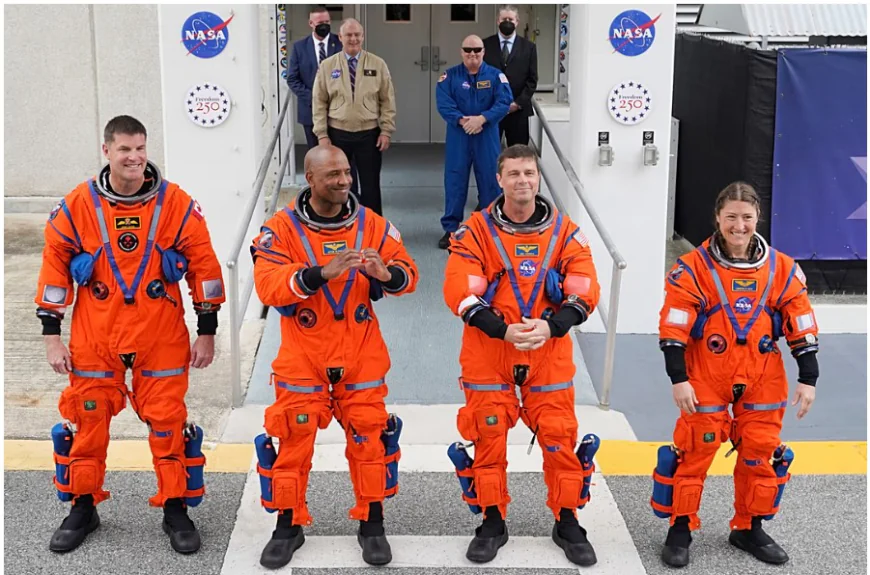


Four astronauts walking together in orange spacesuits ahead of the Artemis II launch
Astronauts Jeremy Hansen, Victor Glover, Reid Wiseman, and Christina Koch prepare for liftoff at the Kennedy Space Center, Florida. (Photo: John Raoux/AP)
The mission also features significant historical firsts. It carries the first Black astronaut, the first woman, and the first non-US citizen to participate in a lunar voyage. Four days after their closest approach, the Moon will appear to the astronauts as the size of a basketball held at arm's length, offering unprecedented views of surface details and a total solar eclipse under the right lighting conditions.
Competition and future goals
While the Apollo program was largely driven by a desire for rapid successes during the Space Race with the Soviet Union, the Artemis program focuses on returning repeatedly to build a permanent lunar base. Following the successful launch, NASA Administrator Jared Isaacman celebrated the event, referring to the half-century gap in lunar missions as merely a "brief hiatus" for the agency.
The current US investments in space are often viewed within the context of rising competition with China, which aims to land humans on the Moon by 2030. During a press conference, Isaacman noted that such competition is an effective way to mobilize a nation's resources, stating that they are definitively in a competitive era again.
Meanwhile, political pressures continue to shape the program's timeline. US President Donald Trump has expressed a strong desire to see a crewed lunar landing before the end of his second term in early 2029. Highlighting the nation's progress, Trump shared his thoughts on his Truth Social account shortly after the launch.
"Economically, militarily, and now in space, we are leading. Nobody is close. America doesn't just compete, it dominates, and the whole world is watching," Trump stated.
What's Your Reaction?
 Like
0
Like
0
 Dislike
0
Dislike
0
 Love
0
Love
0
 Funny
0
Funny
0
 Wow
0
Wow
0
 Sad
0
Sad
0
 Angry
0
Angry
0

Editor | Wise News Press — Delivering accurate, timely global news with integrity, insight, and editorial responsibility.




















Comments (0)