



Germany's religious landscape shifts as churches close and mosques rise
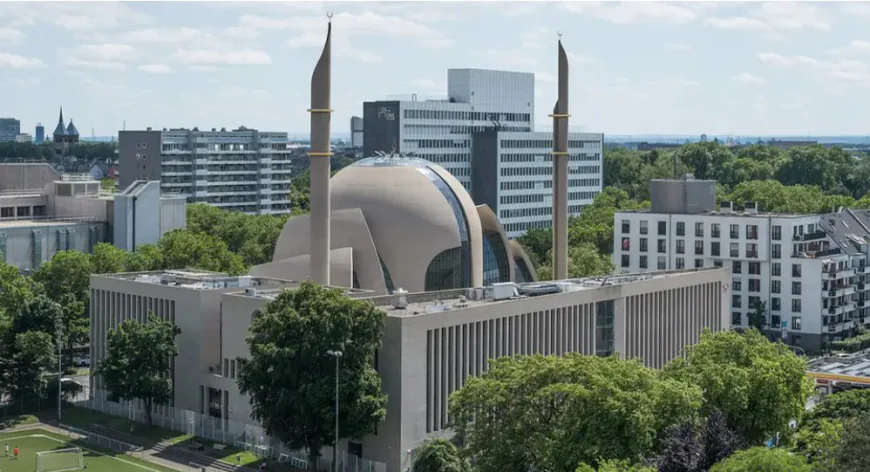
As traditional Christian denominations lose members across Germany, the growing presence of Muslim, Hindu, and Orthodox communities is visibly transforming city skylines.


By Ahmet Taş | Wise News Press
BERLIN, GERMANY — Demographic changes in Germany in recent years are profoundly reshaping the country's religious map and city skylines. While the number of people leaving traditional Catholic and Protestant churches reaches record highs, the number of places of worship for Muslim, Hindu, Buddhist, and Orthodox communities is rapidly increasing due to immigration and demographic diversity.
According to a report by Christoph Strack from Deutsche Welle, unused historical churches are being converted for different purposes such as bicycle shops or restaurants, or handed over to other denominations. Meanwhile, foundations are being laid for massive mosques, synagogues, and temples of Asian religions across the country. One of the most vivid examples of this transformation is taking place in the state of Bavaria.
Diversity in Erlangen: Synagogue, mosque, and Shiva-Vishnu temple
The city of Erlangen in Bavaria, with a population of 119,000, has become a microcosm of the growing religious diversity in Germany. While preparations are underway for the construction of a new synagogue near the university with the support of the city administration, two existing large mosques in the city are also making expansion plans to meet the growing demand of their congregations.
One of the most striking developments in Erlangen is the steps taken by the Hindu community. An association is preparing to build a Shiva-Vishnu temple on land it purchased with its own resources, through donations and loans. The temple, whose foundations are planned to be laid no later than 2027, will be a symbol of the permanent presence of the Indian population in the city. Silvia Klein, Head of the Equal Opportunities and Diversity Unit at the Erlangen Municipality, points out that there are more than 2,000 Indian students studying at the university in the city, emphasizing that Indians constitute the largest non-German demographic group in the city.
Catholic and Protestant churches are losing blood
The Catholic and Protestant churches in Germany, whose roots date back centuries, are in a deep crisis. While more than half of the German society belonged to these two main denominations until a few years ago, this rate has now dropped to 44 percent. In the country of 83.5 million people, this corresponds to 36.6 million people.


This dramatic drop in the number of congregations and declining church tax revenues force churches to shrink and dispose of their buildings. Many closed church buildings are transformed into different commercial or social areas, while some are handed over to growing immigrant Christian communities. For instance, in Erlangen, Coptic Christians took over a disused Catholic church three years ago and turned it into a Coptic Orthodox church. Coptic priest Ragai Edward Matta draws attention to the rapid growth of the congregation, stating, "We used to have 18 families of 50 or 60 people. Today we have about 200 members from 60 families."
The rise of mosques and Asian temples
As traditional churches shrink, the need for space for other faith groups is increasing. In Germany, where the Muslim population exceeded 5 million 300 thousand according to 2020 data, there are 862 mosques affiliated with the Turkish-Islamic Union for Religious Affairs (DITIB) alone. Last year, new mosques were opened for worship in Voerde, Kornwestheim, and Köngen, while the foundations of new ones were laid in Gießen and Willich. The Ahmadiyya community of Pakistani origin also continues to build new mosques every year.
In addition to Muslim congregations, places of worship belonging to Asian religions have also begun to take their place in the skylines of the cities. The number of Indian citizens living in the capital Berlin has increased more than tenfold in the last decade, exceeding 41 thousand, and the city's largest Hindu temple will be opened this June. Vilwanathan Krishnamurthy, who has been involved in the planning phase of the temple, underlines this need, saying, "There is a longing for a religious center where young people can come together." Furthermore, a new Buddhist temple is planned to open in the Mitte district of Berlin in the summer of 2024.


The Orthodox community in Germany continues to grow with a population exceeding 3.8 million. While a new congregation consisting mainly of Syrian Christians was established in Butzbach in the state of Hesse, Romanian and Serbian Orthodox are also building new churches for their growing populations. This structural transformation in the country is engraved in city skylines as physical evidence of Germany's future multicultural and multi-faith structure.
What's Your Reaction?
 Like
0
Like
0
 Dislike
0
Dislike
0
 Love
0
Love
0
 Funny
0
Funny
0
 Wow
0
Wow
0
 Sad
0
Sad
0
 Angry
0
Angry
0

Editor | Wise News Press — Delivering accurate, timely global news with integrity, insight, and editorial responsibility.




















Comments (0)