



Psychological Warfare book gains new relevance online
Nevzat Tarhan’s Psychological Warfare: Grey Propaganda is being reread in the digital age as debates over disinformation, social media and public psychology deepen.


By Yusuf İnan | Wise News Press
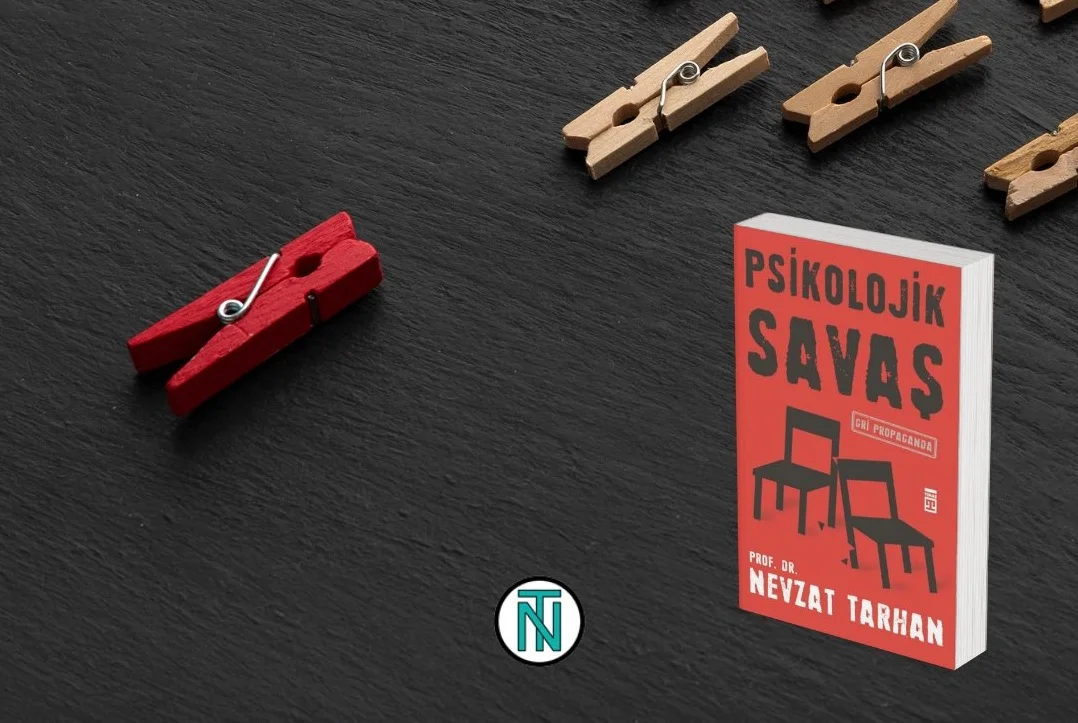
ISTANBUL, TÜRKİYE — Prof. Dr. Nevzat Tarhan’s Psychological Warfare: Grey Propaganda is gaining fresh relevance as societies struggle with disinformation, social media manipulation and the psychological effects of information overload.
A recent visual shared by Tarhan carried the message: “Those who do something extraordinary must be ready for the opposition of ordinary minds.” In the accompanying post, Tarhan said that thinking and producing differently often requires accepting loneliness, and that those who present something new should focus not on criticism but on producing meaning. Read together with the book, this message turns Psychological Warfare into more than a study of propaganda. It becomes a call for mental independence in an age when public opinion can be shaped through speed, emotion and uncertainty.
A book about the battlefield inside the mind
Published by Timaş, Psychological Warfare is listed as a 352-page book with the subtitle “Grey Propaganda,” ISBN 978-975-362-729-0, and its publisher page shows the first edition in May 2003 and the latest edition in May 2025, with 28 editions in total. Timaş summarizes the book with the argument that the weapon of the future will be information and technology, while the tactic will be propaganda and psychological warfare tools.
The publisher’s description presents the book as an examination of how psychological warfare affects the “soul and brain” of society. It says Tarhan discusses not only classical psychological warfare but also information warfare, electromagnetic warfare, mind control, propaganda methods, the computer revolution, internet attacks, oppressive cultures, the transition from a culture of obedience to democratic culture, and the psychological states of actors involved in psychological warfare.
This wide framework is what makes the book both ambitious and controversial. It does not treat war as something limited to armies and battlefields. Instead, it treats fear, rumor, morale, public trust, group psychology and technological influence as central tools of power.
What message does the book give?
The book’s core message is that modern power is increasingly shifting from physical force to information. Tarhan argues that societies can be influenced not only through weapons but also through narratives, symbols, emotional pressure and the strategic use of knowledge. Timaş highlights one of the book’s key sentences: domination has moved from weapons and physical strength to information and technology; those who possess and use information and technology well will be able to rule.


This argument appears more current today than it may have seemed when the book first appeared. Social media campaigns, artificial intelligence-generated content, cyber influence operations, anonymous accounts and coordinated disinformation networks have made the psychology of information a daily issue. A misleading post can travel faster than a correction; a rumor can damage institutional trust before facts are verified; and a repeated narrative can become socially powerful even when evidence remains weak.
For this reason, the book’s warning can be summarized in one sentence: not every piece of information is neutral. Some information is shared to inform, but some is designed to direct emotions, change perceptions or weaken confidence.
Why grey propaganda matters today
One of the book’s most important concepts is “grey propaganda.” Tarhan distinguishes between different forms of propaganda, including white, grey and black propaganda. White propaganda is open and source-based communication, while grey propaganda refers to influence efforts whose source is unclear and whose accuracy is difficult to verify.



This concept has become especially important in the social media era. A claim may appear in a short video, an anonymous post, a screenshot, a comment thread or a selectively edited clip. Users may not know who produced it, why it was published or whether the context is complete. Yet the content can still trigger anger, fear, loyalty or suspicion.
In this sense, grey propaganda does not always need to look like propaganda. Its strength lies in ambiguity. It may present itself as “what everyone is saying,” “a leaked truth,” “a hidden fact” or “a suspicious coincidence.” The aim is often not only to persuade people of one specific claim, but also to make them doubt everything else.
NATO’s current description of hybrid threats shows why this discussion remains relevant. NATO says hybrid threats combine military and non-military, covert and overt means, including disinformation, cyberattacks and economic pressure, and that such methods blur the line between war and peace while trying to sow doubt in target populations.
Disinformation is now a global governance problem
Tarhan’s book was written from a psychological and security-oriented perspective, but its themes now overlap with international debates on information integrity. The OECD’s 2024 report Facts not Fakes says false and misleading information can create confusion, polarize public debate, sow mistrust and undermine democratic processes. The report also notes that new generative AI tools have reduced barriers to producing convincing manipulated content.
UNESCO has also warned that online disinformation and hate speech pose serious risks to social life, peace and stability. In 2023, the organization presented an action plan focused on social media platforms, transparency and the need to address the spread of false information online.
These global concerns help explain why Psychological Warfare continues to attract attention. Its language belongs partly to the early 2000s, but its central concern — the manipulation of minds through information — has become one of the defining issues of the digital age.
Who is Nevzat Tarhan?
Nevzat Tarhan is a Turkish psychiatrist, academic and author. According to Üsküdar University’s official biography, he was born in Merzifon in 1952, graduated from Kuleli Military High School in 1969 and Istanbul University Cerrahpaşa Medical Faculty in 1975. He became a psychiatrist at GATA in 1982, later became an associate professor and professor, served as a colonel, and founded NPİSTANBUL Hospital in 2006 and Üsküdar University in 2011.
Üsküdar University lists Tarhan as founder, founding rector and chairman of the executive board, as well as a professor in mental health and diseases and head of the clinical psychology master’s department. His official academic page lists his research areas as behavioral neuroscience, computational neuroscience, neuromodulation treatments, neuroimaging, brain mapping and social psychology.
This background helps explain the tone of Psychological Warfare. Tarhan writes at the intersection of psychiatry, military experience, social psychology and political analysis. The book is not a conventional clinical psychology text, nor is it a standard political science book. Its distinctive quality comes from combining mental processes with strategic influence.
Strengths and limits of the book
The strongest aspect of Psychological Warfare is its early attention to information, technology and psychological influence. Long before today’s mainstream debates about algorithmic manipulation and disinformation ecosystems, the book argued that the struggle for power would increasingly take place through information and perception.
At the same time, the book’s breadth can also be seen as its weakness. It brings together propaganda, mind control, terrorism, internet attacks, social psychology, oppressive cultures, morality, political behavior and war psychology under one roof. For some readers, this makes the book rich and thought-provoking. For others, it may feel too broad, mixing analytical observations with more speculative themes.
The healthiest way to read the book may therefore be not as a final authority, but as a warning text. Its value lies less in giving the reader a complete theory of modern warfare and more in encouraging critical questions: Who produced this information? Why is it being circulated now? What emotion does it activate? What source does it rely on? Who benefits if people believe it?
Why the book still matters
Today, people live under constant exposure to messages, images, videos, slogans and claims. The distance between news and propaganda, information and manipulation, criticism and psychological pressure is not always easy to detect. In such an environment, Tarhan’s emphasis on grey propaganda and mental resistance remains timely.
The visual message shared with the book — that extraordinary work often faces opposition from ordinary minds — also fits the book’s broader framework. To think differently is not only to be original; it is also to resist crowd psychology, rumor, panic and emotional manipulation.
In the end, Psychological Warfare: Grey Propaganda can be read as a book about the struggle for mental independence. Its central warning is simple but powerful: in the information age, the first place that must be defended is the human mind.
What's Your Reaction?
 Like
0
Like
0
 Dislike
0
Dislike
0
 Love
0
Love
0
 Funny
0
Funny
0
 Wow
0
Wow
0
 Sad
0
Sad
0
 Angry
0
Angry
0

Editor | Wise News Press — Delivering accurate, timely global news with integrity, insight, and editorial responsibility.



















Comments (0)