


How Was the German Armed Forces Established 70 Years Ago?
The German armed forces (Bundeswehr) were established 70 years ago, following intense national debate and a push by Konrad Adenauer to integrate West Germany into NATO as a defense-focused, civilian-controlled army.
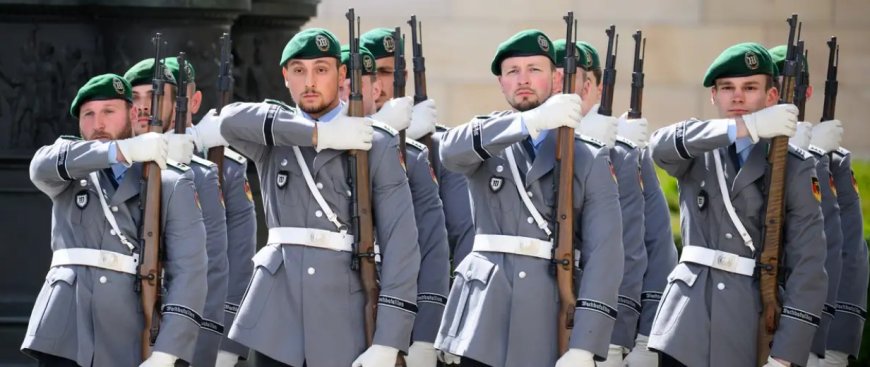


WISE NEWS PRESS / BERLIN, GERMANY — Nov. 12, 2025
The German armed forces (Bundeswehr) are celebrating their 70th anniversary today. In 1945, when World War II ended, few would have believed that Germany would have an army again within a decade. Following the war started by Nazi Germany, the country was occupied, and the Nazi military, the Wehrmacht, was disbanded. The Allied powers were determined that Germany should be completely demilitarized: never again should war originate from German soil.
However, shortly after the war ended, tensions grew among the victorious powers, and Germany was divided into two. The outbreak of the Korean War in 1950 heightened fears in Europe of a Soviet attack, with Western Allies concerned that any potential assault would target the border between the two Germanys.
Adenauer's Goal: A Defense Line Against the Soviets


Konrad Adenauer, the first Chancellor of the Federal Republic of Germany (FRG) and a member of the Christian Democratic Union (CDU), shared this concern. In October 1950, Adenauer warned, "If there is a Russian attack, we will be the first victims."


When Adenauer requested the Western Allies increase their occupation forces, he was reminded that Germany, in return, should contribute to its own defense. Thus began the debate over German "rearmament," a process Adenauer pursued resolutely. For the Catholic politician, who was not close to military matters, this step was a means to reintegrate Germany into the West and gain maneuverability in foreign policy.
The "Ohne Mich!" Protests
The idea of re-establishing a German army just a few years after the war sparked huge opposition in society. The opposition Social Democratic Party (SPD) fiercely criticized the plan, accusing Adenauer of "exploiting the fear of the East" and warning that rearmament would permanently solidify Germany's division.
Protests erupted under the slogan "Ohne mich!" (Count me out!). Angry citizens, including former soldiers, veterans with prosthetics, and those disabled in the war, took to the streets.
Nevertheless, Adenauer achieved his goal. The Paris Treaties and Germany's accession to NATO on May 6, 1955, paved the way for the establishment of a new army. Exactly 70 years ago, on November 12, 1955, the country's first Defense Minister, Theodor Blank, presented assignment documents to 101 volunteers, most in civilian clothes, at the Ermekeil Barracks in Bonn.
Military historian Sönke Neitzel of the University of Potsdam commented: "The Germans were never entirely pacifist. There was a serious minority against rearmament, but the majority supported it. Adenauer won the 1957 election with an absolute majority. If the public had been uncomfortable with rearmament and the compulsory military service that came into force on April 1, 1957, Adenauer would not have been re-elected."
An Army Under Parliamentary Scrutiny
To prevent the military from becoming a "state within a state," the army was placed under strict parliamentary control. Command authority was given to the civilian authority—the defense minister. Soldiers were defined as "citizens in uniform," bound by their conscience, the exact opposite of the rigid obedience system of the past. Theodor Blank stated, "We want an army within a democracy, subordinate to the primacy of politics."
While the German military was restructured politically and socially, the break with the past was not complete in terms of personnel. Some officers had previously served in the Wehrmacht, as no other experienced personnel were available. Neitzel notes: "This old generation remained loyal to the Republic. The German army never posed a threat to democracy."
A New Era with the Ukraine War
During the Cold War, the German army (Bundeswehr) was an integral part of NATO's defense strategy, with a mission focused solely on defending West Germany against a potential attack. The army reached its peak strength in the mid-1980s with 495,000 soldiers.
With the end of the Cold War, the picture changed. The army was downsized, falling below 200,000 soldiers. External operations were permitted by the Federal Constitutional Court in 1994, leading German soldiers to be deployed to various regions for "peacekeeping" missions, the most costly being the Afghanistan operation (2001-2021), where 59 German soldiers lost their lives.
Neitzel suggests this downsizing weakened the army's defense capability: "This was essentially a political problem. The continuous downsizing of the army and the suspension of compulsory military service in 2011 had reduced the German military to a limited capacity."
The Russian comprehensive attack on Ukraine in 2022 fundamentally changed the situation for the German military once again. Germany is now making large investments to equip its army with modern weapons and increase its capacity. Chancellor Friedrich Merz aims for the Bundeswehr to become "Europe's strongest conventional army," which has reignited discussions about reintroducing compulsory military service.
Despite all the challenges, the Bundeswehr today enjoys broad social support in Germany. According to a recent survey, over 80% of Germans view the army positively on its 70th anniversary.
What's Your Reaction?
 Like
0
Like
0
 Dislike
0
Dislike
0
 Love
0
Love
0
 Funny
0
Funny
0
 Wow
0
Wow
0
 Sad
0
Sad
0
 Angry
0
Angry
0

Editor | Wise News Press — Delivering accurate, timely global news with integrity, insight, and editorial responsibility.















Comments (0)