



Central Asia, Azerbaijan meet as Middle Corridor gains strategic weight
Six leaders met in Cholpon-Ata as Azerbaijan took part as a full member for the first time, putting the Middle Corridor, energy and regional integration in focus.


By Yusuf İnan | Wise News Press
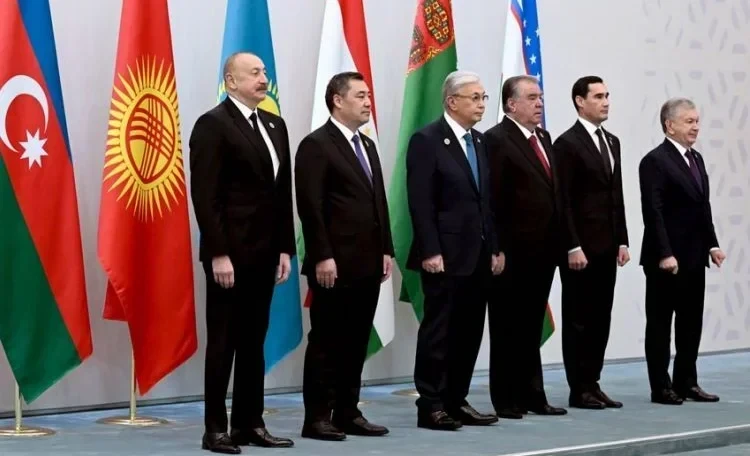
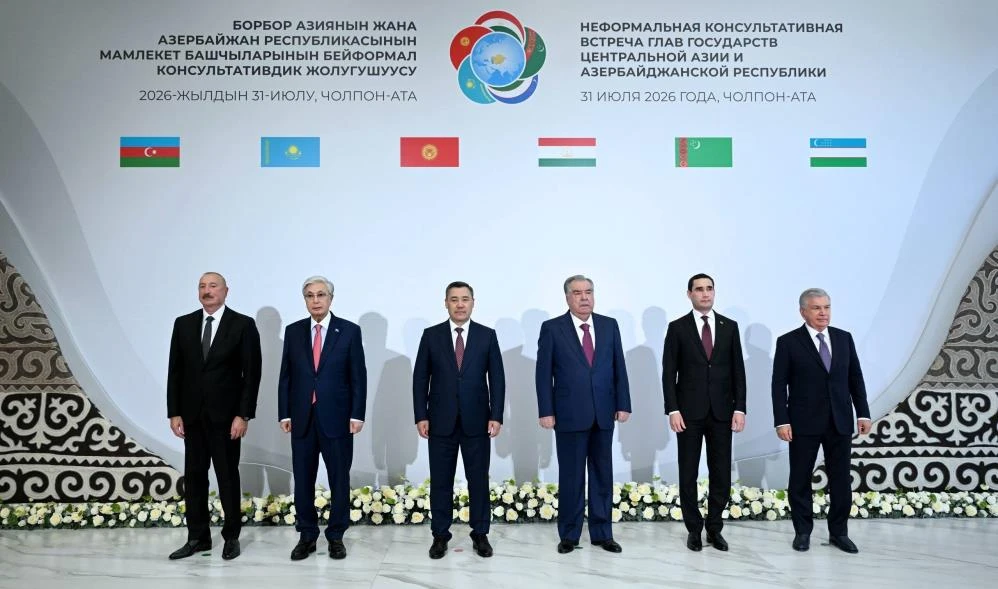
CHOLPON-ATA, Kyrgyzstan — The presidents of Azerbaijan and five Central Asian states met in Kyrgyzstan, marking a significant expansion of regional cooperation as transport, energy and trade links across the Caspian Sea move higher on the strategic agenda.
The July 31 meeting in Cholpon-Ata brought together Azerbaijani President Ilham Aliyev, Kyrgyz President Sadyr Japarov, Kazakh President Kassym-Jomart Tokayev, Uzbek President Shavkat Mirziyoyev, Tajik President Emomali Rahmon and Turkmen President Serdar Berdimuhamedov. The leaders signed the Cholpon-Ata Declaration at the end of the gathering.
Beyond the symbolism of six presidents appearing around the same table, the meeting reflects a broader geopolitical shift. Azerbaijan is increasingly being integrated into Central Asia's regional dialogue, while the Caspian Sea is emerging as a bridge connecting Central Asian economies with the South Caucasus, Türkiye and European markets.
Azerbaijan attends as a full participant for the first time
The Cholpon-Ata gathering was the first meeting of this format in which Azerbaijan participated as a full member rather than as a guest of honor.
The decision to admit Azerbaijan as a full participant was taken at the Seventh Consultative Meeting of the Heads of State of Central Asia in Tashkent in November 2025. Uzbek President Shavkat Mirziyoyev described the step at the time as a way to build a stronger bridge between Central Asia and the South Caucasus and create a more connected space for economic and strategic cooperation.


Aliyev highlighted the significance of the change in Cholpon-Ata, saying that he had previously attended the format as a guest but was now joining the group as a full participant. He also pointed to the intensity of diplomatic contacts between Azerbaijan and Central Asia, saying he had visited Central Asian countries 16 times since the beginning of 2023, while Central Asian leaders had made 26 visits to Azerbaijan over the same period.
Aliyev characterized Azerbaijan and Central Asia as having effectively become a single geopolitical and geoeconomic space. While that description reflects Baku's political assessment rather than a formal institutional arrangement, the growing frequency of summits, bilateral agreements and infrastructure projects shows that the relationship is becoming increasingly structured.
The meeting also coincided with Aliyev's state visit to Kyrgyzstan. Azerbaijan and Kyrgyzstan signed a Treaty on Allied Relations, while the capital of their joint development fund was doubled from $100 million to $200 million.


The Middle Corridor is becoming the strategic backbone
Transport connectivity provides the clearest economic explanation for Azerbaijan's deeper integration with Central Asia.
The Trans-Caspian International Transport Route, widely known as the Middle Corridor, connects markets in China and Central Asia with the South Caucasus and Europe through a combination of rail, maritime and land transport.
Kazakhstan and other Central Asian states provide the eastern portion of the route, while Azerbaijan serves as a key Caspian gateway on its western side. From Azerbaijan, freight can continue through Georgia and Türkiye toward European markets.
The World Bank describes the Middle Corridor as a multimodal trade and transport route linking Chinese and European markets through Central Asia and the Caucasus. Its modeling suggests that coordinated infrastructure investment and efficiency measures could halve travel times and triple trade flows along the corridor by 2030.
That ambition is increasingly being backed by large-scale investment. In February 2026, the World Bank approved an $846 million guarantee designed to mobilize $1.41 billion in commercial financing for railway infrastructure along Kazakhstan's section of the corridor. The project includes a new 322.3 km railway line intended to shorten the route, ease congestion and improve freight capacity.
The significance of the corridor therefore extends beyond transit revenues. Faster and more predictable links could support regional manufacturing, exports, logistics hubs and investment while giving landlocked Central Asian economies more routes to international markets.
Central Asia is looking for multiple routes to global markets
The strategic significance of Cholpon-Ata should not be interpreted simply as the creation of a bloc directed against Russia, China or another outside power.
Central Asian governments have generally pursued diversification rather than replacement: expanding connections with China, Russia, Europe, Türkiye, the Gulf states and South Asia while reducing dependence on any single transport route.
Mirziyoyev has previously called for modernization of railways, roads, border crossings, transmission lines, fiber-optic networks and green corridors across the region. He has also highlighted the China-Kyrgyzstan-Uzbekistan railway, Trans-Afghan routes and Trans-Caspian connections toward Europe as complementary infrastructure projects rather than mutually exclusive alternatives.
Azerbaijan adds an important western link to this strategy. Its ports, railways and connections through the South Caucasus give Central Asian exporters access to routes toward Türkiye, the Black Sea and the European Union.
This makes the emerging Central Asia-Azerbaijan format particularly relevant to governments and companies involved in logistics, rail transport, ports, customs services, energy, telecommunications and regional supply chains.
Energy links add a second strategic layer across the Caspian
Transport is not the only sector linking the two shores of the Caspian Sea.
Azerbaijan, Kazakhstan and Uzbekistan are also developing a Central Asia-Azerbaijan Green Energy Corridor aimed at improving electricity interconnections and creating a route for renewable energy produced in Central Asia to reach markets farther west.
A feasibility study for the project entered a new stage in Baku in March 2026 with representatives of the three governments, transmission system operators and international financial institutions participating. Azerbaijan's Energy Ministry said the project is intended to link the energy systems of Central Asia and the South Caucasus and eventually support renewable electricity flows toward European markets.
The initiative complements separate green electricity projects connecting Azerbaijan with Georgia, Türkiye and European countries.
If these projects advance, the Caspian could increasingly function as more than an oil, gas and freight corridor. It could also become part of a wider electricity and digital connectivity network joining Central Asia with the South Caucasus and Europe.
That possibility gives the new six-country political format an economic dimension that extends well beyond traditional diplomacy.
This is not the Organization of Turkic States
The Cholpon-Ata format should also be distinguished from the Organization of Turkic States.
Azerbaijan, Kazakhstan, Kyrgyzstan, Uzbekistan and Turkmenistan have strong Turkic linguistic and cultural connections, but Tajikistan is also part of the Central Asian consultative format. Türkiye, meanwhile, was not a participant in the Cholpon-Ata meeting.
The Central Asian consultative mechanism is therefore geographic and regional rather than primarily identity-based. Its agenda has developed around practical issues including borders, water, energy, trade, security, transportation and investment.
Azerbaijan's admission expands that geographic logic westward across the Caspian Sea.
The development is particularly notable because the Central Asian consultative meetings began as a mechanism for the five states of the region to address their own differences and common problems. Uzbekistan says the format has helped reopen border crossings, improve water and energy cooperation and strengthen trade and investment links.
Azerbaijan's participation now introduces the South Caucasus directly into that conversation without formally turning the mechanism into a conventional international organization or security alliance.
The next test will come in Turkmenistan in October
The next major test of the expanded format will come quickly.
Turkmenistan is scheduled to host the next Consultative Meeting of the Heads of State of Central Asia and Azerbaijan in the Avaza National Tourist Zone on October 8, 2026. Turkmen authorities say foreign ministers are expected to work on the final agenda ahead of the summit.
That meeting will offer a clearer indication of whether the six-country format develops primarily as a political consultation platform or evolves toward more coordinated economic programs.
Transport tariffs, customs procedures, port capacity, rail infrastructure, electricity interconnections and investment mechanisms will be among the areas to watch as the region seeks to turn political declarations into practical connectivity.
For now, Cholpon-Ata represents an important change in the geography of Central Asian cooperation. Azerbaijan's permanent inclusion means the region's political dialogue no longer stops at the eastern shore of the Caspian.
With major rail investments underway, green energy projects moving into feasibility studies and governments seeking additional routes to global markets, the emerging Central Asia-Azerbaijan relationship could become one of the key building blocks in a wider economic corridor stretching from Asia through the Caspian and South Caucasus toward Türkiye and Europe.
WiseNewsPress.com
What's Your Reaction?
 Like
0
Like
0
 Dislike
0
Dislike
0
 Love
0
Love
0
 Funny
0
Funny
0
 Wow
0
Wow
0
 Sad
0
Sad
0
 Angry
0
Angry
0

Editor | Wise News Press — Delivering accurate, timely global news with integrity, insight, and editorial responsibility.















Comments (0)