



Could Russia attack NATO? Assessing the risks across the Baltic region
Experts see a full Russian attack on NATO as unlikely but warn that a limited operation or provocation in the Baltic region remains possible.


By Ahmet Taş | Wise News Press
BERLIN, Germany — A full-scale Russian attack on NATO is considered unlikely in the near term, but European security officials are increasingly examining the risk of a limited operation or provocation in the Baltic region.
Moscow denies having plans to attack any NATO member. However, Russian military exercises in the Baltic, Belarusian activity near the Suwalki Gap and warnings from European intelligence services continue to fuel concern.
European threat assessments are becoming more serious
According to an analysis by BBC Monitoring, the possibility of Russian military action against a NATO country has returned to the European security agenda in recent months.
The Financial Times reported on October 5 that Estonia was moving some of its forces closer to the Russian border because of concerns about potential aggression from Moscow.
The Danish Defence Intelligence Service warned on September 24 of a “low but increasing risk” that Russia could deploy a limited number of troops to a neighboring NATO country within the coming months.


Officials in Poland and the Czech Republic have also expressed concern about possible Russian ground operations, airspace violations or military provocations against NATO members.
Those assessments do not mean that a direct and large-scale war is considered imminent. Much of the concern focuses on whether Moscow could use a smaller operation to test NATO’s political decision-making and commitment to collective defense.
European officials have also highlighted other possible methods, including sabotage, cyberattacks, disinformation campaigns and incidents involving critical infrastructure.


Such actions could remain below the level of a conventional invasion while still placing pressure on NATO governments and creating uncertainty about the appropriate response.
Moscow says it has no plans to attack NATO
Senior Russian officials have repeatedly denied claims that Moscow intends to attack NATO countries.
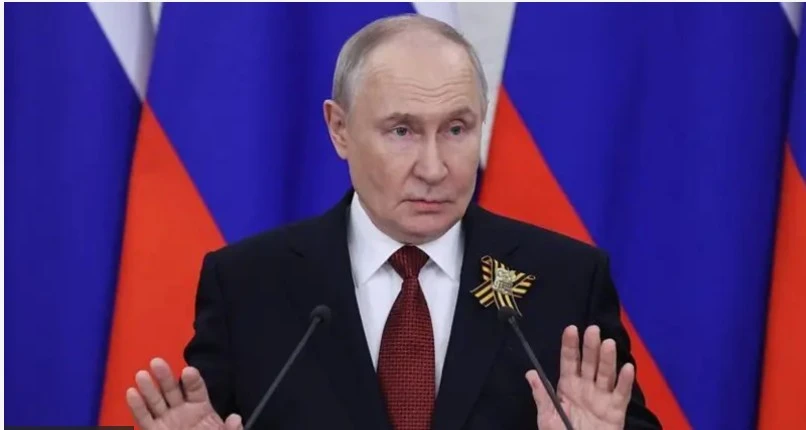
Russian President Vladimir Putin said at the annual Valdai foreign policy forum near Moscow on October 1 that Russia was not planning to attack any country in the future.
“We are not planning to attack anyone in 2029, 2030 or 2050.”
Putin accused European governments of encouraging fear of a Russia-NATO conflict to divert public attention from worsening economic and political conditions at home.
At the same time, the Russian president warned that Moscow would consider using all weapons available to it if NATO directly attacked Russian territory, including the Kaliningrad region.
Putin made the statement while responding to a question about NATO exercises in the Baltic Sea and what Russian officials have described as threats to Kaliningrad.
Several days earlier, the Russian Embassy in Ireland accused NATO of planning an air and naval blockade of Kaliningrad and claimed that Russia was prepared to defend the territory with nuclear weapons if necessary.
Kremlin spokesman Dmitry Peskov described reports of a possible Russian move into a NATO country as “fear scenarios.” Foreign Minister Sergei Lavrov also said Moscow had repeatedly made clear that it had no intention of attacking Europe.
Military activity continues around the Baltic region
Russian officials have not publicly announced a change in the country’s military posture toward NATO. Russia’s Baltic Fleet has nevertheless conducted several exercises in recent months.
Coastal missile units participated in exercises at the beginning of August. Around the same period, Russian anti-sabotage teams rehearsed the defense of a naval base against an attack by a simulated enemy.
Russia’s United Shipbuilding Corporation announced on October 3 that the Velikiye Luki submarine had conducted torpedo-firing exercises.
Belarus, Russia’s closest military ally, held four days of command exercises from September 15 to September 18 near its borders with Lithuania and Poland.
The drills took place close to the Suwalki Gap, a narrow area along the Polish-Lithuanian border that separates Belarus from Russia’s Kaliningrad region.
The corridor provides the Baltic states with their main land connection to the rest of NATO. If the route were cut during a conflict, reinforcing Estonia, Latvia and Lithuania by land could become significantly more difficult.
Military exercises in the area do not by themselves prove that an attack is being prepared. NATO countries nonetheless monitor such activity closely because of the corridor’s strategic importance.
Kaliningrad is also central to regional security calculations. The Russian territory lies between NATO members Poland and Lithuania and hosts important Russian military facilities.
Why a full-scale attack is considered unlikely
Many military analysts believe Russia is unlikely to begin a large conventional war against NATO within the next several years.
Military analyst Ruslan Leviev has pointed to Russia’s continuing difficulty in finding sufficient personnel for the war in Ukraine. In his assessment, Moscow lacks the capacity to open a second and substantially larger front against NATO while maintaining its current operations.
NATO’s Article 5 commitment also provides a powerful deterrent. Under the collective defense provision, an armed attack against one member is treated as an attack against all members.
An attack on Estonia or another Baltic state could therefore expand far beyond a bilateral confrontation and trigger a response involving the entire alliance.
Finnish President Alexander Stubb has said he sees no evidence that Russia is preparing to attack NATO. Finland shares a long border with Russia and joined the alliance in 2023.
Stubb has argued that NATO should remain prepared for every scenario while distinguishing between Russia’s future military capacity and an actual intention to attack.
He has also said that testing NATO’s resolve would be irrational because of the alliance’s combined conventional forces, missile capabilities and nuclear deterrence.
This position does not suggest that Russia presents no security threat. Instead, it separates the risk of a direct conventional invasion from cyber operations, sabotage, disinformation and other forms of hybrid pressure.
A limited operation could test NATO unity
Some analysts view a limited Russian operation against a Baltic country as more plausible than a full-scale invasion.
Political analyst Vladimir Pastukhov said in September that his assessment had changed during the previous six months and that he now considered an invasion of the Baltic states “quite likely.”
Pastukhov acknowledged that Russia’s military commitments in Ukraine made such a move appear irrational. He argued, however, that Putin’s ideological beliefs could influence decision-making and make expansion into the Baltic region a possible next step.
Israel-based defense journalist Sergei Auslender described a limited intervention as “slightly more likely” than a broad invasion.
Auslender cited a scenario in which Russia might seize several dozen square kilometers of Estonian territory under a manufactured pretext. Moscow could also claim that it was acting to protect Russian-speaking residents in Narva, an Estonian city close to the Russian border.
The main purpose of such an operation might not be to gain significant territory. Analysts say Moscow could instead seek to test NATO’s response and create disagreements among alliance members over whether and how to intervene.
An expert assessment published in March argued that a limited operation might form part of the current Ukraine conflict rather than a separate stage beginning after the war.
According to that analysis, Russia’s failure to achieve its objectives in Ukraine through military or diplomatic means could lead Moscow to pressure Europe with the threat of a wider conflict.
An attack could unite NATO instead of dividing it
Other analysts warn that any attempt to test NATO through a limited attack could produce the opposite of Moscow’s intended result.
Russia’s privately owned Nezavisimaya Gazeta argued that such a strategy could unite NATO members rather than divide them and provoke a forceful military response.
Political analyst Anton Barbashin has similarly challenged the assumption that an attack would fracture Europe.
Barbashin said Russian military action on European territory would probably accelerate defense spending and strengthen cooperation across the continent.
Further radicalization of Russian actions against Western countries could also damage Moscow’s relationships with important partners, including China, on which Russia has become increasingly dependent.
The debate therefore centers less on whether a full-scale Russia-NATO war is imminent and more on the possibility of smaller actions designed to create political uncertainty.
Limited incursions, border provocations, airspace violations, sabotage and cyber operations are generally treated as more plausible risks than a conventional invasion of several NATO countries.
NATO’s challenge is to strengthen deterrence on its eastern flank without creating unnecessary panic. A clear and credible response plan would reduce the likelihood that Moscow might view a limited operation as a low-risk way to test the alliance.
WiseNewsPress.com
What's Your Reaction?
 Like
0
Like
0
 Dislike
0
Dislike
0
 Love
0
Love
0
 Funny
0
Funny
0
 Wow
0
Wow
0
 Sad
0
Sad
0
 Angry
0
Angry
0

Ahmet Taş is a journalist, editor and Turkey Office Manager of the Wise News Press Media Group. He works across news, digital media and international publishing, focusing on accurate, responsible and accessible journalism. He contributes to the development of media projects that bring important political, social and global developments to a wider international audience.



















Comments (0)