



Who is Abdul El-Sayed, the first Muslim elected to the US Senate?
Abdul El-Sayed made history in Michigan as the first Muslim elected to the US Senate after campaigning on healthcare, costs and foreign aid.


By Ahmet Taş | Wise News Press
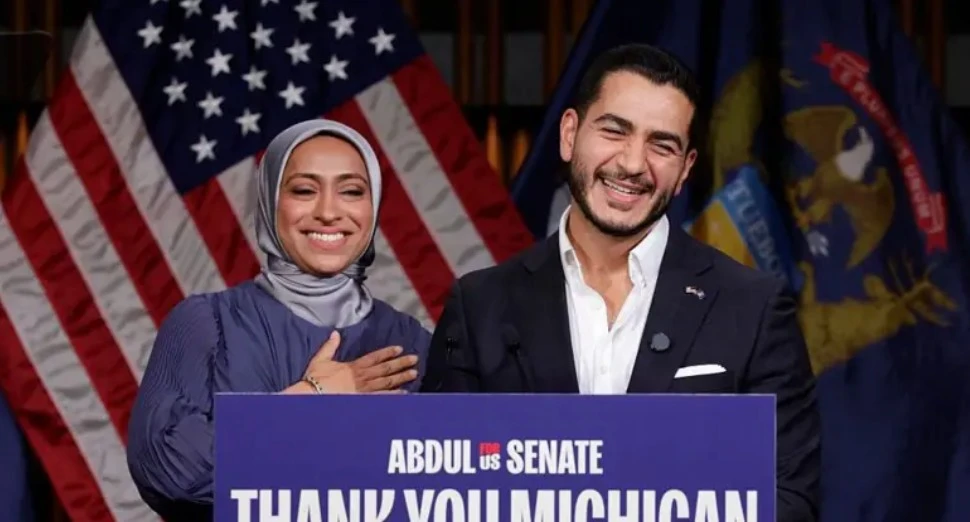
DETROIT, UNITED STATES — Democrat Abdul El-Sayed won Michigan’s closely contested Senate race, becoming the first Muslim elected to the United States Senate and marking a historic milestone for political representation in America.
Media projections declared El-Sayed the winner over Republican Mike Rogers, allowing Democrats to retain the seat vacated by retiring Senator Gary Peters. The result also delivered a significant victory to the Democratic Party’s progressive wing in a state regarded as crucial to the balance of power in Washington.
The 42-year-old physician, epidemiologist and former Detroit health official campaigned on reducing living costs, expanding access to healthcare and limiting corporate influence in politics. His positions on US military assistance, particularly aid to Israel, also made the race one of the country’s most polarised election contests.
From Michigan to the US Senate
Abdulrahman Mohamed El-Sayed was born in 1984 in Rochester Hills, a suburb of Detroit, to Egyptian immigrant parents. His parents divorced when he was three, and he was raised primarily by his father, Mohamed El-Sayed, and his stepmother, Jacqueline Johnson.
El-Sayed attended public schools in Michigan before studying biology and political science at the University of Michigan. He later became a Rhodes Scholar at the University of Oxford, where he completed a doctorate in public health. He also earned a medical degree from Columbia University.
According to the University of Chicago’s Institute of Politics, El-Sayed worked as a physician, epidemiologist, public health specialist and academic. His research focused on health policy, population health and the effects of social and economic inequality on access to medical care.
His professional background became a central element of his political identity. Rather than beginning his career in elected office, El-Sayed entered politics after working in public health administration, academic research and local government.
Rebuilding Detroit’s health department
El-Sayed attracted national attention in 2015 when he was appointed executive director of the Detroit Health Department. He became one of the youngest officials to lead the public health agency of a major American city.
Detroit’s health department had lost much of its capacity during the city’s municipal bankruptcy. El-Sayed was appointed to help rebuild the agency and restore public health services for a population of more than 670,000 people.
His work included programmes involving childhood health, environmental justice, access to care and the prevention of infectious disease. The department also addressed concerns over air pollution, water quality and health disparities affecting lower-income communities.
El-Sayed first sought elected office in 2018, when he ran for governor of Michigan on a progressive platform. He received the support of Senator Bernie Sanders and Representative Alexandria Ocasio-Cortez but finished second in the Democratic primary behind Gretchen Whitmer, who went on to serve two terms as governor.
Although he lost that race, the campaign established El-Sayed as a national figure within the progressive movement and gave him a political network that later became important during his Senate bid.
Healthcare and economic inequality shaped his campaign
El-Sayed placed universal healthcare at the centre of his 2026 Senate campaign. He supported “Medicare for All,” a publicly financed programme intended to provide health coverage to every American.
He argued that the plan could be financed through higher taxes on billionaires and reforms targeting corporate power. His wider economic platform called for reducing the cost of healthcare, food, housing and energy while directing more federal resources toward working families.
Reuters reported that El-Sayed focused on lowering costs and limiting corporate influence in American politics. He presented his public health experience as evidence that government institutions could improve people’s daily lives when properly funded and managed.
His policy programme also addressed clean water, public education, environmental protection and the role of private money in elections. These positions placed him firmly within the Democratic Party’s progressive wing.
However, his campaign ultimately received support from a broader Democratic coalition. Former President Barack Obama backed El-Sayed after the primary, despite being identified with the party’s more moderate establishment. Democrats considered retaining Michigan’s open Senate seat essential to their national strategy.
His position on Israel and foreign military aid
El-Sayed’s criticism of US military assistance to Israel became one of the most contentious issues in the campaign. He described Israel’s military operations in Gaza as genocide and its policies in the occupied West Bank as apartheid. Israel strongly rejects the genocide allegation.
El-Sayed said his opposition to military assistance was not limited to Israel. He argued that the United States should reconsider financing the armed forces of other countries, including Egypt, Saudi Arabia, Qatar and the United Arab Emirates.
He maintained that American tax revenue should be used to build schools, expand healthcare and create economic opportunities at home rather than financing military operations abroad. His broader position was that US foreign policy should rely less heavily on military assistance and weapons transfers.
The policy appealed to many progressive, Arab-American and Muslim voters in Michigan. It also caused concern among some Jewish voters who have traditionally supported Democratic candidates.
Michigan’s large Arab-American population and influential Jewish community made the state an important arena for the national debate over Gaza, Israel and American foreign policy.
Trump’s attacks and unsupported allegations
El-Sayed’s religion and family background became major campaign issues during the closing weeks of the race. President Donald Trump repeatedly attacked him at campaign rallies, calling him a “jihadist” and claiming that he supported terrorists.
Trump also said El-Sayed should be required to pass through a metal detector before being allowed into the Senate. El-Sayed rejected the remarks and said he should be judged by his policies rather than his name, ancestry or faith.
Republican campaigners also alleged that El-Sayed had connections to the Muslim Brotherhood. The Associated Press reported that there was no evidence that he had any affiliation with the organisation. El-Sayed repeatedly denied ties to the Muslim Brotherhood or other extremist groups.
Republicans additionally criticised El-Sayed over his appearances with political commentator Hasan Piker and raised questions about past statements and an open letter concerning Egyptian politics.
El-Sayed responded by stressing his commitment to the US Constitution. He said disagreements over his political positions were legitimate but argued that attempts to portray him as disloyal because he was Muslim relied on prejudice rather than evidence.
A division within the Democratic Party
Before facing Rogers, El-Sayed won a closely contested Democratic primary against Representative Haley Stevens. The primary exposed divisions between the party’s progressive and centrist factions.
Stevens later endorsed Rogers only days before the general election, an unusual decision that intensified the political controversy surrounding the race.
Progressive leaders, including Sanders and Ocasio-Cortez, campaigned for El-Sayed. Obama and other senior Democrats also supported him after the primary, reflecting the national importance of keeping the Michigan seat under Democratic control.
Rogers entered the race with the backing of Trump and national Republican organisations. A former member of Congress and former FBI agent, he sought to portray El-Sayed as too radical for Michigan.
According to Reuters, however, Rogers struggled to overcome voters’ concerns about the economy, rising costs and Trump’s approval ratings. Those domestic issues ultimately played a central role in the election outcome.
Why El-Sayed’s victory is historic
Muslim politicians had previously been elected to the House of Representatives and to state and local offices, but no Muslim had served in the US Senate. El-Sayed’s election therefore represents a significant first in American political history.
His victory also prevented Republicans from capturing the seat held by retiring Democratic Senator Gary Peters. Beyond its symbolic importance, the result had practical consequences for the balance of power in Congress.
El-Sayed is expected to pursue legislation involving universal healthcare, taxation of extreme wealth, environmental justice and restrictions on corporate influence. His foreign policy positions could also make him a prominent voice in Senate debates over military spending and US assistance to foreign governments.
Throughout the campaign, El-Sayed argued that the economic and social problems facing voters were not caused by his name or religion. He acknowledged that he might worship differently from many Americans but said he shared their hopes for security, affordable healthcare, education and a better future for their children.
His election demonstrated that appeals based on religious identity did not prevent him from building a winning coalition in one of the country’s most competitive states. It also introduced a new progressive figure to the Senate at a moment when the Democratic Party is debating its direction on healthcare, economic inequality and US foreign policy.
WiseNewsPress.com
What's Your Reaction?
 Like
0
 Dislike
0
 Love
0
 Funny
0
 Wow
0
 Sad
0
 Angry
0

Ahmet Taş is a journalist, editor and Turkey Office Manager of the Wise News Press Media Group. He works across news, digital media and international publishing, focusing on accurate, responsible and accessible journalism. He contributes to the development of media projects that bring important political, social and global developments to a wider international audience.



















Comments (0)