



Elon Musk: Robots will outnumber humans by 2030s
At Davos 2026, Elon Musk predicted that AI will surpass collective human intelligence by 2031, while Tesla announced mass production of its Optimus robot.


By Ahmet Taş | Wise News Press
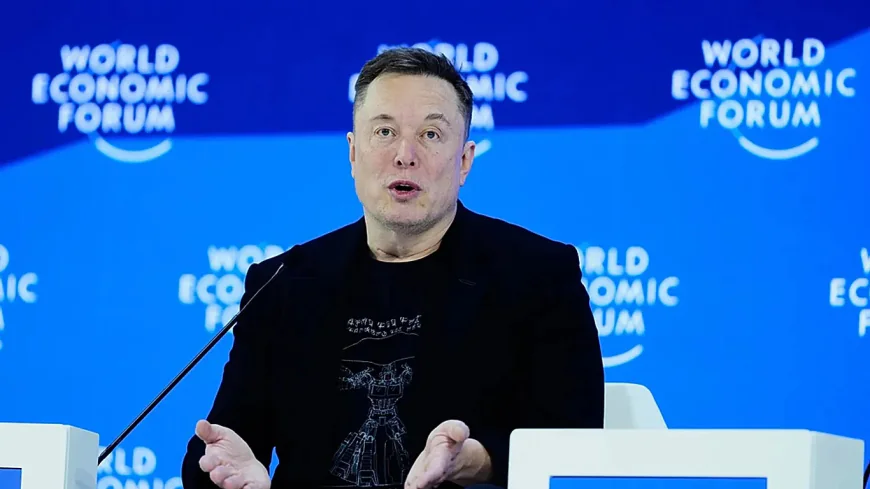
DAVOS, SWITZERLAND — Elon Musk has sparked global debate at the 2026 World Economic Forum in Davos by predicting that artificial intelligence will surpass individual human intelligence by the end of 2026 and eventually outnumber the human population.
During a fireside chat with BlackRock CEO Larry Fink, the Tesla CEO outlined a future of "unprecedented global abundance" driven by ubiquitous robotics. Musk asserted that while AI software alone is transformative, the real shift occurs when intelligence is embedded in physical humanoid machines. He predicted that by 2030 or 2031, AI will be smarter than the collective intelligence of all humanity, eventually leading to a world where robots are more common than people.
Tesla Optimus enters mass production
Following Musk’s bold claims, Tesla confirmed it is initiating mass production of its Optimus Gen 3 humanoid robot. While initial production at the Fremont facility will begin slowly, the company is targeting an eventual capacity of one million units per year. This strategic focus comes as Tesla’s vehicle delivery growth slowed in 2025, falling 9% to 1.64 million units. Consequently, Chinese rival BYD surpassed Tesla as the world’s leading battery electric vehicle (BEV) manufacturer in 2025, delivering 2.26 million units.
Promises versus current technical hurdles
Despite Musk’s optimism, current humanoid technology faces significant real-world challenges. Demonstrations at recent events like CES 2026 have shown that while robots can perform specific tasks, they often struggle with unstructured environments or simple manual chores like folding laundry. Critical bottlenecks identified for 2026 include:
-
Energy and Power: Electricity supply, rather than technology, may become the primary limiting factor for AI and robotic scaling.


-
Safety and Trust: Issues such as "AI hallucinations" and physical safety protocols remain vital for integration into human spaces.
-
Autonomy Limits: Some current "autonomous" home robots still require remote human teleoperation behind the scenes.
Industrial integration accelerating
While consumer use remains in early stages, industrial deployment is advancing rapidly. Boston Dynamics recently unveiled the product version of its fully electric Atlas robot, which is ready for deployment in Hyundai facilities starting this year. These enterprise-grade robots are designed for high-risk industrial tasks, featuring superhuman agility and the ability to autonomously navigate to charging stations to swap their own batteries.


Source: EuroNews
What's Your Reaction?
 Like
0
Like
0
 Dislike
0
Dislike
0
 Love
0
Love
0
 Funny
0
Funny
0
 Wow
0
Wow
0
 Sad
0
Sad
0
 Angry
0
Angry
0

Editor | Wise News Press — Delivering accurate, timely global news with integrity, insight, and editorial responsibility.





















Comments (0)