



NATO F-18s shoot down unidentified drone near Romania-Moldova border
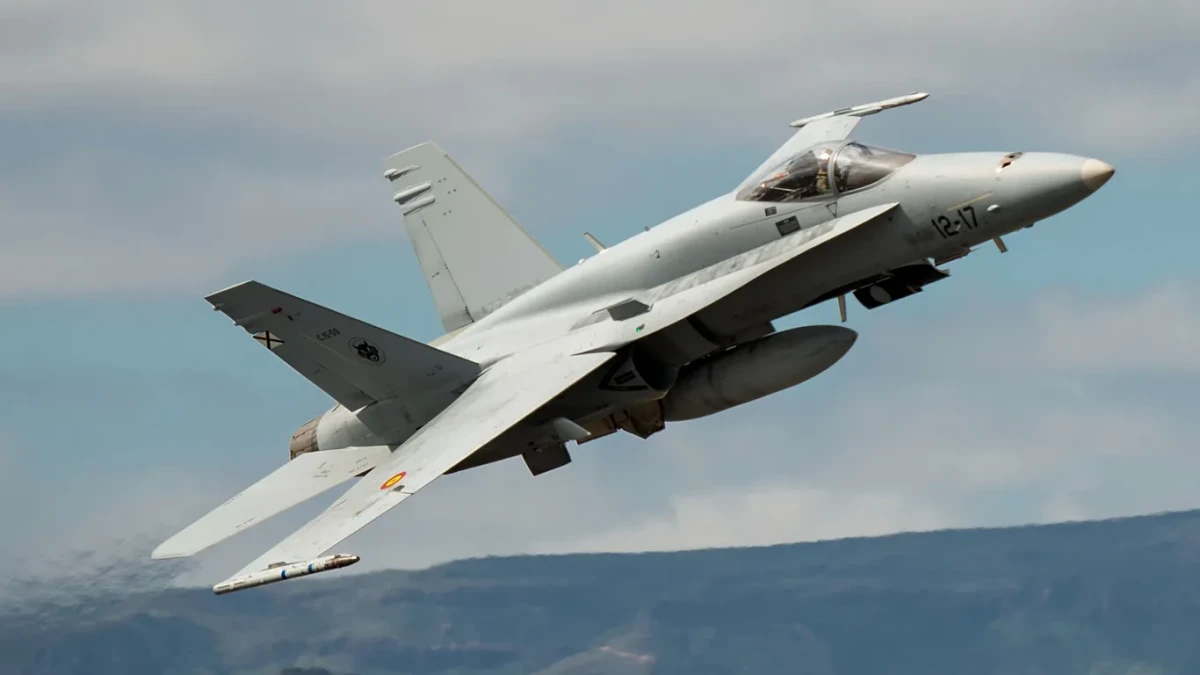
Two Spanish F-18 jets deployed on a NATO mission in Romania intercepted and destroyed an unidentified drone near the Moldovan border after an airspace alert.


By Ahmet Taş | Wise News Press
BUCHAREST, ROMANIA — Two Spanish F-18 fighter jets deployed in Romania under a NATO mission intercepted and destroyed an unidentified drone near the Moldovan border on Sunday, Romanian authorities said, amid a growing series of airspace incidents along NATO’s eastern flank.
According to Euronews, citing Romanian Defence Minister Radu Miruță, the drone was first detected about 24 kilometers north of Galați before being intercepted between Băleni and Cudalbi in southeastern Romania. Romanian authorities have not yet confirmed the origin of the aircraft.
F-18 fighters received authorization to intervene at 4:44 a.m.
The two Spanish F-18s were already on alert as part of NATO’s air-policing mission when they were authorized to respond at 4:44 a.m. on Sunday.
The unidentified unmanned aerial vehicle was initially detected north of Galați, a city close to Romania’s borders with Moldova and Ukraine.
The fighter jets subsequently intercepted the aircraft in an area between Băleni and Cudalbi, near the Moldovan border, where the drone was destroyed.


Romanian authorities have not publicly identified the drone’s model, operator or country of origin.
That distinction is important because the incident occurred after a series of drone incursions linked to the wider Russia-Ukraine war, but the latest aircraft has not yet been officially attributed to Russia, Ukraine or another actor.
Romanian military authorities are expected to examine available radar data and debris to determine the aircraft’s origin and flight path.


Romanian defence minister praises Spanish and Romanian personnel
Defence Minister Radu Miruță praised both the Spanish pilots who carried out the interception and Romanian personnel responsible for coordinating the operation from the command center.
Miruță said Romania had demonstrated that it could defend its own airspace while benefiting from the support of NATO allies.
He described the incident as a practical example of allied security based on air patrols, rapid reaction and solidarity among NATO members.
Romania occupies a particularly sensitive position on NATO’s eastern flank.
The country shares approximately 614 kilometers of land border with Ukraine, placing it close to areas where Russian and Ukrainian forces regularly use long-range drones and missiles.
Since the beginning of Russia’s full-scale invasion of Ukraine, Romanian authorities have repeatedly monitored aerial objects approaching or entering national airspace, particularly along the Danube River and near the Black Sea.
Incident followed a night of heavy Russia-Ukraine strikes
The interception came after another night of intense Russian and Ukrainian long-range attacks.
According to Euronews, Russian strikes caused major fires in Kyiv and injured at least two people.
Moscow, meanwhile, claimed that more than 600 Ukrainian drones had been launched against Russian territory during the same period and said three people were injured.
Those figures were reported by the respective sides and were not independently verified in the source material.
The increasing use of long-range drones by both Russia and Ukraine has raised concerns in neighboring NATO states because aircraft can deviate from their intended routes, lose navigation control or cross national borders.
Romania, Poland and other eastern NATO members have repeatedly scrambled fighter jets in response to aerial activity near their territory.
The latest interception therefore comes amid a broader effort by NATO to maintain continuous surveillance and quick-response capacity along the alliance’s eastern frontier.
Romania has recorded repeated drone incursions in recent weeks
Sunday’s incident was the latest in a string of drone-related events reported in Romanian airspace.
According to Euronews, two Spanish F-18 fighters were scrambled from Mihail Kogălniceanu Air Base last Thursday after another flying object was detected near Romania’s river border with Ukraine.
That drone reportedly remained in Romanian airspace for approximately 12 minutes before returning toward Ukraine.
Authorities sent an emergency SMS warning to residents in the Tulcea area during the incident.
A day later, another drone crashed inside Romania after reportedly flying at such a low altitude that it was not detected by radar in advance.
The incidents have renewed questions about the ability of ground-based radar systems to track small unmanned aircraft flying close to terrain.
At roughly the same time, NATO aircraft were also reported to have shot down another drone over Latvia, adding to concerns about aerial threats across the alliance’s eastern flank.
Another unidentified drone exploded over Bulgaria earlier this month
Romania has also been linked to another cross-border drone incident earlier in August.
An unidentified aircraft reportedly entered through Romanian territory before exploding in Bulgarian airspace near the Romanian border.
The incident occurred close to natural gas infrastructure, according to the Euronews report.
The series of episodes shows how the widespread use of relatively inexpensive unmanned aircraft is creating a new air-defense challenge for NATO members bordering Ukraine.
Small drones can fly at low altitude, follow irregular routes and present a smaller radar signature than conventional aircraft.
They may therefore require a combination of radar systems, electronic surveillance, fighter aircraft and ground-based counter-drone technology to detect and intercept reliably.
For Romania, this challenge has become particularly important because of the country’s proximity to Ukrainian regions repeatedly targeted during Russian attacks.
Russian drone hit a home in Galați in May
One of the most serious earlier incidents occurred on May 29 in Galați.
According to Euronews, a drone identified as Russian struck a residential property, starting a fire and injuring two people.
NATO described that incident at the time as a form of irresponsible Russian escalation.
NATO Secretary General Mark Rutte subsequently reiterated that the alliance was prepared to defend every part of allied territory against such threats.
Sunday’s interception is significant because, unlike some previous cases involving drones that crossed Romanian territory or crashed after entering the country, allied fighter aircraft directly engaged and destroyed the unidentified vehicle.
That highlights the increasingly active role NATO air-policing missions are playing in protecting Romanian airspace.
NATO’s eastern airspace faces growing pressure from drone warfare
The expansion of drone warfare in the Russia-Ukraine conflict is creating a broader security problem for countries bordering the war zone.
Hundreds of drones and missiles can be launched during major waves of attacks, increasing the risk that individual systems may cross borders deliberately or unintentionally.
For NATO, the challenge is to determine quickly whether an incoming object represents an immediate threat, identify its origin where possible and respond without unnecessarily escalating the situation.
Romania’s reliance on Spanish F-18 aircraft also illustrates NATO’s multinational approach to eastern-flank security.
Allied air forces routinely rotate through bases in Romania and other eastern member states to reinforce national air-defense capabilities.
The latest operation demonstrates that those aircraft are not deployed solely for deterrence but can be called upon for real-time interceptions when national airspace is threatened.
Romanian authorities have not yet announced the origin of the drone destroyed near Băleni and Cudalbi.
Until technical analysis is completed, the incident remains officially an interception of an unidentified aircraft rather than a confirmed Russian or Ukrainian drone.
Further information is expected as Romanian defence officials examine the circumstances of the flight, its route and any debris recovered after the interception.
WiseNewsPress.com
What's Your Reaction?
 Like
0
Like
0
 Dislike
0
Dislike
0
 Love
0
Love
0
 Funny
0
Funny
0
 Wow
0
Wow
0
 Sad
0
Sad
0
 Angry
0
Angry
0

Ahmet Taş is a journalist, editor and Turkey Office Manager of the Wise News Press Media Group. He works across news, digital media and international publishing, focusing on accurate, responsible and accessible journalism. He contributes to the development of media projects that bring important political, social and global developments to a wider international audience.


















Comments (0)