



Uluköy sarcophagus reveals Roman-Byzantine and early Christian traces
A sarcophagus in Uluköy, Amasya, features herringbone, rosette-star and lozenge motifs that may point to Late Roman and Early Byzantine origins.


By Yusuf İnan | Wise News Press
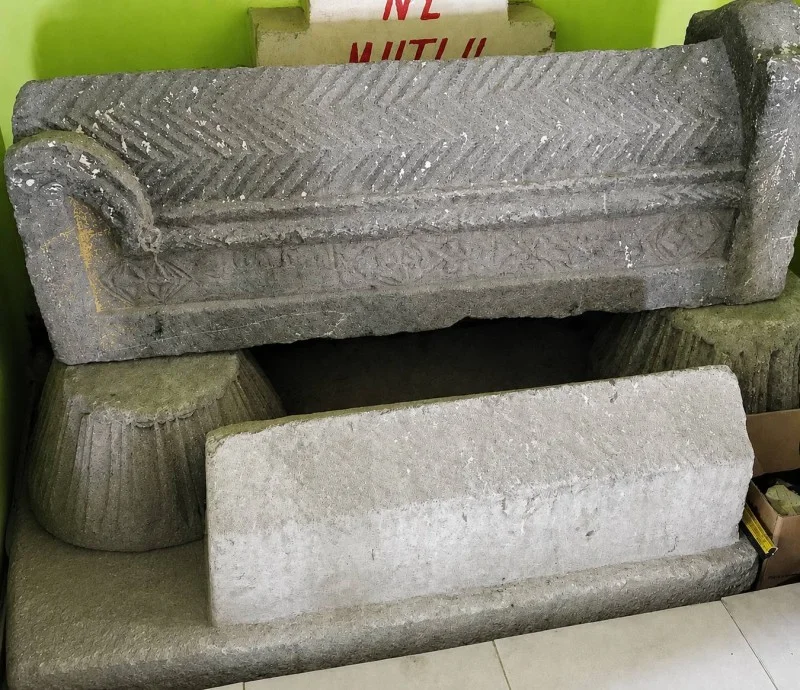
AMASYA, Türkiye — A sarcophagus found in Uluköy, a village in the Taşova district of Amasya, is drawing attention for its geometric carvings and possible links to the Late Roman and Early Byzantine periods.
A visual examination of the stone monument suggests that it may be more than a simple burial object. Its herringbone pattern, rosette-star motifs, lozenge-shaped geometric bands and volute-like side details point to a layered artistic tradition that may reflect the transition from Roman funerary culture to early Byzantine symbolism. However, a definitive dating would require expert archaeological, art historical and material analysis.
What the sarcophagus shows at first glance
The object appears to be a sarcophagus or part of a funerary structure preserved with a lid-like upper section.
The sloped upper surface gives the impression of a roof. In Roman and Byzantine funerary art, such forms can be associated with the idea of the grave as an “eternal house” for the deceased. This does not necessarily mean the monument was designed as a literal house, but the architectural language suggests an attempt to give the burial a symbolic and monumental character.
The front surface carries the most striking decorative elements. The upper band is covered with a herringbone or zigzag pattern, while the lower decorative register includes rosette-star forms and geometric framing. These details suggest that the stone was carved according to a specific visual and symbolic tradition.
The herringbone pattern recalls Roman-Byzantine stonework
One of the clearest features on the sarcophagus is the dense herringbone or zigzag decoration on the upper part.


This motif was widely used in ancient and late antique stonework. It may have served a purely decorative purpose, adding rhythm and texture to the surface. At the same time, because it resembles roof tiles, it may strengthen the idea that the sarcophagus was visually connected to the concept of a final dwelling place.
The herringbone pattern should not be read as a Christian symbol by itself. It is a broader decorative form inherited from Roman artistic traditions and used in different contexts during the Byzantine period.
For that reason, the motif is important not because it proves a specific religious identity, but because it helps place the object within a Late Antique visual culture.


Rosette and star motifs may carry symbolic meaning
The front panel of the sarcophagus contains rosette or star-like motifs that deserve special attention.
In Roman and Byzantine art, rosettes were not only decorative elements. They could also be associated with ideas such as eternal life, the immortality of the soul, celestial protection, sacred space and continuity after death.
If the motifs are arranged as six- or eight-pointed stars, they may also be interpreted within the wider symbolic language of early Christianity.
In the first centuries of Christianity, direct cross imagery was not always used openly or uniformly. In some contexts, Christian symbolism appeared through more indirect forms such as stars, rosettes, monograms or geometric compositions that contained a hidden cross-like structure.
This does not mean that the Uluköy sarcophagus can be identified as Christian with certainty. But the motifs are compatible with the kind of symbolic funerary language seen during the transition from pagan Roman to Christian Byzantine culture.
A possible “hidden cross” interpretation
The rosette-star forms on the sarcophagus may contain intersecting lines that create a cross-like internal structure.
This kind of arrangement can sometimes be associated with early Christian symbolic expression. In some local traditions, Christograms or symbolic references to Christ were stylized through geometric or star-shaped compositions rather than open cross forms.
The Christogram, or Krismon, is generally understood as a monogram associated with the name of Christ. In regional stonework, symbolic forms could vary considerably. A rosette or star with a central crossing pattern might therefore be read as a possible hidden Christian sign.
However, the photograph does not show a clear inscription, an explicit cross, alpha and omega symbols, a fish, a dove or a definitive Christogram. For this reason, the most careful conclusion is that the sarcophagus bears motifs compatible with early Christian funerary symbolism, but cannot be identified with certainty without expert study.
Lozenge geometry marks a Late Antique visual language
Another important element is the lozenge-shaped geometric decoration surrounding or framing the lower motif band.
Lozenge patterns were common in Late Roman and Early Byzantine decorative art. They appeared on stone monuments, sarcophagi, architectural elements and other carved surfaces.
In funerary contexts, such geometric borders may have served as visual frames. They could also be interpreted as symbolic boundaries around the sacred space of burial.
The repeated use of geometric forms may express order, protection and continuity. In this sense, the lozenge band on the Uluköy sarcophagus may have both decorative and symbolic value.
The side details suggest a monumental character
The curved, volute-like detail visible at the side of the sarcophagus is also significant.
Volutes are associated with classical architectural decoration and were widely used in Roman visual culture. Their presence on a funerary object can give the monument a more formal, architectural and prestigious appearance.
This may suggest that the sarcophagus was not made for an ordinary burial. It may have belonged to a person or family with some social, economic or religious status in the local community.
The quality and complexity of the carving raise the possibility that Uluköy was once part of a more important settlement network than its current village identity may suggest.
Could it be connected to an early Christian site?
Local historical discussions have connected Uluköy with older names such as Annesi, Annisa and later Sonisa.
Researcher Muhammed Canlı has suggested that the sarcophagus could potentially be connected with a chapel or family burial area associated with early Christian figures mentioned in historical correspondence, including Saint Basil, Saint Macrina, Gregory and Naucratius.
This remains a hypothesis rather than a proven archaeological conclusion. Still, the suggestion is worth further investigation because the sarcophagus carries visual elements that fit the broader Late Roman-Early Byzantine world.
If the site was indeed connected with an early Christian community, the sarcophagus could help illuminate the religious and cultural landscape of the Taşova-Amasya region during Late Antiquity.
A cautious dating: 4th to 6th century AD
Based on visual style alone, a cautious dating range could place the sarcophagus between the 4th and 6th centuries AD.
This period corresponds to the late Roman world and the early Byzantine era, when Christianity became increasingly visible in Anatolia’s funerary art and public religious culture.
But this dating must remain tentative. A proper study would need to examine the stone type, carving technique, archaeological context, nearby remains, possible inscriptions and comparisons with similar sarcophagi from the region.
Without such analysis, the object can be described as likely Late Antique in character, but not definitively dated.
Uluköy deserves deeper archaeological study
The Uluköy sarcophagus shows that the history of Amasya’s rural settlements may be richer than commonly assumed.
Amasya is already known for its multi-layered historical identity, from ancient royal tombs to Ottoman houses and regional religious heritage. But objects like this sarcophagus show that important traces may also survive in villages and smaller settlements.
The monument should be documented, protected and studied by specialists. Archaeologists, art historians, epigraphists and Byzantine researchers could help determine whether it belonged to a single burial, a family cemetery or a larger religious complex.
Such research could also clarify whether Uluköy was part of a broader Late Roman and Byzantine settlement network.
A stone memory of Uluköy
The sarcophagus is a powerful reminder that local history often survives not only in written records, but also in stone.
Its herringbone decoration, rosette-star motifs, lozenge geometry and classical side details point to a complex artistic and symbolic world.
There is no definitive inscription or clear cross visible in the image, but the monument carries features that are compatible with early Christian funerary symbolism and Late Roman-Early Byzantine stonework.
For Uluköy, this sarcophagus may represent more than an archaeological object. It may be a fragment of the village’s deeper historical memory — a memory that still waits to be fully studied, protected and understood.
What's Your Reaction?
 Like
0
Like
0
 Dislike
0
Dislike
0
 Love
0
Love
0
 Funny
0
Funny
0
 Wow
0
Wow
0
 Sad
0
Sad
0
 Angry
0
Angry
0

Editor | Wise News Press — Delivering accurate, timely global news with integrity, insight, and editorial responsibility.
















Comments (0)