



Crimean Tatar influence in Ukraine: From parliament to intelligence
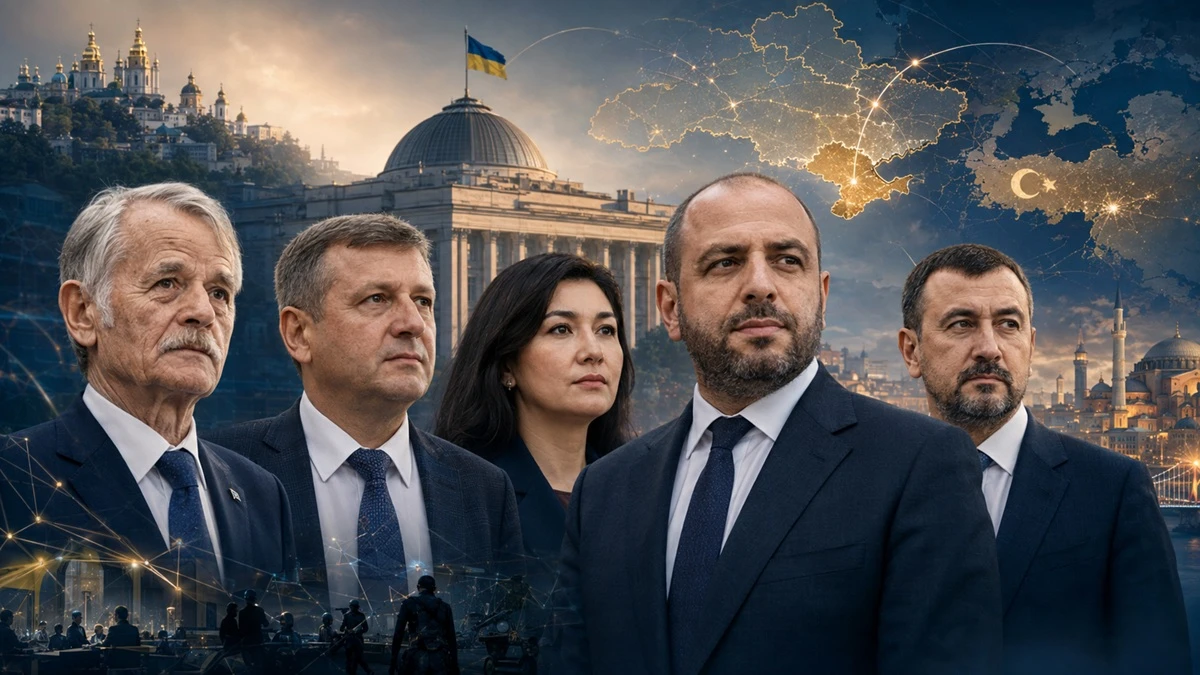
Crimean Tatar figures hold strategic roles across Ukraine’s parliament, intelligence, diplomacy, defense and law, with growing links to Türkiye and the Muslim world.


By Yusuf Inan | Wise News Press
Journalist and Author | Political and Strategic Analyst
KYIV, UKRAINE — Crimean Tatars have only limited numerical representation in Ukraine’s parliament, yet politicians and officials from the community occupy strategic positions stretching from intelligence and diplomacy to defense, justice and human rights.
Ukraine’s Verkhovna Rada has around 390 serving lawmakers in its current records. Parliament does not publish an official list based on ethnic identity, meaning there is no formal category of “Crimean Tatar MPs.” However, three sitting deputies whose Crimean Tatar identity is publicly established stand out: Mustafa Cemilev, Ahtem Çiygöz and Tamila Taşeva.
Looking beyond parliament reveals a much broader picture. Figures from Crimean Tatar political circles are present in Ukraine’s security establishment, foreign policy, defense procurement, human-rights institutions, prosecution service and cultural diplomacy.
Three Crimean Tatar MPs represent different spheres of influence
Veteran Crimean Tatar national leader Mustafa Cemilev continues to serve in parliament with the European Solidarity faction. He sits on the committee responsible for human rights, de-occupation and reintegration of occupied territories, national minorities and interethnic relations.


Cemilev’s international parliamentary network is equally significant. He serves as a deputy co-chair in the parliamentary group for relations with Saudi Arabia and is also involved in friendship groups with Türkiye, Indonesia and Lebanon.
His role therefore extends beyond historical representation of the Crimea issue. His political standing and international contacts allow him to serve as a channel to Türkiye and parts of the wider Muslim world.
Ahtem Çiygöz is first deputy chair of the same parliamentary committee. He also works on the special commission monitoring the receipt and use of international military assistance provided to Ukraine during wartime.


His position is particularly significant for the Turkic world. Çiygöz is a co-chair of the parliamentary group for relations with Türkiye and is also a member of the Azerbaijan and Uzbekistan friendship groups.
That combination makes him one of the most institutionalized parliamentary links on the Türkiye-Azerbaijan-Uzbekistan axis.
Tamila Taşeva, who entered parliament at the end of 2024, chairs a subcommittee dealing with the restoration of Ukrainian state authority in Crimea and other occupied territories.
Her participation in parliamentary groups linked to Uzbekistan, Indonesia and Malaysia creates a different diplomatic corridor.
The three MPs therefore represent distinct forms of influence: Cemilev carries historical and symbolic legitimacy, Çiygöz provides a parliamentary bridge to the Turkic world, and Taşeva offers particularly important access to Southeast Asia and Muslim civil-society networks.
Tamila Taşeva built contacts with major Muslim organizations in Asia
Taşeva’s importance does not come only from parliamentary friendship groups.
Before entering parliament, while serving as the Ukrainian President’s Permanent Representative in Crimea, she led a Ukrainian delegation visiting India, Malaysia and Indonesia.
During the visit to Indonesia, the delegation met representatives of Nahdlatul Ulama, Muhammadiyah and the Indonesian Ulema Council, some of the most influential Muslim organizations in the country.
The discussions addressed occupied Crimea, the situation of Crimean Tatar Muslims and pressure exerted by Russian authorities.
This diplomatic channel offers Ukraine an opportunity to present Crimea not only through the framework of European security or the Russia-Ukraine war, but also as a question involving the rights of a Muslim Indigenous people.
That framing could carry particular weight in countries such as Indonesia and Malaysia, where the conflict may be viewed through different political and social lenses than in Europe.
Within the current parliamentary group, Taşeva therefore stands out as one of the figures with the strongest documented experience in communicating the Crimean Tatar issue to Muslim societies in Southeast Asia.
Rustem Umerov rose to the center of Ukraine’s security establishment
Among Crimean Tatar figures connected to the Ukrainian state, Rustem Umerov has reached one of the highest levels of institutional power.
His career has included service as a member of parliament, head of the State Property Fund, minister of defense and secretary of the National Security and Defense Council.
In August 2026, President Volodymyr Zelenskyy moved Umerov into the leadership of Ukraine’s Foreign Intelligence Service.
His importance, however, is not based on office alone.
Umerov has played significant roles in negotiations and security diplomacy, including contacts involving Türkiye and Gulf countries.
In 2025 and 2026 he participated in high-level work involving Qatar and Saudi Arabia, while Ukrainian officials also included him in discussions on security cooperation with Gulf and Middle Eastern partners.
His involvement in negotiations held in Istanbul and Abu Dhabi further strengthened his position as a figure capable of operating simultaneously within Ukraine’s security system and international diplomatic channels.
For that reason, Umerov is more than a Crimean Tatar community representative.
He is one of the figures through whom Ukraine can connect its national-security strategy with Türkiye, the Gulf and parts of the wider Muslim world.
Nariman Celâl turns Ankara into a strategic Crimean Tatar diplomatic hub
For Türkiye, one of the most significant positions is held by Nariman Celâl, Ukraine’s ambassador in Ankara.
Celâl formally began his duties after presenting his credentials to Turkish President Recep Tayyip Erdoğan in July 2025.
His background gives the appointment considerable political weight.
Celâl has been one of the senior figures of the Mejlis of the Crimean Tatar People and served as its first deputy chairman.
Russian authorities detained him in occupied Crimea in 2021 and he was later sentenced to 17 years in prison. He returned to Ukraine following his release in 2024.
As a result, Ukraine’s embassy in Ankara is headed not simply by a career diplomat, but by a Crimean Tatar political figure whose personal history is directly connected to occupation, political imprisonment and the Crimean Tatar national movement.
Three separate elements come together in his profile:
Crimean Tatar Mejlis legitimacy, official authority as Ukraine’s ambassador, and the personal experience of having been a Russian political prisoner.
This makes Ankara a particularly important diplomatic center for the Crimean Tatar issue.
Türkiye already has deep historical, cultural and political ties with Crimean Tatars, while the Erdoğan administration has repeatedly raised the issue of Crimean Tatar political prisoners and Crimea in contacts with Kyiv and Moscow.
Celâl’s appointment therefore creates an unusually direct bridge between Ukrainian state diplomacy and Crimean Tatar political representation.
Defense procurement, prosecution, human rights and cultural diplomacy expand the network
The network is not limited to parliament, intelligence and embassies.
Arsen Zhumadilov has held a central role in Ukraine’s defense-procurement system, heading the Defense Procurement Agency responsible for large-scale acquisition of weapons, ammunition, drones, equipment and other military supplies.
His position is especially relevant to Türkiye because Turkish-Ukrainian relations include a significant defense-industrial dimension.
Türkiye’s experience in unmanned systems, munitions, naval platforms and other defense technologies means a Ukrainian procurement official in such a position could potentially become important in bilateral industrial cooperation.
However, publicly documented evidence of a personal Türkiye or Muslim-world diplomatic network comparable with Umerov or Celâl remains more limited.
Nariman Suleimanov serves at the head of the Prosecutor’s Office of the Autonomous Republic of Crimea and Sevastopol.
The institution works on cases involving alleged war crimes in occupied Crimea, illegal archaeological activity, removal of cultural heritage, sanctions and collaboration-related investigations.
His sphere of influence is therefore primarily legal rather than diplomatic.
Nevertheless, the evidence collected by Crimea prosecutors can support international efforts concerning religious persecution, political prisoners and violations affecting Crimean Tatars.
Elvin Kadyrov, the Ukrainian Ombudsman’s representative dealing with the rights of residents of Crimea and Sevastopol, has developed a particularly practical channel with Türkiye.
Kadyrov has held meetings with the Turkish Ombudsman institution over political prisoners, missing persons and Ukrainian prisoners of war.
Ukraine has also transmitted information to Türkiye about seriously ill Crimean political prisoners, seeking Turkish assistance in humanitarian and release-related efforts.
His influence is therefore specialized but operational: Türkiye functions as an important humanitarian and prisoner-release channel.
Cultural diplomacy provides another layer.
Alim Aliev, deputy director general of the Ukrainian Institute, is a journalist and human-rights advocate with extensive work on Crimean Tatar history, culture and identity.
Through the Ukrainian Institute, Aliev has helped bring Crimean Tatar cultural projects to international audiences, including initiatives in Qatar.
His direct political decision-making power is more limited, but his ability to communicate through culture makes him an important figure for engagement with Arab and Muslim societies.
The status of the Crimean Tatar Mejlis was strengthened in 2026
Any assessment of Crimean Tatar influence must also include the Mejlis of the Crimean Tatar People.
In April 2026, President Zelenskyy initiated steps to strengthen and formalize the Mejlis’ legal position as a representative body of the Crimean Tatar people.
The move further institutionalized the relationship between Ukraine’s state structures and Crimean Tatar national representation.
This means Refat Çubarov, chairman of the Mejlis, cannot be evaluated merely as the head of a civil-society organization.
He remains an important political representative even though he is not currently an MP or a conventional state official.
When Cemilev’s historical leadership, Çubarov’s presidency of the Mejlis, Celâl’s role as ambassador in Ankara and the Crimean Tatar MPs in parliament are considered together, a network emerges in which national representation and state institutions increasingly overlap.
This is especially important because it allows Kyiv to work with Crimean Tatar institutions without reducing the issue to minority policy alone.
Türkiye and the Muslim world create a strategic diplomatic network
One of the most significant foreign-policy assets created by this network is its ability to communicate with Türkiye and the wider Muslim world.
On the Türkiye track, Nariman Celâl provides the formal diplomatic channel; Ahtem Çiygöz provides parliamentary access; Mustafa Cemilev contributes historical legitimacy and senior political connections; and Elvin Kadyrov represents the humanitarian and human-rights channel.
For the Turkic world, Çiygöz’s links to Azerbaijan and Uzbekistan are particularly important, while Tamila Taşeva also maintains an Uzbekistan parliamentary connection.
The combination creates possible routes toward Ankara, Baku and Tashkent — three particularly influential capitals in the Turkic political space.
In the Gulf and Arab world, Rustem Umerov stands out because of his state-level security and negotiation contacts with Qatar and Saudi Arabia.
Mustafa Cemilev’s parliamentary connection to Saudi Arabia adds a second political layer.
Alim Aliev’s cultural-diplomacy work in Qatar provides another, softer form of engagement.
For Southeast Asian Muslim societies, Tamila Taşeva has the strongest documented network through Indonesia and Malaysia and her contacts with Nahdlatul Ulama, Muhammadiyah and the Indonesian Ulema Council.
There is also an important institutional history with the Organisation of Islamic Cooperation.
Former Ukrainian First Deputy Foreign Minister Emine Ceppar, herself a prominent Crimean Tatar diplomat, held direct discussions with the OIC Secretary-General during her time in office.
Her work included efforts to deepen Ukraine-OIC relations, promote the Crimea Platform and raise the rights of Crimean Tatar Muslims within the broader Islamic diplomatic agenda.
Although Ceppar is no longer in the same government position, the institutional experience and contacts developed during that period remain relevant to any future Ukrainian strategy toward the Islamic world.
Ukraine has also increasingly used official state iftars as part of this diplomatic architecture.
Since 2023, presidential-level iftar events have brought together Crimean Tatar leaders, Ukrainian Muslim soldiers, muftis, government officials and foreign diplomatic representatives.
In 2026, figures including Rustem Umerov, Mustafa Cemilev, Refat Çubarov, Tamila Taşeva and Crimea prosecutor Nariman Suleimanov were among those connected to such state-level Muslim-community events.
These gatherings carry a broader political message beyond their religious character.
They allow Kyiv to demonstrate to Muslim-majority countries that Muslims and Crimean Tatars are presented as an integral part of the Ukrainian state and its national defense.
That creates a diplomatic narrative different from Ukraine’s conventional Western outreach.
Kyiv can present the Crimea issue simultaneously as:
a question of Ukrainian territorial integrity,
a question of Indigenous rights,
a question of religious freedom,
and a question concerning the future of a Muslim community under occupation.
This combination potentially gives Ukraine a distinctive communication tool in Türkiye, Azerbaijan and Uzbekistan; in Gulf states such as Saudi Arabia and Qatar; and in Muslim-majority Asian countries such as Indonesia and Malaysia.
The overall picture therefore suggests that the political weight of Crimean Tatars within Ukraine cannot be measured simply by counting MPs.
There may be only three clearly identifiable Crimean Tatar deputies in the current parliament, but figures from the same political and social network are present in foreign intelligence, the embassy in Türkiye, defense procurement, Crimea’s prosecution system, the Ombudsman institution, cultural diplomacy and the Mejlis.
Numerically, the network is small.
Institutionally, however, its positions are unusually strategic.
For Ukraine, the potential value of this network is equally clear: Crimean Tatar leaders can connect the Crimea question with audiences that Kyiv’s conventional European and transatlantic diplomacy may not always reach as effectively.
Whether Ukraine uses this capacity to its full potential remains a question of political strategy.
But the channels already exist — from Ankara, Baku and Tashkent to Riyadh, Doha, Jakarta and Kuala Lumpur — and the Crimean Tatar political network gives Kyiv a potentially powerful bridge between Ukraine’s national interests and the wider Turkic and Muslim worlds.
Yusuf İnan
WiseNewsPress.com
Yusuf İnan is a journalist, author, and political and strategic analyst. He serves as editor-in-chief of UAPresa.com, WiseNewsPress.com, SehitlerOlmez.com and YerelGundem.com. His work focuses on strategic and political analysis concerning developments in Türkiye and around the world.
What's Your Reaction?
 Like
0
Like
0
 Dislike
0
Dislike
0
 Love
0
Love
0
 Funny
0
Funny
0
 Wow
0
Wow
0
 Sad
0
Sad
0
 Angry
0
Angry
0

Editor | Wise News Press — Delivering accurate, timely global news with integrity, insight, and editorial responsibility.









Comments (0)