



Turkish Foreign Minister Hakan Fidan receives honorary doctorate in Moscow
Turkish Foreign Minister Hakan Fidan received an honorary doctorate from MGIMO in Moscow and was later received by Russian President Vladimir Putin in Kazan.


By Ahmet Taş | Wise News Press
MOSCOW, Russia — Turkish Foreign Minister Hakan Fidan was awarded an honorary doctorate by the Moscow State Institute of International Relations during his Russia visit and was also received by Russian President Vladimir Putin in Kazan.
The honorary title was presented to Fidan at a ceremony held at MGIMO, one of Russia’s most prestigious institutions for diplomacy and international relations. The award was given in recognition of Fidan’s contribution to international diplomacy and relations between peoples. During the same visit, Fidan also held high-level diplomatic contacts, including a meeting with Putin as part of his Russia program.
MGIMO awards honorary doctorate to Hakan Fidan
The Moscow State Institute of International Relations, widely known as MGIMO, awarded Turkish Foreign Minister Hakan Fidan an honorary doctorate during a formal ceremony in Moscow.
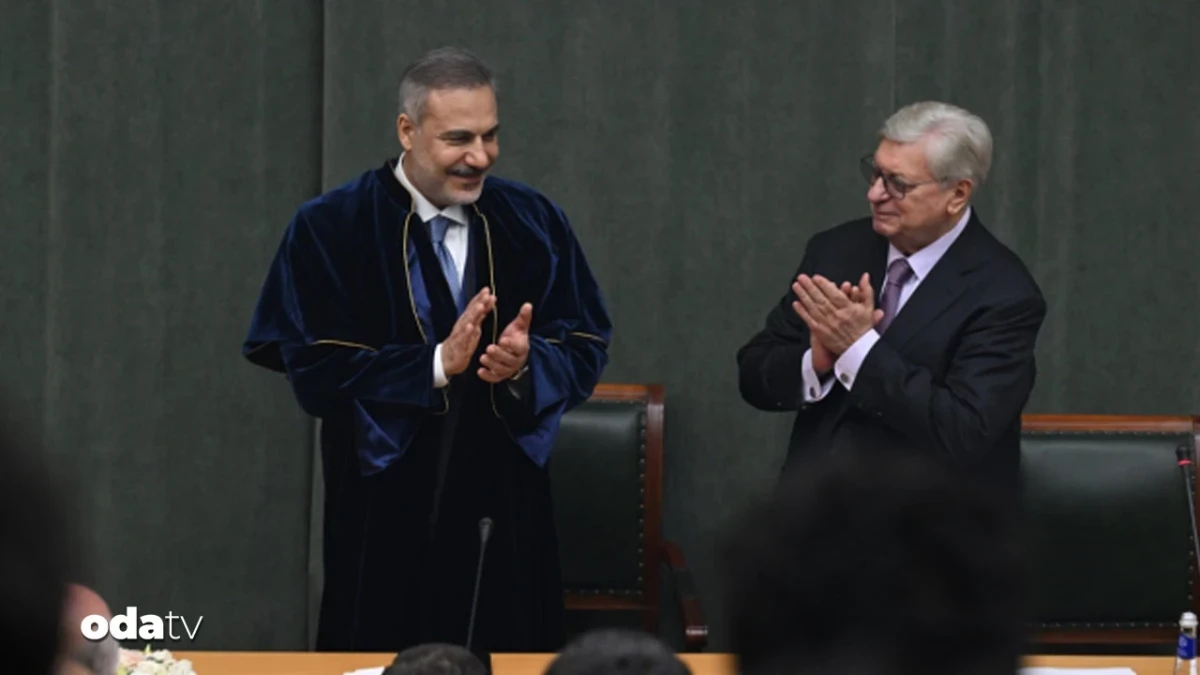
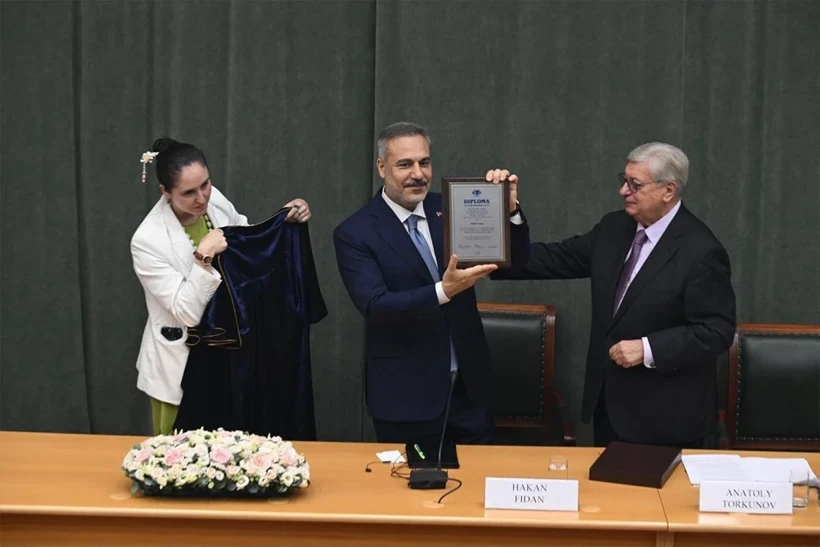
The honorary doctorate certificate was presented by MGIMO Rector Anatoly Torkunov. The ceremony was attended by diplomats, academics, students and representatives from the diplomatic community.


Fidan wore the academic gown during the ceremony, a moment that drew attention in Turkish media under headlines noting that the foreign minister had “worn the robe” at one of Russia’s leading diplomatic schools.
The award was described as a recognition of Fidan’s work in diplomacy and his contribution to dialogue between countries. For Ankara and Moscow, the ceremony also carried symbolic value at a time when Turkey and Russia continue to maintain close but complex diplomatic engagement across several regional issues.
Fidan links the award to Turkey-Russia relations
In his speech at the ceremony, Fidan thanked MGIMO for the honorary doctorate and underlined the institution’s long-standing role in training diplomats, statesmen and international relations specialists.


Fidan said he viewed the award not only as a personal honor but also as a sign of respect for the deep-rooted relations between Turkey and Russia. He emphasized that the two countries have a broad and historically important relationship that includes diplomacy, trade, energy and regional security.
The Turkish foreign minister also stressed the importance of dialogue in addressing international crises. His remarks reflected Ankara’s ongoing position that communication channels with Moscow should remain open, even when Turkey and Russia do not share identical positions on every regional file.
Turkey and Russia have continued to work together in some areas while standing on different sides of certain disputes. This makes diplomatic contact between the two countries especially significant for regional stability.
Why MGIMO matters in Russian diplomacy
MGIMO is regarded as one of Russia’s most influential schools in the field of diplomacy and international relations. For decades, the institution has trained many of Russia’s senior diplomats, foreign policy experts and public officials.
Among MGIMO’s notable alumni are Russian Foreign Minister Sergey Lavrov, Azerbaijani President Ilham Aliyev and Kazakh President Kassym-Jomart Tokayev.
The university has also awarded honorary doctorates to several international figures in the past. Turkish President Recep Tayyip Erdoğan and United Nations Secretary-General António Guterres are among the names previously associated with the institution’s honorary recognition.
For this reason, Fidan’s honorary doctorate was not only an academic title but also a diplomatic gesture. It highlighted the importance Moscow attaches to its communication with Ankara and to Turkey’s role in regional affairs.
Putin receives Fidan in Kazan
Fidan’s Russia visit also included a meeting with Russian President Vladimir Putin. According to the Turkish Foreign Ministry, Putin received Fidan in Kazan on June 17 as part of the foreign minister’s official contacts.
The meeting marked one of the highest-level moments of Fidan’s visit. It came at a time when Turkey and Russia continue to discuss a wide range of issues, including bilateral relations, energy, trade, the Black Sea, the war in Ukraine, Syria and developments in the South Caucasus.
Although the full details of the Putin-Fidan meeting were not publicly disclosed, the visit was viewed as part of Ankara’s continuing diplomatic engagement with Moscow.
Turkey is a NATO member, but it has also maintained direct communication with Russia throughout periods of heightened tension between Moscow and the West. This position gives Ankara a distinctive role in regional diplomacy, particularly on issues involving the Black Sea and Ukraine.
A complex but active diplomatic relationship
Turkey-Russia relations are marked by both cooperation and competition. The two countries have strong ties in energy, tourism, trade and regional diplomacy, but they also have differing positions on several conflicts and strategic files.
In Syria, Libya, the South Caucasus and Ukraine, Ankara and Moscow have at times supported different actors or pursued different priorities. Still, both countries have generally kept diplomatic channels open.
This pattern has made Turkey-Russia relations one of the most closely watched bilateral relationships in the region. The two countries often seek to manage disagreements through negotiation while preserving practical cooperation in areas of mutual interest.
Fidan’s visit to Moscow and Kazan fits into this broader diplomatic framework. The honorary doctorate ceremony at MGIMO provided a symbolic setting, while the meeting with Putin reflected the continuing political importance of direct contact between Ankara and Moscow.
Diplomacy, energy and regional security on the agenda
Turkey and Russia have multiple areas of engagement. Energy remains one of the most important pillars of the relationship, with natural gas, nuclear cooperation and regional energy routes frequently shaping bilateral discussions.
Trade is another major area. Both countries have sought to maintain economic ties despite international tensions and sanctions linked to the war in Ukraine.
Diplomacy and security are equally important. Turkey has repeatedly emphasized the need for dialogue in regional conflicts, while Russia remains a central actor in several crises affecting Turkey’s security environment.
Fidan’s remarks at MGIMO placed emphasis on diplomacy and regional stability. His message was that Turkey and Russia, as two major regional powers, have a responsibility to keep dialogue alive and manage crises through diplomatic channels.
The symbolic value of the visit
The timing and setting of the visit gave it additional significance. A Turkish foreign minister receiving an honorary doctorate from Russia’s leading diplomatic school, followed by a meeting with the Russian president, sends a message of continued engagement between Ankara and Moscow.
For Russia, the ceremony signaled recognition of Turkey’s diplomatic role. For Turkey, it offered an opportunity to underline that relations with Russia are built on historical depth, strategic necessity and ongoing dialogue.
The visit also showed the layered nature of Turkish foreign policy. Ankara continues to balance its NATO commitments, regional security concerns, economic interests and direct engagement with Russia.
In this context, Fidan’s Russia program was more than a ceremonial visit. It combined academic recognition, diplomatic symbolism and high-level political contact.
Ankara and Moscow expected to keep channels open
Fidan’s honorary doctorate from MGIMO and his meeting with Putin in Kazan are likely to be followed by continued diplomatic contacts between Turkey and Russia.
The two countries remain central actors in several regional files, and their ability to communicate directly is considered important for managing tensions. From Ukraine and the Black Sea to energy and trade, Ankara and Moscow have multiple reasons to keep dialogue active.
The visit highlighted both the symbolic and practical dimensions of Turkey-Russia relations. While the MGIMO ceremony emphasized diplomatic respect and institutional recognition, the Putin meeting underscored the ongoing strategic conversation between the two capitals.
For Ankara, maintaining communication with Moscow remains a key part of its regional diplomacy. For Moscow, Turkey continues to be an important interlocutor in a changing international environment.
What's Your Reaction?
 Like
0
Like
0
 Dislike
0
Dislike
0
 Love
0
Love
0
 Funny
0
Funny
0
 Wow
0
Wow
0
 Sad
0
Sad
0
 Angry
0
Angry
0

Editor | Wise News Press — Delivering accurate, timely global news with integrity, insight, and editorial responsibility.













Comments (0)