



North Korea grows richer from Russia’s war as military ties deepen
North Korea is estimated to have earned billions from military support for Russia, strengthening Kim Jong Un’s rule while fueling visible investment in Pyongyang.


By Ahmet Taş | Wise News Press
PYONGYANG, NORTH KOREA — North Korea has earned billions of dollars from supplying Russia with ammunition, weapons and troops for its war against Ukraine, providing Kim Jong Un’s government with an unusual influx of resources that has strengthened the regime and transformed parts of Pyongyang.
According to DW Türkçe, estimates from South Korean and international economic researchers suggest North Korea’s military support for Moscow has generated revenue on a scale comparable with a substantial share of the country’s entire annual economy. The benefits, however, appear concentrated in the capital, the military establishment and politically connected groups rather than being evenly distributed across the population.
Pyongyang is becoming brighter and more modern
For years, nighttime satellite images of North Korea showed a country largely covered in darkness because of chronic electricity shortages.
That image is beginning to change in central Pyongyang.
DW Türkçe, citing reporting by NK News, says the illuminated area in the center of the North Korean capital has more than doubled since April 2020, while the intensity of nighttime lighting has roughly tripled.


The government appears to be prioritizing electricity supplies for new residential districts and prestige projects designed to demonstrate economic progress.
Kim Jong Un announced at the Workers’ Party congress in 2021 that 50,000 new homes would be constructed in Pyongyang. The government has since pushed forward with large residential developments, including the Hwasong district, where high-rise apartment blocks dominate the skyline.
Visitors familiar with North Korea also describe a visibly more modern capital, with imported vehicles — including Chinese electric cars — smartphone applications for taxis and QR-code payments, as well as shops carrying foreign fashion and cosmetic products.


The government has also completed major projects including a large hospital and a greenhouse complex described as roughly comparable in size to New York’s Central Park.
In June 2025, Kim opened the Wonsan-Kalma coastal tourism complex, a five-kilometer resort designed to accommodate around 20,000 visitors.
Military support for Russia has generated billions
Analysts believe Russia’s war against Ukraine is one of the primary reasons Pyongyang suddenly has access to significantly greater resources.
A report published in March by South Korea’s Institute for National Security Strategy, or INSS, estimated that North Korea received between $7.7 billion and $14.4 billion in return for supplying ammunition and sending soldiers to Russia.
Bloomberg Economics separately estimated that North Korea earned more than $14 billion from military assistance provided to Russia between 2022 and 2025.
The scale is significant for one of the world’s most isolated economies.
DW Türkçe notes that North Korea’s gross domestic product last year was estimated at approximately $27 billion.
Other sources of foreign currency have also contributed. Trade with China, the deployment of North Korean workers abroad, exports and cybercrime are estimated to have generated roughly another $8 billion.
One of the most significant cases occurred in February 2025, when hackers believed to be linked to North Korea stole Ethereum worth about $1.5 billion from cryptocurrency platform Bybit.
Together, these flows have given Pyongyang access to money and resources that were difficult to obtain during earlier periods of international sanctions and isolation.
Weapons, ammunition and troops have become valuable exports
Russia has benefited from North Korea’s large stockpiles of artillery ammunition and other military equipment as its war in Ukraine has consumed huge quantities of weapons.
According to Ukrainian estimates cited by DW Türkçe, North Korea supplied around half of the ammunition Russia required on the battlefield during 2024 and 2025.
Pyongyang has also provided self-propelled artillery, multiple-launch rocket systems and ballistic missiles.
The source additionally says Ukraine believes North Korea is planning to send a missile unit consisting of 90 personnel, six launchers and up to 120 missiles to Russia. Those figures reflect the Ukrainian assessment cited in the original report.
Between 16,000 and 22,000 North Korean troops were previously deployed to assist Russian forces, including operations around Russia’s Kursk region and subsequent mine-clearing activities.
Ukrainian President Volodymyr Zelenskyy has said Kim may be preparing to deploy another 30,000 to 50,000 soldiers.
For Pyongyang, sending personnel can generate considerable revenue.
According to the INSS estimates cited by DW Türkçe, the North Korean government receives about $2,800 per month for each soldier, around $3,000 for an officer, and between $6,000 and $10,000 for every soldier killed.
These are estimates from the South Korean institute rather than publicly confirmed contract terms between Moscow and Pyongyang.
Russia pays partly with oil, food and military technology
The partnership is not based solely on cash.
As during the Soviet era, a significant portion of trade between Moscow and Pyongyang is believed to take the form of barter.
In exchange for ammunition, military equipment and personnel, Russia supplies North Korea with crude oil, refined petroleum products, grain and military-related goods.
DW Türkçe reports that the cooperation may also include technologies connected to air-defense systems, drones, missiles and submarines.
Such technology could be strategically important for North Korea because international sanctions have long restricted its access to advanced military components.
The partnership has already coincided with visible developments in North Korea’s armed forces, including the launching of two 5,000-ton destroyers.
Closer ties with Moscow have also increased Kim Jong Un’s diplomatic standing.
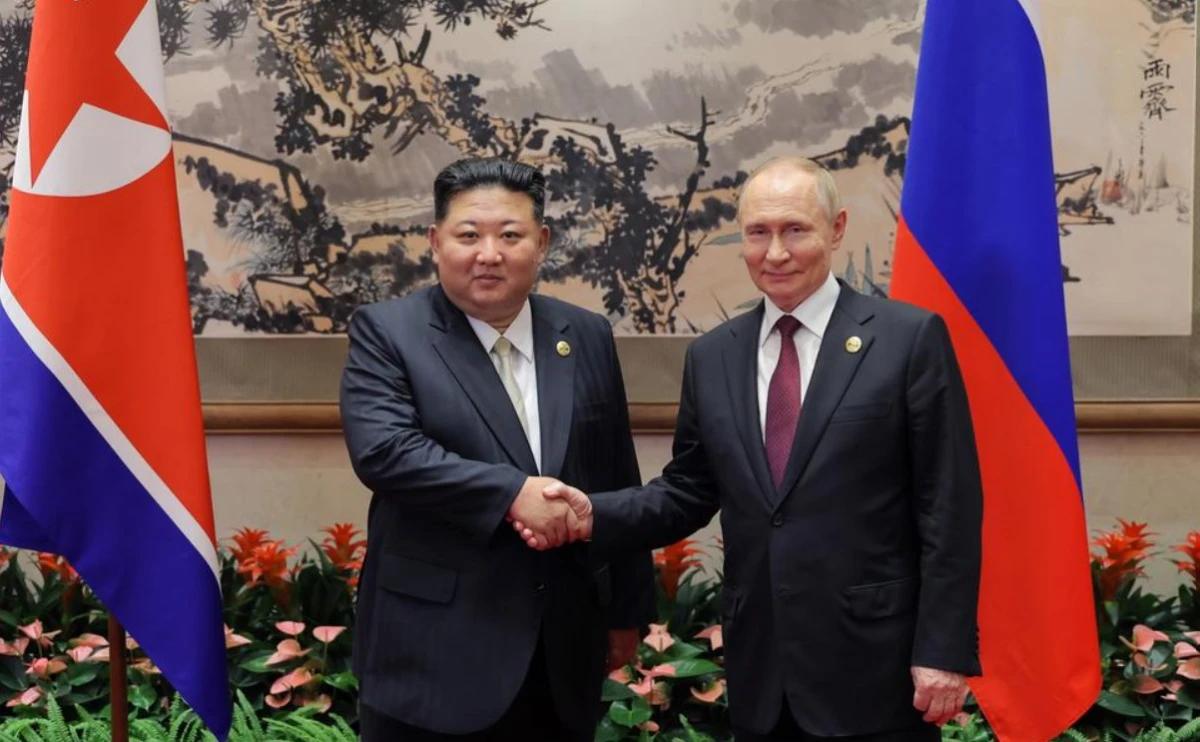
Russian President Vladimir Putin visited Pyongyang in June 2024, while Chinese President Xi Jinping visited North Korea this year. Kim also appeared alongside Xi and Putin in Beijing in September 2025 during events marking the 80th anniversary of the end of World War II.
The diplomatic activity has helped North Korea move away from the level of international isolation it faced only several years ago.
Economic gains strengthen Kim’s political position
The change is particularly striking compared with North Korea’s situation during the COVID-19 pandemic.
At the beginning of 2021, Kim publicly acknowledged that economic performance in almost every sector had fallen short of expectations.
Five years later, his political message has changed markedly.
At a more recent party gathering, surrounded by displays of artillery, Kim declared that conditions had fundamentally changed.
The Russian partnership has provided him not only with money but also with greater military relevance and diplomatic leverage.
For Moscow, North Korea provides ammunition, weapons and personnel at a time when Russia requires enormous quantities of military supplies.
For Pyongyang, Russia offers foreign currency, fuel, food, technology and political support.
The relationship has therefore developed into an increasingly important strategic exchange for both governments.
The new prosperity is not reaching everyone
Despite the construction boom in Pyongyang, economists caution against interpreting the visible changes in the capital as evidence that living standards are improving across North Korea.
Food prices remain high, while depreciation of the North Korean won has placed particular pressure on poorer households without access to foreign currency.
According to DW Türkçe, many families increasingly depend on women working in order to maintain household living standards.
Kim has attempted to address the gap between Pyongyang and the rest of the country through the “20x10” regional development program, introduced in 2024.
Under the plan, modern factories are supposed to be built in 20 cities or counties every year, eventually producing 200 regional industrial projects over a decade.
However, North Korea specialist Andrei Lankov of Kookmin University in Seoul argues that many of these projects are struggling.
Lankov says factories are often constructed without adequate electricity, equipment, raw-material supply chains or other infrastructure necessary to keep them operating efficiently.
He also argues that North Korea’s centrally planned economic model is poorly suited to many small and medium-sized industrial businesses.
The key distinction, according to Lankov, is that North Korea’s current economic improvement is very different from the growth seen in the mid-2010s.
That earlier expansion was partly linked to domestic economic changes. The current boom, by contrast, is being driven primarily by an unusually favorable international environment — above all Russia’s demand for North Korean military support.
For Kim Jong Un, the war in Ukraine has therefore become more than a geopolitical opportunity. It has created a major new source of revenue, strengthened his military position and provided the resources to showcase economic progress at home, even as much of the population continues to face severe economic constraints.
WiseNewsPress.com
What's Your Reaction?
 Like
0
Like
0
 Dislike
0
Dislike
0
 Love
0
Love
0
 Funny
0
Funny
0
 Wow
0
Wow
0
 Sad
0
Sad
0
 Angry
0
Angry
0
Ahmet Taş is a journalist, editor and Turkey Office Manager of the Wise News Press Media Group. He works across news, digital media and international publishing, focusing on accurate, responsible and accessible journalism. He contributes to the development of media projects that bring important political, social and global developments to a wider international audience.













Comments (0)