



Faith groups in Ukraine's defense: who fought and who paid the price
An analysis of how Orthodox, Catholic, Protestant, Muslim and Jewish communities in Ukraine have served, supported troops and suffered losses.


By Yusuf İnan | Wise News Press
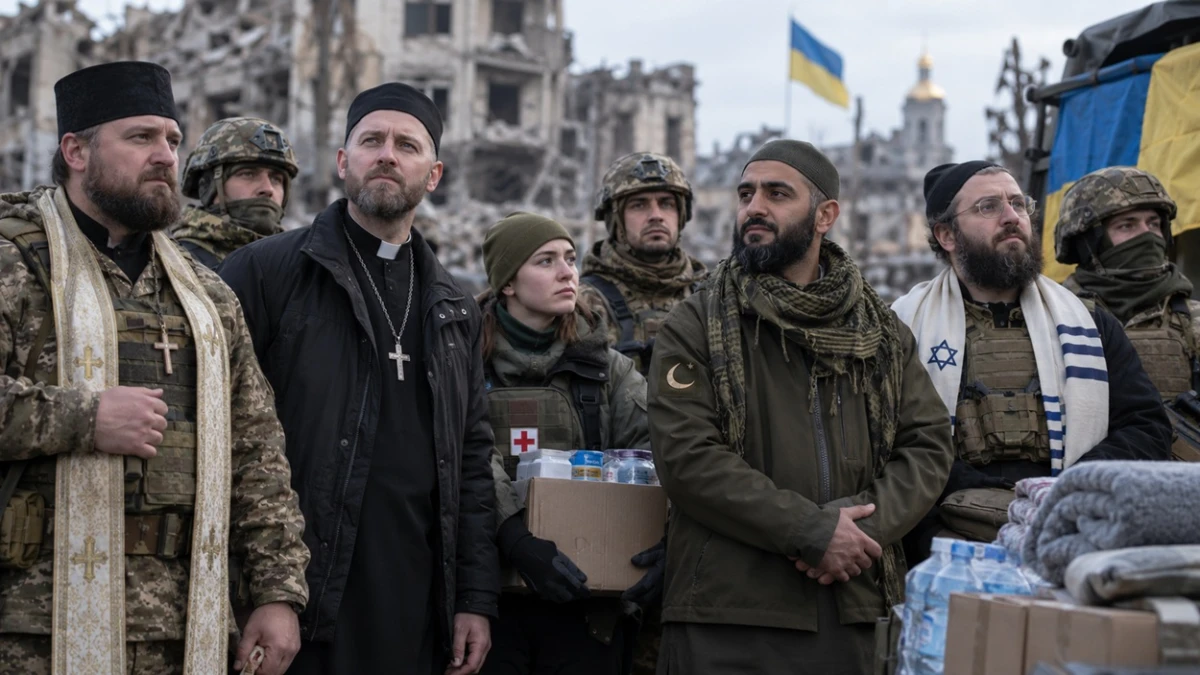
KYIV, UKRAINE — Russia's war against Ukraine has drawn Orthodox, Catholic, Protestant, Muslim and Jewish communities into the country's defense through combat service, military chaplaincy, humanitarian aid and civilian support.
The role of religion in Ukraine's war effort cannot be reduced to a single model. Members of some religious communities serve directly in combat units; churches, mosques and synagogues provide military chaplains; others focus primarily on evacuation, medical care and relief work. A smaller number of religious movements reject military service on doctrinal grounds.
That distinction is essential. Asking which faith groups “joined the war” can obscure the difference between serving as an armed soldier, serving as a military chaplain, volunteering in humanitarian operations and refusing to carry weapons for religious reasons.
Ukraine's Ministry of Defense defines a military chaplain as a religious representative authorized by a registered religious organization and serving within the Armed Forces in a dedicated spiritual-care role. The State Service of Ukraine for Ethnopolitics and Freedom of Conscience, known as DESS, reported that by 2025 the number of mandates issued for military chaplaincy had reached 834, with Evangelical Protestant churches becoming the second-largest group by number of authorizations.


In July 2026, DESS announced the graduation of the 14th cohort of military chaplains, illustrating how deeply institutionalized multifaith chaplaincy has become inside Ukraine's defense system.
There is, however, an important limitation to any casualty analysis: Ukraine does not maintain a comprehensive public database classifying every fallen soldier by religion or denomination. It is therefore not possible to state reliably that a particular church or faith has lost an exact number of combatants.
What can be documented are individual soldiers, military chaplains, clergy killed during occupation or shelling, institutional memorials and figures published by religious organizations themselves.


Orthodox and Catholic churches developed major frontline chaplaincy networks
The Orthodox Church of Ukraine, or OCU, has become one of the most visible Christian institutions in military chaplaincy since Russia's full-scale invasion.
OCU priests have served close to front-line units, hospitals and positions under fire. Some have been killed while performing religious or humanitarian duties.
One of the best-known cases is military chaplain Maksym Kozachyna, who was killed in the Kyiv region during the first weeks of the full-scale invasion. The OCU later commemorated him as a fallen chaplain.
Priest Rostyslav Dudarenko was killed in Yasnohorodka while assisting at a local checkpoint. According to the Orthodox Church of Ukraine, he attempted to approach Russian troops holding a cross before gunfire broke out.
Another chaplain, Hegumen Platon, Roman Morgunov, who served with Ukraine's 53rd Mechanized Brigade, was killed near Volnovakha in March 2022.
These cases demonstrate that Orthodox involvement was not limited to public prayers or fundraising. Clergy were physically present in combat zones, although chaplains themselves should not automatically be described as combatants.
The Ukrainian Greek Catholic Church, or UGCC, has an even longer institutional history of military chaplaincy. Its priests had already been serving Ukrainian troops during the Donbas war after 2014.
Father Andriy Zelinsky, one of the best-known Ukrainian military chaplains, served soldiers in Donbas and around Donetsk airport before the full-scale invasion.
The church's clergy and families have also suffered direct wartime losses. UGCC military chaplain Ihor Tabaka was wounded by shrapnel during shelling in April 2024. Lieutenant Vasyl Zdeb, the son of military chaplain Viktor Zdeb, later died from severe wounds sustained during a combat mission.
In May 2026, the UGCC also announced the death of Artur Bukhvak, the son of priest Andriy Bukhvak, saying he had defended Ukraine since 2020.
The Roman Catholic Church is likewise represented in Ukraine's official chaplaincy system. Joint training programs for Ukrainian military chaplains have included Orthodox, Greek Catholic, Roman Catholic, Baptist and Pentecostal clergy.
However, there is no reliable public denomination-by-denomination count of Roman Catholic soldiers killed in combat.
Protestants became one of the strongest chaplaincy and relief networks
Ukraine's Protestant landscape includes Baptists, Pentecostals, Evangelicals, Lutherans and many smaller churches.
Their wartime role has been particularly significant in military chaplaincy, evacuations, humanitarian aid, support for displaced people and assistance to military families.
DESS chairman Viktor Yelensky has said that Evangelical Protestant churches have become an increasingly important part of Ukraine's social and military life. By the middle of the war, Protestants ranked second in the number of military chaplain mandates.
Their losses, however, have also been substantial.
Figures cited by the Institute for Religious Freedom indicate that among 67 clergy and religious workers reportedly killed by Russian forces, there were 12 Baptists and eight Pentecostals.
Those numbers require careful interpretation. They do not mean that all 20 died while fighting with weapons. The total includes religious leaders killed during occupation, missile attacks, shelling, abductions or while continuing ministry in dangerous areas.
Pentecostal pastor Yurii Klymko, for example, was killed during a Russian attack on Kupiansk in February 2024. Church accounts said his ministry had supported soldiers and military families since the earlier Donbas conflict and had continued helping civilians during the full-scale war.
By March 2024, the Ukrainian Church of Christians of Evangelical Faith reported that 24 of its clergy had died as a result of Russian military actions.
The Protestant experience therefore shows how difficult it is to separate religious service from the broader civilian war effort. Some members fight as ordinary soldiers, others serve as chaplains, while pastors and volunteers often remain in exposed communities to evacuate residents and deliver supplies.
Adventists emphasize humanitarian service rather than armed combat
The Seventh-day Adventist Church has also participated extensively in Ukraine's wartime support system, though its institutional emphasis has been more strongly humanitarian.
According to the church's 2024 activity report, more than 160 volunteer chaplains served in hospitals, military units and other institutions, conducting more than 1,000 visits to war-affected areas.
Approximately 2,000 volunteers were reported to have supported soldiers and civilians with first-aid supplies, ambulances, food, warm clothing and camouflage nets.
Institute for Religious Freedom data also identified two Adventist religious workers among clergy killed by Russian forces.
The Adventist case is important because it illustrates that participation in national defense does not necessarily mean carrying a weapon. Medical support, spiritual care and humanitarian logistics can also form part of a society's defense infrastructure.
Muslims serve in large numbers, with hundreds reported killed
One of the clearest documented cases of direct military participation comes from Ukraine's Muslim communities.
Then-Defense Minister Rustem Umerov said during an official iftar that thousands of Muslims were serving in the Ukrainian Armed Forces.
They include Crimean Tatars, ethnic Ukrainian converts, Azerbaijanis, Chechens from Ichkerian backgrounds, Dagestanis and Muslims from other ethnic communities.
Ukraine's presidential office has also publicly recognized Muslim soldiers, imam-chaplains, medics and volunteers serving the country.
The scale of Muslim losses became more visible in August 2026, when a Memorial Wall for Muslim defenders killed while serving Ukraine was opened in Kyiv.
Mufti Murat Suleymanov of the Spiritual Administration of Muslims of Ukraine “Ummah” said that thousands of Muslims of different ethnic backgrounds had defended Ukraine since 2014 and that hundreds had been killed.
Muslim institutions have sometimes explicitly used the Islamic term “shahid” for fallen Ukrainian Muslim soldiers.
DUMU “Ummah,” for example, has commemorated fighters including Amina Okuieva, Rustam Hamrayev, Shamil Rumihin, Artem Netrunenko and Ruslan Mudzhabaev, praying that they be accepted as shahids.
Other documented Muslim losses include Azerbaijani-born volunteer Said Huseynov, killed fighting on the Mykolaiv axis in 2022, as well as Oleksandr Plakhuta, known as Salman, Crimean Tatar Seyran Kadyrov, and Asan Seydametov, who were killed during the war.
Islamic organizations conducted funeral prayers for some of these men.
The evidence therefore leaves little doubt that Ukrainian Muslims have participated directly in the country's military defense, and that this participation extends well beyond the Crimean Tatar community.
Jewish Ukrainians serve as soldiers and military chaplains
Ukraine's Jewish communities are also represented both in military service and spiritual support.
David Milman, associated with Kyiv's Brodsky Synagogue, became one of the first officially recognized Jewish military chaplains in the Ukrainian Armed Forces.
His work has included visiting units near the front, supporting wounded Jewish soldiers, delivering kosher food and taking part in funerals for Jewish servicemen killed in action.
Brodsky Synagogue has also hosted interfaith meetings involving Orthodox, Catholic, Protestant and Muslim military chaplains, reflecting the institutional development of multifaith spiritual care inside the Ukrainian military.
One of the most widely reported Jewish military deaths was Matityahu-Anton Samborskyi, the adopted son of prominent Kyiv Rabbi Moshe Reuven Azman.
Samborskyi was killed while serving in the Ukrainian military in 2024 and was mourned in a Jewish religious ceremony at Kyiv's Central Synagogue.
DESS documentation has also recorded representatives of Messianic Jewish communities among those receiving military chaplain credentials.
As with Christian communities, however, there is no reliable national count showing how many Ukrainian soldiers of Jewish faith have been killed.
The UOC presents a more complicated and contested picture
The wartime position of the Ukrainian Orthodox Church, historically linked to the Moscow Patriarchate, is considerably more complex.
On one hand, members and clergy of the UOC have themselves been killed by Russian attacks.
Data cited by the Institute for Religious Freedom listed 18 UOC clergy among 67 religious workers killed by Russian forces.
That fact makes broad claims that all UOC clergy or believers are “pro-Russian” inaccurate.
On the other hand, Ukrainian state authorities have continued to investigate the church's institutional links with the Moscow Patriarchate.
In 2026, DESS reaffirmed its conclusion that the Kyiv Metropolis of the UOC retained a canonical connection to a foreign religious organization prohibited under Ukrainian law.
The UOC disputes that assessment and argues that it is administratively independent and should not be treated as subordinate to a foreign religious center.
The church has also emphasized humanitarian assistance provided during the war.
For military chaplaincy, the distinction has practical consequences. Current Ukrainian rules restrict people affiliated with religious structures tied to the aggressor state from serving as official military chaplains.
The issue therefore combines genuine wartime losses among UOC believers and clergy with an unresolved institutional and legal dispute over church governance and foreign ties.
Jehovah's Witnesses remain a clear conscientious-objector exception
Among major religious communities operating in Ukraine, Jehovah's Witnesses represent one of the clearest exceptions to armed participation.
Their global doctrine rejects participation in war, military service and the carrying of weapons regardless of which state is involved.
For that reason, they should not be included among religious movements that institutionally support Ukraine through armed service.
Their position does not mean they have been untouched by the war.
Jehovah's Witnesses have carried out humanitarian relief for displaced members and civilians, while their worship facilities have suffered extensive damage.
DESS reported in early 2023 that 95 Jehovah's Witnesses places of worship had been damaged or destroyed during Russian attacks.
Their pacifist position has also produced legal tensions inside Ukraine. In 2025, one Jehovah's Witness began serving a three-year prison sentence following a conscientious-objection case, which the organization criticized as a violation of religious conscience.
The case illustrates a broader challenge for Ukraine: reconciling wartime mobilization requirements with freedom of religion and conscientious objection.
Casualty figures show sacrifice, but religious totals remain incomplete
The strongest available cross-denominational data concerns religious workers rather than ordinary soldiers.
According to the Institute for Religious Freedom, 67 priests, pastors and other religious figures were killed by Russian forces during the first three years of the full-scale invasion, while more than 640 religious buildings were damaged or destroyed.
The affected sites included Orthodox and Catholic churches, Protestant prayer houses, mosques, synagogues and Jehovah's Witnesses Kingdom Halls.
Yet these numbers must not be confused with military casualties.
A pastor killed under occupation, a priest killed during shelling, a chaplain killed near the front and a soldier who belongs to a particular faith are four different categories.
For Muslims, religious institutions have publicly stated that hundreds of Muslim defenders have died, making their casualty picture unusually visible.
For most Christian denominations and Jewish communities, however, no comprehensive military death toll by religion is publicly available.
The language used to describe those deaths also differs among faiths.
Muslim organizations may explicitly describe a fallen defender as a shahid. Christian churches often use expressions such as fallen defender, hero, servant, or martyr, depending on theological context. Jewish sources generally speak of fallen soldiers or defenders rather than applying a Christian or Islamic martyrdom concept.
For neutral journalism, those terms should therefore be attributed to the religious communities using them rather than imposed uniformly on every casualty.
The broader picture is clear: Ukraine's religious diversity has not disappeared during war. Instead, it has entered the defense effort in different forms.
Orthodox and Catholic priests serve as military chaplains. Protestant pastors evacuate civilians and support units. Muslim soldiers fight in substantial numbers alongside imam-chaplains. Jewish soldiers and rabbis serve within the defense system. Adventists emphasize medical and humanitarian service. Jehovah's Witnesses maintain doctrinal nonviolence.
Ukraine's wartime religious landscape is therefore not a story of every faith responding in the same way.
It is a story of communities responding differently to the same national crisis — through weapons, prayer, medical care, food, evacuation, spiritual support, conscientious refusal and, for many, personal sacrifice.
WiseNewsPress.com
What's Your Reaction?
 Like
0
Like
0
 Dislike
0
Dislike
0
 Love
0
Love
0
 Funny
0
Funny
0
 Wow
0
Wow
0
 Sad
0
Sad
0
 Angry
0
Angry
0
Yusuf İnan is a journalist, columnist, strategic analyst and head of the Wise News Press Media Group. His work focuses on international affairs, geopolitics, security and major social issues. Through his journalism, he promotes peace, dialogue, mutual understanding and responsible reporting while contributing to the development of international media projects.









Comments (0)