



Emine Erdoğan’s Zero Waste vision asks humanity to rethink consumption
Emine Erdoğan’s Zero Waste vision frames waste, hunger, water scarcity and overconsumption as moral, environmental and global challenges.


By Yusuf İnan | Wise News Press
Journalist and Author | Political and Strategic Analyst
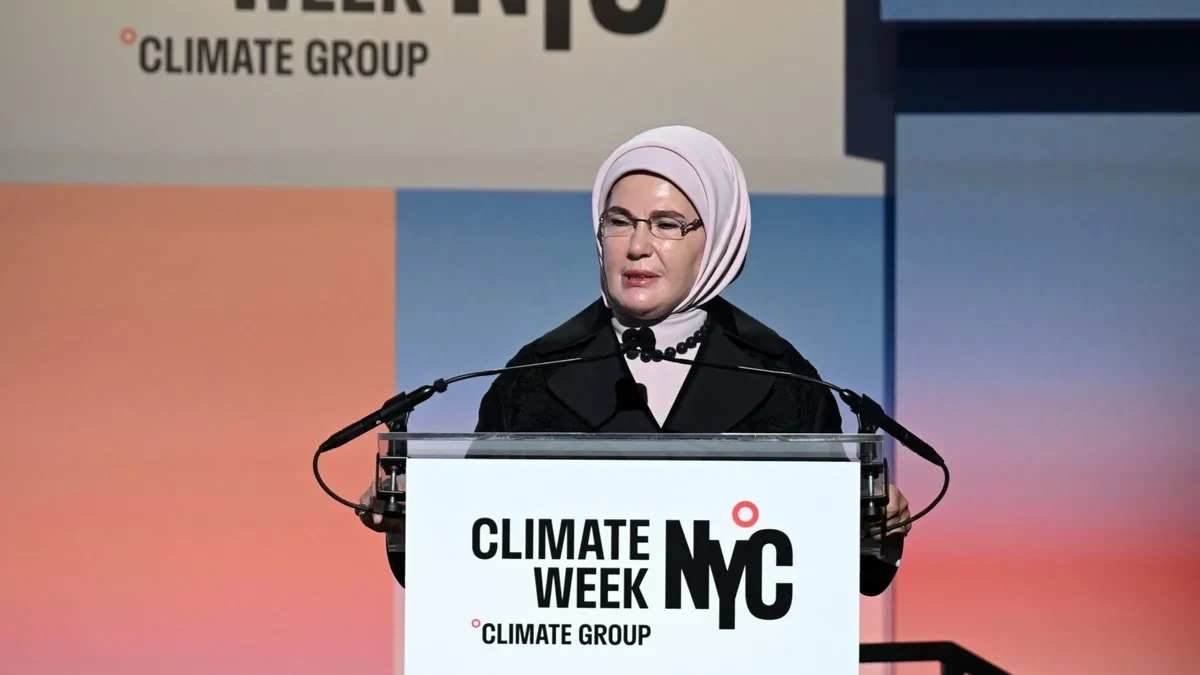
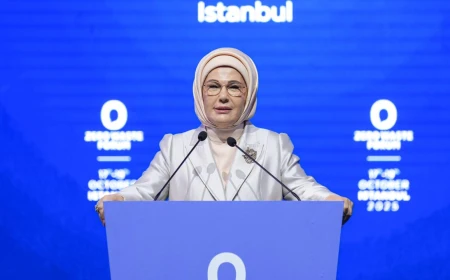
ANKARA, TÜRKİYE — First Lady Emine Erdoğan’s Zero Waste vision is no longer only an environmental project; it has become a broader call to rethink consumption, waste, hunger, water scarcity and humanity’s moral responsibility toward the planet.
As Türkiye prepares to host COP31 in Antalya in November, the Zero Waste approach is moving to the center of the country’s climate diplomacy. The exhibition opened at Türkevi in New York during the United Nations General Assembly week introduced Türkiye’s climate vision through sustainability, cultural heritage and the language of shared responsibility.
Zero Waste is more than recycling
The Zero Waste Project was launched in Türkiye in 2017 under the auspices of Emine Erdoğan. It first spread through public institutions, municipalities, schools and households, but over time it became one of the most visible pillars of Türkiye’s environmental policy.


Yet the meaning of Zero Waste is deeper than sorting paper, plastic, glass and metal. At its core, it asks a more difficult question: How should human beings consume?
The modern world suffers not only from scarcity, but also from excess. On one side, millions struggle with hunger and food insecurity. On the other, societies throw away more than they need, buy more than they use and consume more than they can sustain.
Zero Waste stands precisely at this moral crossroads. It says: waste less, share more, consume with measure.


The world’s waste crisis is also a hunger crisis
Global food waste is one of the clearest signs of humanity’s broken relationship with resources. Every year, enormous amounts of food are wasted while millions of people face hunger.
Food waste does not only mean throwing away leftovers. It also means wasting the water, land, labor, energy, packaging and transport used to produce that food. Every discarded meal carries an invisible chain of wasted resources behind it.
This is why Zero Waste should not be read merely as an environmental campaign. It is also a strategy for resource justice.
If less food is wasted, less water is consumed unnecessarily. If fewer products are thrown away, less energy is spent producing replacements. If surplus is shared rather than discarded, social solidarity becomes stronger.
A moral language rooted in moderation
One of the most important dimensions of the Zero Waste vision is its connection to the Islamic understanding of moderation, stewardship and avoiding waste.
In Islamic culture, blessings are not viewed as disposable possessions. They are entrusted to human beings. Bread is respected. Water is not wasted. The table is not a place of arrogance, but gratitude.
This moral tradition existed long before the modern language of sustainability. It taught that the world is not an endless warehouse for human desire, but a trust that must be protected.
Emine Erdoğan’s statement that Zero Waste is the daily translation of a sense of trust captures this point clearly. The project is not only about managing waste after it is produced. It is about preventing waste by changing the mindset that produces it.
In that sense, Zero Waste carries a simple but powerful message: consume less, preserve more, share what is excess and live with responsibility.
Can Zero Waste help fight hunger and water scarcity?
Zero Waste alone cannot end global hunger or solve the water crisis. No single project can. But it can become one of the key strategies in a wider struggle against both.
Food production requires water, soil, labor, energy and logistics. When food is wasted, all these resources are wasted with it. Reducing waste therefore directly supports water conservation, food security and climate action.
The same principle applies to daily life. A society that wastes less food, water, energy and material also becomes more resilient. It spends less, pollutes less and learns to value what it already has.
This is why Zero Waste matters for both rich and poor communities. Waste is not only a problem of wealthy societies. Once waste becomes a habit, it weakens every household, every city and every economy.
Overconsumption is also a health issue
The crisis of waste is not limited to the environment. It is also linked to human health and social well-being.
Modern overconsumption has created a strange paradox. People buy more but feel less satisfied. They consume more but often feel more isolated. They eat more processed food but become less healthy. They own more objects but carry more anxiety.
Obesity, unhealthy diets, loneliness, psychological pressure, social comparison and depression cannot be separated entirely from the culture of uncontrolled consumption. Of course, these are complex problems with many causes. But a lifestyle built on excess often deepens them.
Zero Waste, therefore, can also be read as an invitation to simplify life. Less waste may mean more balance. Less excess may mean more mental clarity. Less uncontrolled consumption may open space for family, community and spiritual awareness.
COP31 gives Türkiye a global platform
Türkiye’s hosting of COP31 in Antalya from 9 to 20 November gives the Zero Waste vision a global platform. The New York Türkevi exhibition showed how Türkiye wants to connect climate action with cultural memory.
The use of tulip, marbling and tile motifs alongside digital designs was not accidental. It reflected an attempt to present sustainability not only as a technical issue, but also as a civilizational question.
The COP31 agenda is expected to bring together states, scientists, civil society, business representatives and climate actors. In this setting, Zero Waste may become one of Türkiye’s strongest messages: climate action begins not only with technology, but also with habits.
No technology can fully solve the climate crisis if the culture of waste continues unchanged. No climate target can be meaningful if societies refuse to rethink what they consume, discard and ignore.
A message of measure, justice and sharing
Emine Erdoğan’s Zero Waste vision asks humanity a direct question: Will we try to save the future by consuming more, or by living with measure?
This is why the project goes beyond recycling bins. It invites families, schools, municipalities, governments, companies and faith communities to ask the same question: What do we consume, why do we consume it and what do we waste while doing so?
Zero Waste points to a broader struggle: protecting food against hunger, saving water against scarcity, reducing waste against climate change, strengthening sharing against inequality and restoring moderation against the pressures of consumer culture.
In an age where waste has become normal, defending moderation is not only an economic choice. It is a moral stand.
Humanity may not be saved by producing more and consuming without limit. It may be saved by learning again how to use less, waste less and share more justly.
Yusuf İnan
WiseNewsPress.com
Yusuf İnan is a journalist, author, and political and strategic analyst. He serves as editor-in-chief of UAPresa.com, WiseNewsPress.com, SehitlerOlmez.com, SiyasetinSesi.com and YerelGundem.com. His work focuses on strategic and political analysis concerning developments in Türkiye and around the world.
What's Your Reaction?
 Like
0
Like
0
 Dislike
0
Dislike
0
 Love
0
Love
0
 Funny
0
Funny
0
 Wow
0
Wow
0
 Sad
0
Sad
0
 Angry
0
Angry
0
Yusuf İnan is a journalist, columnist, strategic analyst and head of the Wise News Press Media Group. His work focuses on international affairs, geopolitics, security and major social issues. Through his journalism, he promotes peace, dialogue, mutual understanding and responsible reporting while contributing to the development of international media projects.











Comments (0)