



Five fronts of new warfare: From energy security to algorithms
New-generation warfare is no longer limited to battlefields, as energy, technology, finance, trade routes and human capital become strategic fronts.


By Ahmet Taş | Wise News Press
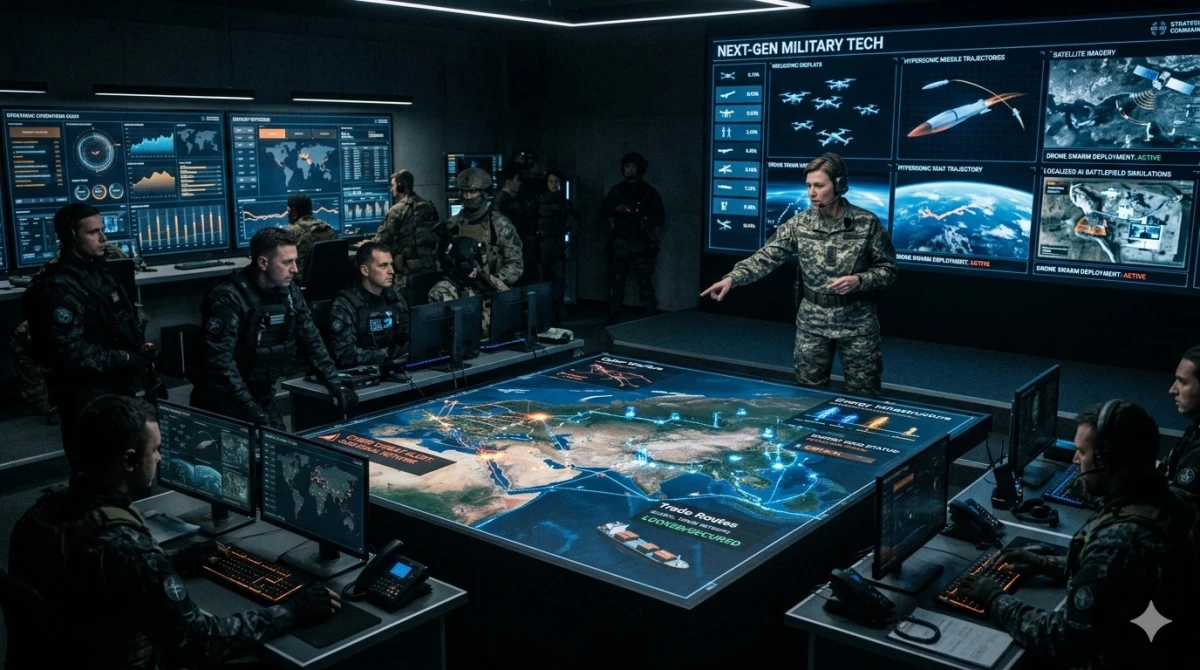
ANKARA, TURKEY — New-generation warfare is no longer confined to trenches, tanks and missiles, but is increasingly fought through energy, algorithms, finance, trade routes and human capital.
According to an analysis by Mehmet Öğütçü, conflicts from Ukraine to Gaza, tensions around Iran and Israel, attacks in the Red Sea, military pressure around Taiwan and competition for critical minerals in Africa should not be viewed as isolated crises. Instead, they increasingly appear as different fronts of the same global power struggle. The shift forces countries such as Turkey, located at the crossroads of multiple geopolitical fault lines, to rethink what national security means in the 21st century.
The meaning of war is changing
Many people still imagine a world war as a dramatic announcement, a formal declaration or a sudden clash between great armies. Yet history often shows that major global ruptures are not fully understood while they are happening.
In 1914, many Europeans thought the crisis would end within months. In the early years of the Cold War, few could foresee that the confrontation would shape global politics for more than four decades. The same may be true of the 2020s.
Future generations may look back and say that a new global conflict did not begin on a single day. It emerged gradually, across multiple regions, through different tools and with different actors.


This is not a world war in the classical sense. There is no single front line and no single formal declaration. But there is a multilayered global competition over energy, technology, finance, trade, data, artificial intelligence, critical minerals and skilled people.
In the past, defeating a country often meant defeating its army. Today, cutting its energy supply, freezing its financial access, restricting its technology imports, disrupting its ports or attracting away its best engineers can produce equally strategic consequences.
Energy is no longer only about oil
The first front of new-generation warfare is energy. In the 20th century, major wars were often shaped by oil. In the 21st century, energy security includes far more than oil and gas.


Electricity grids, LNG terminals, nuclear technology, battery production, hydrogen systems, rare earths, lithium, cobalt, nickel and energy storage now form part of the same strategic battlefield.
The global race for critical minerals across Africa, Latin America and Asia reflects this shift. Future electric vehicles, fighter jets, data centers and artificial intelligence systems cannot be built without these minerals.
Russia’s war against Ukraine gave Europe a costly lesson in energy dependency. Relations once justified by economic logic turned into strategic vulnerability when geopolitical conflict escalated.
For Turkey, the issue is even more sensitive. It remains an energy-importing economy, but it is also a strategic corridor between Asia and Europe. That means Turkey cannot think only as an energy consumer. It must aim to become an energy manager, transit hub and market-shaping actor.
Black Sea gas, nuclear energy, renewables and geothermal capacity matter. But beyond production, Turkey’s long-term goal of becoming an energy trading center may become one of the pillars of its geopolitical independence.
The technology front is fought in laboratories
The second front is technology. For the first time, some of the most decisive contests are being fought not on battlefields, but in laboratories, chip factories, data centers and software systems.
The U.S.-China rivalry is increasingly centered not on aircraft carriers alone, but on semiconductors, artificial intelligence and advanced computing. Restrictions on high-end chips, the strategic importance of companies such as NVIDIA and the race for AI infrastructure all show that technology has become a core national security issue.
Artificial intelligence is not just another software innovation. It may become a transformation comparable to electricity or the internet. Societies that missed earlier industrial revolutions paid a long-term price. Those that miss the AI revolution may face a similar strategic decline.
The battlefield already reflects this change. Drones are now central to modern war. But the next stage will be defined by the software that guides them, autonomous systems, AI-assisted decision-making and integrated defense architectures.
For Turkey, producing drones is important, but not enough. The real strategic question is whether Turkey can develop the software, sensors, data systems and AI capabilities that make such platforms effective.
A young population gives Turkey an advantage. But youth alone does not create technological power. It must be supported by education, research ecosystems, venture capital, freedom of innovation and long-term institutional planning.
Finance has become a geopolitical weapon
The third front is finance. In earlier eras, cities were besieged. Today, economies can be besieged.
Countries can be pressured without tanks crossing their borders. Sanctions can block payment systems. Reserves can be frozen. Insurance costs can rise. Capital flows can be redirected. Access to global markets can be restricted.
The sanctions imposed on Russia are among the clearest examples of financial warfare. Iran has lived for years with the cost of financial isolation. China, meanwhile, has been trying to build alternative payment systems and trade mechanisms based on national currencies.
Finance is no longer merely a technical area for central bankers and economy ministries. It is one of the most powerful tools of geopolitics.
For Turkey, this front raises two major questions. First, financial independence cannot be built without a strong production economy. Second, long-term investment becomes increasingly difficult without rule of law, predictability and institutional credibility.
Global capital no longer seeks only high returns. It also seeks trust, stability, transparency and legal security. That means financial resilience is not only the responsibility of the central bank. It is the responsibility of the entire institutional system.
Trade corridors are drawing new power maps
The fourth front is trade corridors. The modern version of the Silk Road is no longer only about caravans, railways or ports. It is about geoeconomic power.
China’s Belt and Road Initiative, the Middle Corridor, the India-Middle East-Europe Corridor, the Northern Sea Route and Eastern Mediterranean energy links are not simply transportation projects. They are strategic maps for influence, investment and political leverage.
Whoever controls corridors can influence trade. Whoever influences trade can direct investment. Whoever directs investment can expand political reach.
Recent disruptions in the Red Sea have shown how quickly attacks on shipping routes can affect freight prices and supply chains. Tensions around the Strait of Hormuz remind the world that a few days of disruption in a key chokepoint can affect economies from Tokyo to Berlin and from Shanghai to Istanbul.
Taiwan is another example. It is not only an island. It is one of the centers of advanced semiconductor production. A crisis there would not only be military; it would be economic and technological.
Turkey has a strong geographic advantage in this new map. It stands at the intersection of Europe, Asia and the Middle East. But geography alone is not destiny. To convert location into power, Turkey needs stronger ports, railways, digital infrastructure, logistics capacity and an investment climate that global companies can trust.
Human capital may be the most decisive front
The fifth and perhaps most important front is human capital. States are no longer competing only for land, oil, capital or technology. They are competing for skilled people.
The United States seeks top researchers. Canada uses selective immigration programs. Germany needs engineers. Gulf countries are offering major incentives to technology specialists. The message is clear: talent is now strategic infrastructure.
When a country’s brightest young people search for their future elsewhere, this is not merely a personal decision. It is a long-term national competitiveness issue.
Today’s oil fields are universities. Today’s refineries are research centers. Today’s strongest armies are made not only of soldiers, but of engineers, scientists, coders, data experts and innovators.
For Turkey, this may be the most critical issue of all. A young population is an asset only if it can be educated well, retained, trusted and given hope. Without merit, opportunity, legal confidence and intellectual freedom, human capital can become a national loss instead of a national advantage.
Turkey stands at the center of multiple fault lines
Few countries sit at the intersection of as many strategic fault lines as Turkey.
To the north, there is the Russia-Ukraine war in the Black Sea. To the south, Syria and Iraq remain fragile. Iran-Israel tensions affect the wider region. The Eastern Mediterranean remains a field of energy competition. The Aegean still carries unresolved disputes. The Caucasus is unstable. Central Asia is becoming increasingly important in new corridor politics.
On top of these, global trade wars, energy transition, AI competition and financial fragility are reshaping the world economy.
For Turkey, this means pressure on several fronts at the same time. It also means opportunity, if the country can adapt to the new definition of security.
National security can no longer be reduced to border security. Energy security, financial resilience, technology production, data sovereignty and the ability to keep skilled people in the country are all part of national security.
New-generation warfare represents a shift from bayonets to algorithms. Countries that want to survive and compete in this era will need more than military strength. They will need technology, data, institutions, legal confidence, financial depth, resilient infrastructure and people who believe their future can be built at home.
What's Your Reaction?
 Like
0
Like
0
 Dislike
0
Dislike
0
 Love
0
Love
0
 Funny
0
Funny
0
 Wow
0
Wow
0
 Sad
0
Sad
0
 Angry
0
Angry
0

Editor | Wise News Press — Delivering accurate, timely global news with integrity, insight, and editorial responsibility.
















Comments (0)