



Poland’s Constitutional Tribunal crisis: Nawrocki turns plane around
Poland’s Constitutional Tribunal crisis deepened after a disputed suspension order, police deployment and President Karol Nawrocki’s return to Warsaw.


By Ahmet Taş | Wise News Press
WARSAW, POLAND — Poland’s Constitutional Tribunal was thrown into a deep institutional crisis after a disputed suspension order targeted its president and deputy, triggering rival statements, police deployment and political accusations of a coup.
The Tribunal’s website and official social media account subsequently published conflicting accounts of who legally controlled the institution. Three people were detained near the court complex, while President Karol Nawrocki interrupted a flight to Senegal and returned to Poland.
Legal status of suspension order remains disputed
A notice published on the Constitutional Tribunal’s website said Tribunal President Bogdan Święczkowski and his deputy, Bartłomiej Sochański, had been suspended from their duties for one month.
According to the notice, the two officials were accused of preventing a General Assembly attended by all judges properly elected by the Polish parliament and of unlawfully determining the composition of judicial panels assigned to hear cases.
The decision cited Article 130 of Poland’s Law on the Structure of Common Courts. The provision allows the immediate suspension of a judge for a limited period when the dignity of the court or the interests of judicial service are considered to require such action.
The order was issued by Anna Korwin-Piotrowska, who presented herself as the Tribunal’s longest-serving judge and assumed administrative responsibilities at the institution.
Her authority, however, is itself at the center of the dispute. Korwin-Piotrowska was elected to the Tribunal by the current parliament but has not been sworn in by President Nawrocki. The rival sides therefore reject each other’s interpretation of who has the authority to lead the court and take disciplinary decisions.
For that reason, the suspension should not be presented as an uncontested or legally settled removal. It is a decision announced by one side of a broader institutional conflict and rejected as invalid by the Tribunal’s existing leadership.
Tribunal website and social media account contradict each other
Shortly after the suspension notice appeared, the Constitutional Tribunal’s official account on X claimed that the institution’s website had been unlawfully taken over.
The account maintained that Święczkowski and Sochański remained in office and argued that Korwin-Piotrowska had no authority to act on behalf of the Tribunal. It described the events as an attempted “coup.”
The same description was later used by senior members of the opposition Law and Justice party, known by its Polish abbreviation PiS. Party officials accused Prime Minister Donald Tusk’s government of attempting to seize control of an independent constitutional body.
No publicly available information, however, indicates military intervention, an armed seizure of state institutions or an attempt to overthrow Poland’s elected government.
The word “coup” should therefore be attributed to the Tribunal’s existing leadership and PiS politicians. It is a political and legal allegation, not an independently established description of the events.
Police deployed as three people were detained
PiS leader Jarosław Kaczyński, senior party figures and a group of supporters gathered outside the Constitutional Tribunal after news of the disputed suspension emerged.
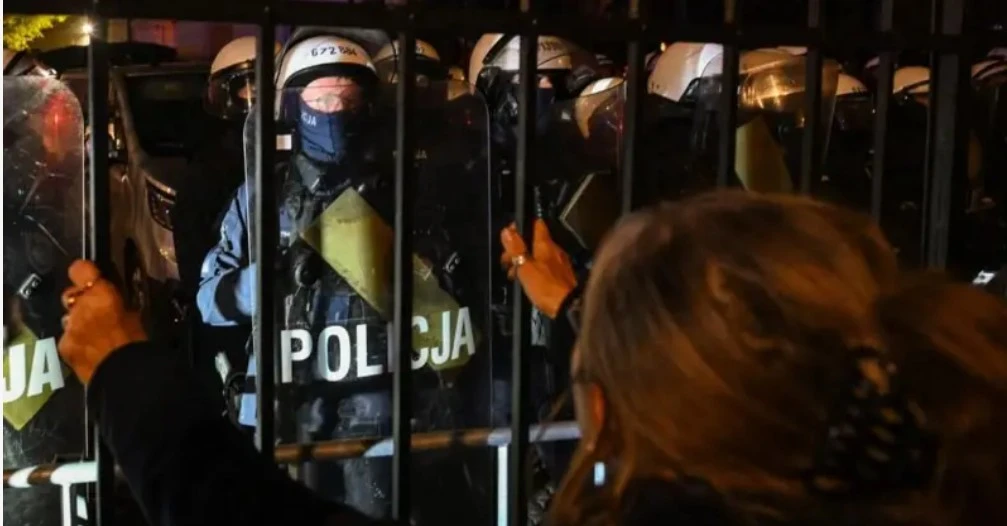
Warsaw police deployed officers to the Tribunal grounds and surrounding area. Police representatives said the operation was intended to protect employees, maintain public order and prevent unauthorized access to the complex.
Three people were detained after attempting to enter the court grounds. Reports also indicated that objects had been thrown during the confrontation.
Although some media reports described the security operation as a “police blockade,” Warsaw police said officers were carrying out their statutory duties on the Tribunal grounds and had not entered the main court building.
The deployment reportedly followed a request from Korwin-Piotrowska, who cited threats against judges and employees as well as a risk of public disorder.
Nawrocki interrupted his flight to Senegal
President Karol Nawrocki was on his way to Senegal for an official visit when he was informed of the developments at the Constitutional Tribunal.
His aircraft was reportedly flying through Spanish airspace when the decision was made to reverse course and return to Poland.
“At such a moment, the president must be in Poland. I am interrupting my flight to Senegal. I am returning.”
The Polish presidency confirmed that Nawrocki had cut short his journey because of the situation in Warsaw.
The president’s return added another layer to the institutional confrontation. Nawrocki has refused to administer the oath to judges elected to the Tribunal by the current parliament, including figures whose status now affects the dispute over the court’s leadership.
His position means that the conflict extends beyond the Tribunal itself and involves the presidency, parliament, government and competing groups within the judiciary.
Prosecutors submit five immunity requests
Justice Minister and Prosecutor General Waldemar Żurek announced that prosecutors had submitted five requests to lift the judicial immunity of Święczkowski and Sochański.
Four of the requests concern Święczkowski, while one concerns Sochański. The formal applications reportedly consisted of 224 pages and were accompanied by approximately 50 volumes of investigative files.
The documents were delivered to Korwin-Piotrowska rather than Święczkowski, reflecting the government side’s position that the latter should not continue exercising the powers of Tribunal president.
It remains unclear who will legally review the immunity requests or how a valid panel can be formed while the two sides reject each other’s authority.
Tusk and PiS offer opposing interpretations
Prime Minister Donald Tusk presented the developments as part of his government’s effort to restore the rule of law after what he described as years of unlawful conduct under previous PiS governments.
Tusk said restoring the rule of law was the government’s duty and argued that the process would inevitably be difficult and occasionally painful. He maintained that decisive action was necessary.
PiS leaders offered the opposite interpretation. They accused the government of interfering with judicial independence and attempting to remove officials who did not accept the administration’s authority over the Tribunal.
The rival statements demonstrate that the dispute is not limited to the positions of two court officials. It concerns the legal status of judges, the authority to manage the Tribunal and the balance of power between Poland’s constitutional institutions.
Crisis rooted in a long-running judicial conflict
Poland’s constitutional crisis developed over several years, particularly following judicial appointments and reforms introduced during PiS rule.
Those measures were repeatedly challenged by opposition parties, legal organizations and European institutions over concerns about judicial independence. PiS argued that its reforms were necessary to make the judiciary more accountable and remove structures inherited from earlier political periods.
After taking office, Tusk’s coalition pledged to reverse changes it considered incompatible with the Polish Constitution and European rule-of-law standards. The government’s opponents contend that these efforts amount to the political replacement of one group of judges with another.
The conflict has also produced rival claims regarding which judges were validly appointed and whether the president may refuse to administer their oath. Those unresolved questions now determine who can legally lead the Constitutional Tribunal and convene its General Assembly.
The publication of contradictory statements through the Tribunal’s website and social media account illustrates the depth of the institutional breakdown. Each side claims to speak for the court while denying the legal standing of the other.
At this stage, the developments are best described as a serious constitutional and political crisis rather than a verified coup attempt. The status of the suspension order, the leadership of the Tribunal and the immunity proceedings are all likely to face further political and legal challenges.
WiseNewsPress.com
What's Your Reaction?
 Like
0
 Dislike
0
 Love
0
 Funny
0
 Wow
0
 Sad
0
 Angry
0

Ahmet Taş is a journalist, editor and Turkey Office Manager of the Wise News Press Media Group. He works across news, digital media and international publishing, focusing on accurate, responsible and accessible journalism. He contributes to the development of media projects that bring important political, social and global developments to a wider international audience.










Comments (0)