



Ukraine says Operation Vivaldi retook 277 km² using battlefield robots
Ukraine says Operation Vivaldi retook 16 settlements and 277 km² near Lyman using ground robots, drones, electronic warfare and artillery.


By Yusuf İnan | Wise News Press
KYIV, UKRAINE — Ukraine’s military says it retook 16 settlements and 277 square kilometres near Lyman during Operation Vivaldi, combining ground robots, aerial drones, electronic warfare, artillery and infantry assaults.
The four-phase operation drew attention for integrating unmanned ground vehicles with reconnaissance and attack drones under a unified command structure. It also included missions in which heavy aerial drones reportedly carried small ground robots behind Russian lines.
The territorial gains and casualty figures were announced by Ukrainian authorities and could not be independently verified in full. Publicly available evidence also does not support several dramatic claims circulating about the operation, including that Russia lost 176 square kilometres “within seconds” or that the entire campaign was completed without Ukrainian casualties.
What was Operation Vivaldi designed to achieve?
Operation Vivaldi was conducted north of Lyman, between the city and Ukraine’s main defensive positions around Sloviansk and Kramatorsk in the Donetsk region.


According to the Ukrainian military, Russian forces intended to move around the Sloviansk-Kramatorsk defensive belt from the north and threaten the Kharkiv-Sloviansk highway, a key logistical route supporting Ukrainian forces in the Donbas.
Brigadier General Andrii Biletskyi, commander of Ukraine’s Third Army Corps, said the operation stopped the advance of Russia’s Western Grouping of Forces and forced Moscow to redeploy elements of its First Guards Tank Army.
Biletskyi said the redeployment also reduced Russian pressure around Kupiansk-Vuzlovyi. Ukrainian forces claimed they protected the main supply route and prevented Russian units from developing a broader encirclement operation against Sloviansk and Kramatorsk.


Reuters reported that the operation was publicly announced on 15 September. Ukrainian commanders initially said that 75 square kilometres had been cleared of Russian infiltration groups and a further 10 square kilometres had been recaptured.
Reuters said it could not independently confirm the battlefield claims. Territorial control has become increasingly difficult to determine because extensive drone surveillance and long-range strikes have created broad and constantly changing contested zones.
Four ‘seasons’ and the reported results
The operation was named after Antonio Vivaldi’s “The Four Seasons” and organised into four successive phases, which Ukrainian commanders described as “seasons.”
Following the first three phases, the Ukrainian Presidency said on 30 September that 176 square kilometres had been returned to Ukrainian control. It also claimed that Russian forces had suffered more than 5,000 personnel losses, including soldiers killed or wounded, while 250 Russian troops had been captured.
Ukraine’s Third Army Corps announced the completion of the fourth phase on 14 October. The corps said Ukrainian units had retaken another 101 square kilometres, increasing the reported total to 277 square kilometres and 16 settlements.
The military identified Zelena Dolyna, Lypove and Kolodiazi among the settlements retaken during the fourth phase. Earlier operations were reported around Serednie, Shandryholove, Derylove, Ridkodub, Katerynivka, Novoselivka and Yarova.
The Third Army Corps estimated total Russian personnel losses across the four phases at approximately 8,000. It did not provide a complete breakdown separating those killed, wounded or captured.
Russia has not released a comprehensive and independently verifiable account of the operation. The territorial and casualty figures therefore remain claims made by the Ukrainian side.
Ground robots first exposed positions, then attacked
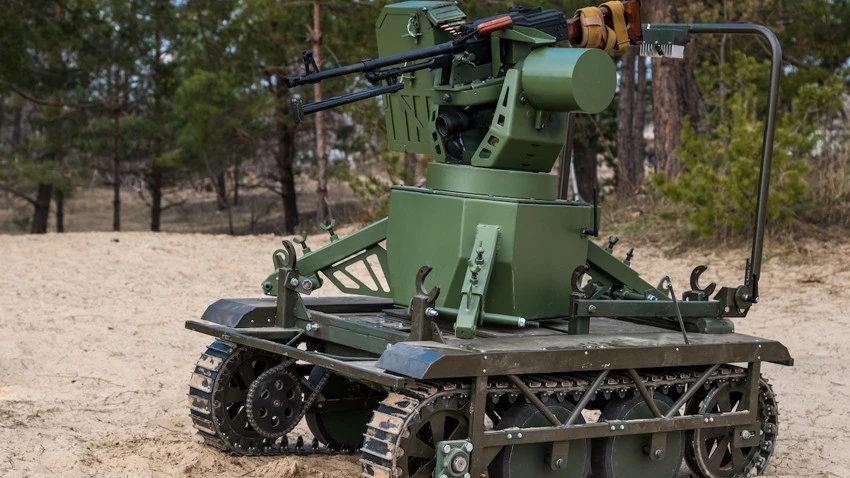
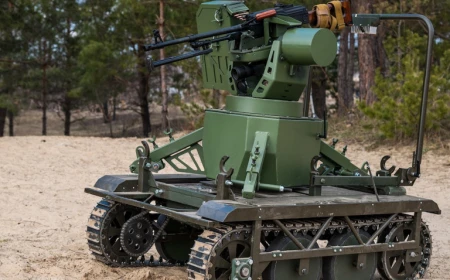
Unmanned ground vehicles were reportedly assigned multiple roles rather than being treated as a single-purpose weapon. Ukrainian units said the machines conducted reconnaissance, transported ammunition, evacuated wounded personnel, laid and cleared mines, delivered explosives and provided direct fire support.
During some assaults, ground robots were sent forward as decoys to draw fire from Russian observation posts and anti-tank teams. Once Russian positions opened fire, reconnaissance and FPV drones identified their locations and transmitted the coordinates to artillery or kamikaze-drone crews.
Ukrainian infantry units could then advance through gaps created in the defensive network with less direct exposure to concealed Russian positions. The method was intended to transfer some of the most dangerous tasks from soldiers to relatively expendable machines.
Ukrainian troops also said they converted two Soviet-era BTR-60 armoured personnel carriers into remotely controlled explosive vehicles. The vehicles were reportedly driven toward Russian positions in a way that made them appear to be carrying reinforcements.
According to the Ukrainian account, the vehicles detonated near fortified positions, damaging defensive structures and a communications and command node. Reliable public information has not established the precise quantity of explosives carried by the vehicles.
‘Gryphon’ is a combined tactic, not an aerial drone
Some accounts have incorrectly described Gryphon as an unmanned aircraft capable of carrying a 45-kilogram payload. Ukrainian military reporting instead uses the name for a tactic developed by the NC13 ground-robot unit and for the small unmanned ground vehicles involved.
Under the concept, heavy bomber drones carry compact kamikaze ground robots over frontline obstacles and release them between 5 and 15 kilometres behind Russian positions. After landing, the wheeled robots continue toward their assigned targets under remote control.
The robots can be directed against military personnel, logistical routes, vehicles and supply points. Cameras mounted on the vehicles allow operators to monitor the route and select targets from a distance.
NC13 commander Mykola Zinkevych said the method was first tested in January 2026. He claimed the unit subsequently conducted more than 100 missions involving reconnaissance, strikes, mining operations and attacks on moving targets.
The unit described the aerial deployment of armed ground robots as a world first. Although military publications have highlighted the tactic as an important innovation, its status as the first operation of its kind in warfare has not been independently established.
The name Gryphon was reportedly chosen in memory of a Ukrainian serviceman who disappeared during a combat mission near Andriivka in the Donetsk region in 2023.
Drones were only one part of the operation
Presenting Vivaldi as a campaign won exclusively by kamikaze drones and robots overlooks its other components. Ukrainian reporting indicates that infantry, artillery, electronic warfare, reconnaissance and logistics units operated alongside unmanned systems.
FPV teams targeted Russian supply vehicles, drone positions and troops moving toward the front. Electronic warfare units attempted to disrupt Russian reconnaissance and attack drones, while Ukrainian surveillance systems tracked reinforcements and identified firing positions.
Artillery remained important for suppressing Russian counterattacks and holding recaptured ground. Drones helped locate targets, but heavier firepower was required against fortified positions and concentrations of troops.
Units involved included the Third Assault Brigade, the 60th, 66th and 125th mechanised brigades, special operations groups, border guards, anti-tank units and several unmanned-systems formations.
Ground vehicles were also used for mine warfare and logistics. Ukrainian commanders said robots could perform repetitive or highly dangerous tasks for longer periods without exposing engineering teams and supply personnel to direct fire.
The operational model was therefore based on coordination among different capabilities rather than on a single technological breakthrough.
Which claims remain unverified?
Several widely circulated descriptions of Vivaldi do not correspond with the official timeline. Russia did not lose 176 square kilometres “within seconds.” That figure represented cumulative Ukrainian gains reported after the first three phases. The total was later updated to 277 square kilometres following the fourth phase.
The figure of approximately 3,000 Russian personnel referred to losses claimed by the Third Army Corps during the fourth phase alone. The 250 captured soldiers were reported separately after the first three phases. The figures should not be presented as one confirmed casualty total covering the same period.
There is also no verified evidence that the entire operation was completed with zero Ukrainian casualties. Ukrainian sources have described individual robotic or armoured assaults as casualty-free, but such statements cannot be applied to the months-long campaign as a whole.
Publicly available reliable sources have not confirmed that the unmanned BTR-60 vehicles carried exactly 400 kilograms of explosives. They also do not establish that the same air-dropped robots were simultaneously equipped with AGS-17 automatic grenade launchers and 12.7 mm heavy machine guns.
Suggestions that Operation Vivaldi is part of an officially approved “salami-slicing” campaign intended to advance toward Russia’s Belgorod region are also unconfirmed. Such a scenario should be presented as an analyst’s forecast rather than an announced Ukrainian military plan.
The available information shows that Operation Vivaldi was a significant Ukrainian counteroffensive involving an unusually broad combination of aerial and ground robots. The exact scale of its results remains contested, but the operation provides an important example of how unmanned systems can support infantry, expose defensive positions and reduce soldiers’ exposure to high-risk battlefield tasks.
WiseNewsPress.com
What's Your Reaction?
 Like
0
 Dislike
0
 Love
0
 Funny
0
 Wow
0
 Sad
0
 Angry
0
Yusuf İnan is a journalist, columnist, strategic analyst and head of the Wise News Press Media Group. His work focuses on international affairs, geopolitics, security and major social issues. Through his journalism, he promotes peace, dialogue, mutual understanding and responsible reporting while contributing to the development of international media projects.













Comments (0)