



Is the Mecca Pact shifting toward a regional non-aggression framework?
Dr. Osman Gazi Kandemir argues that the Tehran talks could shift the Mecca Pact from an anti-Iran alliance toward a regional non-aggression framework.


By Ahmet Taş | Wise News Press
ANKARA, TÜRKİYE — Strategic analyst Dr. Osman Gazi Kandemir argues that the October 26 Tehran talks could transform the Mecca Joint Defense Agreement from an anti-Iran bloc into a regional non-aggression mechanism.
In an article written for Independent Türkçe, Kandemir said the agreement signed by Türkiye, Saudi Arabia and Pakistan on August 7, 2026, was initially interpreted as a structure designed to deter Iran. He argued, however, that the Tehran meeting had significantly challenged that interpretation.
According to Kandemir, the future of the Mecca Pact may depend on the development of contacts among Türkiye, Saudi Arabia, Pakistan and Iran. If expanded, he suggested, the pact could become a broader security framework intended to prevent regional military competition from escalating into direct conflict.
The agreement was initially viewed as an anti-Iran alliance
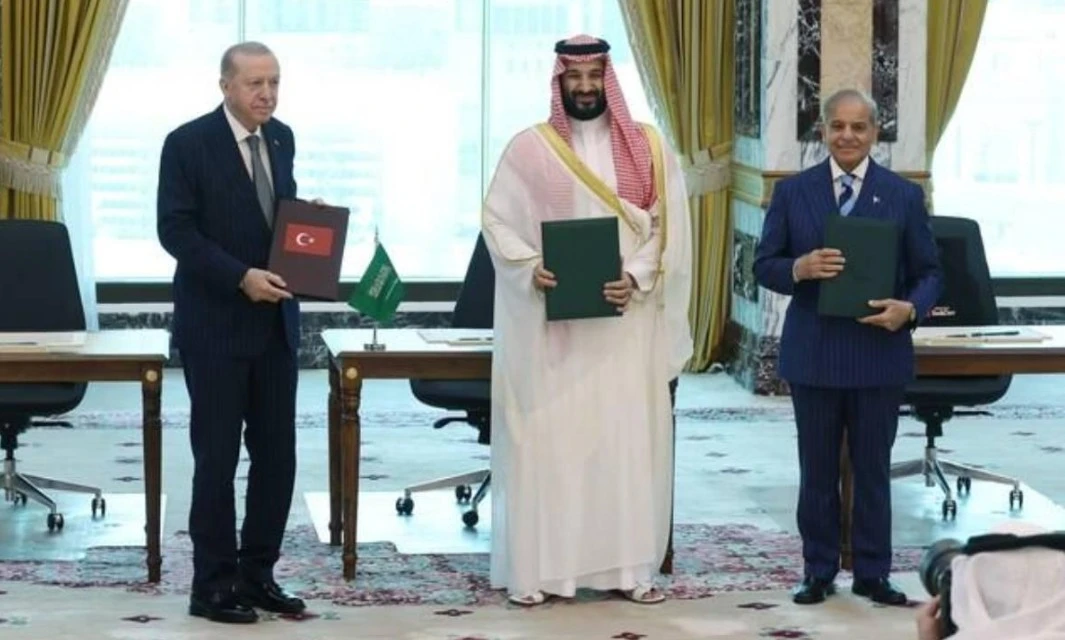
President Recep Tayyip Erdoğan, Saudi Crown Prince Mohammed bin Salman and Pakistani Prime Minister Shehbaz Sharif signed the Mecca Joint Defense Agreement on August 7, 2026.
Kandemir wrote that the agreement was widely interpreted from the outset as an alliance formed against Iran. He said attacks by Iran-backed Houthis involving missiles and unmanned aerial vehicles against Saudi territory provided a basis for that assessment.
A clause treating an armed attack against one member as an attack against all members was also interpreted as a collective defense commitment intended to deter Tehran.
Kandemir acknowledged that this interpretation reflected the regional conditions surrounding the agreement. He argued, however, that defining the pact solely as an anti-Iran military alliance could overlook its broader potential.
The founding countries have repeatedly stated that the pact does not target any particular state and remains open to new members that accept its principles, Kandemir noted. In his assessment, the Tehran meeting gave that position greater significance.
The Tehran meeting challenged the original interpretation
According to Kandemir’s article, the October 26 meeting in Tehran brought together Saudi Defense Minister Prince Khalid bin Salman, Pakistani Chief of Army Staff Field Marshal Asim Munir and Turkish National Intelligence Organization chief İbrahim Kalın.
The delegation met Iranian President Masoud Pezeshkian, Foreign Minister Abbas Araghchi and Supreme National Security Council Secretary Mohsen Rezaei. Kandemir also noted that the meeting took place one day before elections in Israel.
Pezeshkian said Iran supported understandings that could strengthen regional security. Iranian Foreign Ministry spokesperson Esmaeil Baghaei described the meeting as a possible first step toward security mechanisms based on the interests of regional countries.
Kandemir argued that the meeting suggested the Mecca Pact should not necessarily be viewed as a closed defense structure directed at Iran.
If Iran were to join the arrangement, Kandemir said, Tehran could become bound by a commitment not to attack the other members. Under that scenario, an attack on another member would also mean accepting a collective response under the pact’s terms.
No formal plan for Iranian membership or a timetable for expanding the alliance was presented in the article. Kandemir’s assessment focused on the possibilities created by the Tehran dialogue.
From collective defense to a non-aggression structure
Kandemir argued that the Mecca Pact should not be evaluated only as a mechanism for responding collectively to external attacks. In his view, it could also develop into an arrangement binding its members to mutual non-aggression.
Iranian membership, he suggested, would place Tehran under an obligation not to attack other participating states during the agreement’s proposed 10-year period. Any violation would trigger the collective response accepted by all members.
Kandemir compared this possibility with the 1975 Helsinki Final Act. The Helsinki framework did not eliminate hostility between NATO and the Warsaw Pact, he wrote, but established principles on the non-use of force and the inviolability of borders.
Those rules brought a degree of predictability to Europe without ending the rivalry between the two blocs. Kandemir said the Mecca Pact could evolve in a similar direction by attempting to manage hostility rather than defeat an identified enemy.
This comparison represents Kandemir’s interpretation of the pact’s possible trajectory. The parties have not announced a new non-aggression agreement or confirmed that Iran will be invited to join.
Why Türkiye, Saudi Arabia and Iran may seek stability
Kandemir identified Türkiye and Saudi Arabia as countries that have been directly affected by prolonged regional wars.
He argued that Türkiye had paid the price of conflicts stretching from Iraq to Syria over the past 40 years through migration, terrorism and the loss of commercial markets. Regional stability therefore carries both economic and security significance for Ankara, according to his analysis.
Saudi Arabia, meanwhile, is pursuing Crown Prince Mohammed bin Salman’s Vision 2030 program, which aims to reduce dependence on oil and attract investment in tourism and technology.
“Capital does not flow into a war zone.”
Kandemir argued that Saudi Arabia’s economic transformation would be difficult to sustain in an environment marked by missile attacks and continuing regional conflict.
He said Iran faced a similar need for stability after living under war or the threat of war since 1979. For a country under heavy sanctions and directing significant resources toward defense, a regional non-aggression framework could provide economic and strategic relief, he wrote.
Türkiye’s NATO membership and Pakistan’s status as a partner trusted by Washington could make this diplomatic channel more valuable to Tehran, Kandemir added.
He also wrote that if a proposal carried to Tehran by Asim Munir were accepted, the Mecca Pact countries and Qatar could potentially serve as guarantors. No formal confirmation of such an arrangement was included in the article.
Egypt could become the next major test for expansion
Kandemir described Egypt as a critical threshold if the pact were to expand. He also emphasized the economic and strategic constraints affecting Cairo’s ability to act independently.
Egypt has relied on annual US military assistance, International Monetary Fund programs and Gulf investment since the Camp David process, Kandemir wrote. He argued that attacks affecting Red Sea traffic had also reduced revenue from the Suez Canal.
These dependencies may restrict Egypt’s room for maneuver, but they also demonstrate why Cairo could be among the countries that benefit most from regional stability, according to his analysis.
Kandemir identified Syria, Lebanon and Jordan as other states in need of a more stable regional environment. He referred to Syria’s efforts to rebuild its state, Lebanon’s economic collapse and Hezbollah-related challenges, and Jordan’s refugee burden.
He argued that the inclusion of these countries could provide short- and medium-term relief, open space for economic development and help reduce bloodshed.
The pact’s members have not announced a formal enlargement plan covering Egypt, Syria, Lebanon or Jordan. These countries were discussed by Kandemir as possible participants in a future regional security arrangement.
A new regional equation for Israel and the United States
Kandemir argued that Israel could be the country most unsettled by the pact’s possible evolution toward accommodation with Iran.
He said Israeli media had sought to portray the agreement as an arrangement that would remain ineffective in practice. Kandemir cited a Jerusalem Post report noting that no collective response followed a Houthi drone strike on an Aramco refinery in Jizan two days after the pact was signed.
The Tehran meeting, he argued, raised a different question: whether a regional political structure built around a continuing threat and conflict could remain comfortable if tensions between Sunni states and Shia Iran began to ease.
Kandemir described Washington’s position as more complicated. He wrote that Trump had said decision time on Iran was approaching while entering the November 3 midterm elections with weak public support.
He also referred to remarks by Tom Barrack in Doha on October 20, saying that an oil-for-security arrangement no longer met US needs and that Washington supported regional initiatives such as the Mecca Pact.
Kandemir suggested that the United States may initially have preferred the alliance to become an anti-Iran structure that could assume a larger share of the regional security burden. He also raised the possibility that a more peaceful Middle East could reduce the value of relationships built around arms sales, military bases and security guarantees.
The outcome, Kandemir concluded, may depend on whether regional countries can maintain a consistent position in the face of changing US policies.
He cautioned against both unrealistic optimism and excessive pessimism. Distrust remains deep, and the parties continue to view one another with suspicion. Nevertheless, he argued, the Tehran meeting demonstrated that regional states may be able to discuss their security problems directly.
WiseNewsPress.com
What's Your Reaction?
 Like
0
 Dislike
0
 Love
0
 Funny
0
 Wow
0
 Sad
0
 Angry
0

Ahmet Taş is a journalist, editor and Turkey Office Manager of the Wise News Press Media Group. He works across news, digital media and international publishing, focusing on accurate, responsible and accessible journalism. He contributes to the development of media projects that bring important political, social and global developments to a wider international audience.















Comments (0)