



Russia’s way out runs through a fair peace table in Turkey
Russia’s openness to Ukraine peace talks in Turkey may signal that Putin is searching for a way out of a costly strategic mistake.


Yusuf İnan
Journalist | Political and Strategic Analyst
Russia’s decision to bring Turkey back into the discussion as a possible venue for peace talks with Ukraine should be read as a late but important sign that Vladimir Putin may be looking for a way out of this meaningless war.
By invading Ukraine, Russia made not only a military mistake but also a historic and strategic one. This war did not bring Russia victory. On the contrary, it brought NATO closer to Russia’s borders, pushed the Ukrainian people permanently away from Moscow, and deeply damaged Russia’s credibility across its surrounding regions.
Today, the possibility of peace talks in Turkey is not merely a diplomatic option for the Kremlin. It may be Russia’s chance to step back from the edge of the abyss.


Is the Turkey table an attempt to keep the West outside?
At first glance, Russia’s emphasis on Turkey as a possible venue for peace talks highlights Ankara’s diplomatic weight. Yet there is also a deeper strategic calculation behind this preference.
When Moscow sits directly across from the Western world over the Ukraine war—whether facing policymakers in Washington or UN corridors in New York—it faces sanctions, NATO expansion, war crimes debates, and heavy political pressure.. Turkey, however, represents a different channel. Ankara is a NATO member, but it is also one of the few capitals still able to speak directly with Moscow.
For this reason, Russia may be seeking a more controlled, flexible and less pressured diplomatic ground through Turkey rather than being locked into a Western-led negotiation framework.


But such a platform must not be used to cover Russia’s mistake. It must be used to reverse it. Any table established in Turkey should not weaken Ukraine’s sovereignty; it should create the conditions for a fair and lasting peace.
Russia’s historic mistake was invading Ukraine
The Putin administration did not merely calculate territory when it invaded Ukraine. It also shattered its own historical sphere of influence.
There were deep historical, cultural and family ties between the Russian and Ukrainian peoples. Their stories had been intertwined for generations. Yet war turned that connection into a bloody rupture. Moscow tried to win Ukraine, but instead it lost Ukrainian society entirely.
More importantly, Russia’s war, launched under the language of “security,” did not reduce security threats. It multiplied them. NATO moved closer to Russia than ever before. European countries reorganized their defense policies. Trust in Moscow weakened across Russia’s neighborhood.
This war has given Russia no concrete gain. Instead, it has exhausted its military power, damaged its economy, narrowed its diplomatic space and wounded its historical image.
Trump’s realism should be an example for Putin
The recent diplomatic turn in the U.S.-Iran track shows that great powers can still seek political exits from destructive crises.
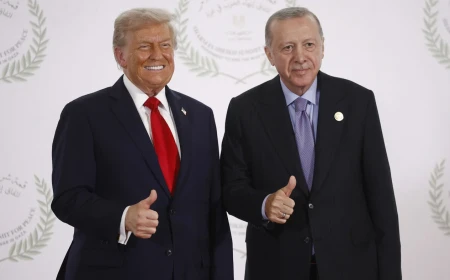
Washington saw the cost of prolonging military confrontation and expanding a regional fire. Rather than allowing the crisis to deepen, it chose the table and a path toward de-escalation. The Trump administration’s realistic vision showed that ending an increasingly costly confrontation is not weakness; it is statecraft.
Putin must act with the same realism. A leader who comes from the security bureaucracy cannot fail to see the heavy cost on the ground and the depth of Russia’s strategic loss.
The longer the war continues, the more Russia’s strategic deadlock becomes visible. Moscow does not need new fronts. It needs a fair way back, just as the U.S.-Iran example shows that conflicts can be brought back to diplomacy.
The name of that road is a peace table in Turkey.
Crimea opened a deep wound in the Turkic world
Russia’s insistence on Crimea does not only deepen its crisis with Ukraine; it also damages Moscow’s relations with the Turkic world from within.
Crimea was already a region where Russia enjoyed significant strategic advantages in the Black Sea. But occupation turned Crimea into neither a real gain for Russia nor a source of stability for the Ukrainian people.
The legal violations, pressure and identity concerns faced by Crimean Tatars do not echo only in Ukraine. Their pain is also heard across the Turkic and Islamic world.
Today, views of Russia are changing in Kazakhstan, Uzbekistan, Turkmenistan and other Turkic republics. Alphabet debates, language policies, cultural orientations and foreign policy choices all point to a gradual distancing from Moscow.
If Russia does not see this, it is strategically blind. If it does see it, then it should not resist peace.
China’s strategy should teach Russia a lesson
Russia has China’s example right in front of it.
China follows a long-term strategy that makes the world economy increasingly dependent on its production, trade, technology and logistics. Instead of bleeding on battlefields, it accumulates power through markets and supply chains.
Russia, meanwhile, is close to losing one of its strongest assets: the energy market.
Europe was one of the biggest customers of Russian energy. The war accelerated the process of breaking that dependency. Moscow lost at the energy, trade and diplomacy tables what it thought it could gain with tanks.
China sells products to the world. Russia tried to sell fear to the world. But in the 21st century, lasting power is not built on military capacity alone. It also requires economic strength, technology, credibility and strategic patience.
The Syria loss and Russia’s credibility crisis
One of Russia’s greatest reputational losses has also come through Syria.
For years, Moscow was seen as the strongest protector of the Syrian regime. Yet Syria’s devastation, combined with Russia’s distraction and exhaustion in Ukraine, has made Moscow’s security guarantees increasingly questionable.
From Armenia to Central Asia, from the Caucasus to the Turkic world, a serious question is now being asked: How reliable is Russia’s guarantee?
This is not only a geopolitical decline. It is also a psychological unraveling. States do not walk only with the powerful; they walk with the reliable. Russia believed it was displaying strength through the Ukraine war, but it lost credibility in the eyes of many partners.
Peace would not be defeat for Russia, but salvation
If Russia withdrew from the territories it occupied and signed a fair peace recognizing Ukraine’s sovereignty, this would not be a defeat for Moscow. It would be a historic rescue.
It may not be easy for Putin to explain this at home. But continuing the war brings an even heavier price.
Russia should not only withdraw. It should also contribute to rebuilding the Ukrainian cities it destroyed. This could become an opportunity for Moscow to partially repair the image it has lost in the eyes of the Ukrainian people.
The peace table should not discuss only a ceasefire. It should also discuss reconstruction. The side that started the destruction has a historic responsibility to take part in rebuilding what it destroyed.
Erdoğan, Zelenskyy and Putin should meet in Turkey
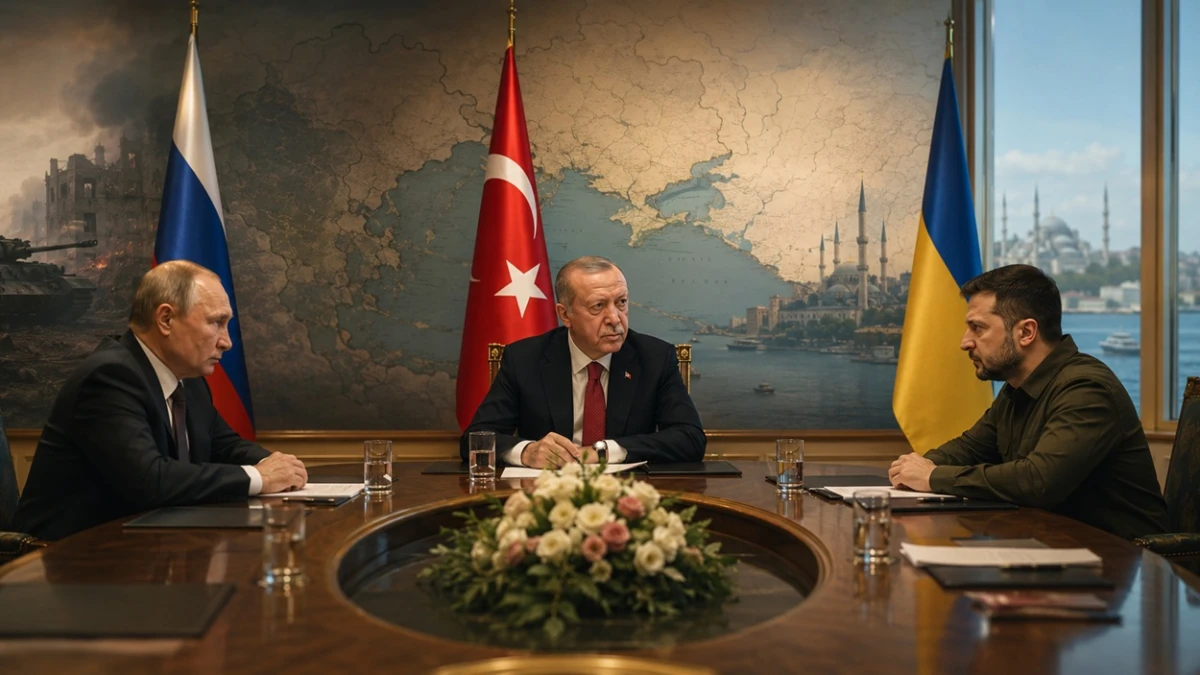
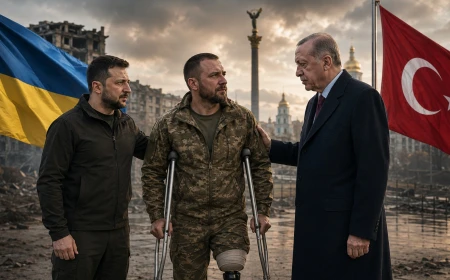
A meeting in Turkey between President Recep Tayyip Erdoğan, Ukrainian President Volodymyr Zelenskyy and Russian President Vladimir Putin could create an opportunity to close one of the greatest crises facing humanity.
Turkey is not merely a host in this process. It is a balancing actor. Ankara can speak with Russia, preserves its relationship with Ukraine, is directly affected by Black Sea security, and maintains communication with the West.
But peace cannot be an imposed settlement that weakens Ukraine’s will. Peace must be based on Ukraine’s sovereignty, territorial integrity, security needs and compensation for the destruction caused by the war.
Final word: Russia can recover through peace
Putin has two roads before him.
The first is to insist on the mistake and drag Russia deeper into a crisis that will leave it more isolated in Crimea, the Caucasus, Central Asia and the Turkic world.
The second is to sign a fair peace in Turkey, end the heavy burden of occupation and begin restoring Russia as a credible actor.
This war has given Russia nothing. But peace can still give Russia a way forward.
A fair table in Turkey is not only a rescue door for Ukraine. It is also a rescue door for Russia.
Yusuf Inan
Yusuf Inan is a journalist and writer. He serves as Editor-in-Chief of UAPresa.com, WiseNewsPress.com, SehitlerOlmez.com and YerelGundem.com, and specializes in strategic and political analysis of Turkish and global affairs.
What's Your Reaction?
 Like
0
Like
0
 Dislike
0
Dislike
0
 Love
0
Love
0
 Funny
0
Funny
0
 Wow
0
Wow
0
 Sad
0
Sad
0
 Angry
0
Angry
0

Editor | Wise News Press — Delivering accurate, timely global news with integrity, insight, and editorial responsibility.











Comments (0)