



Why Russia Is Courting Hakan Fidan: Diplomacy or Succession Signal?
Hakan Fidan’s reception in Russia, MGIMO honorary doctorate and Putin meeting have revived debate over his international profile and political future.


By Yusuf İnan
Journalist | Political and Strategic Analyst
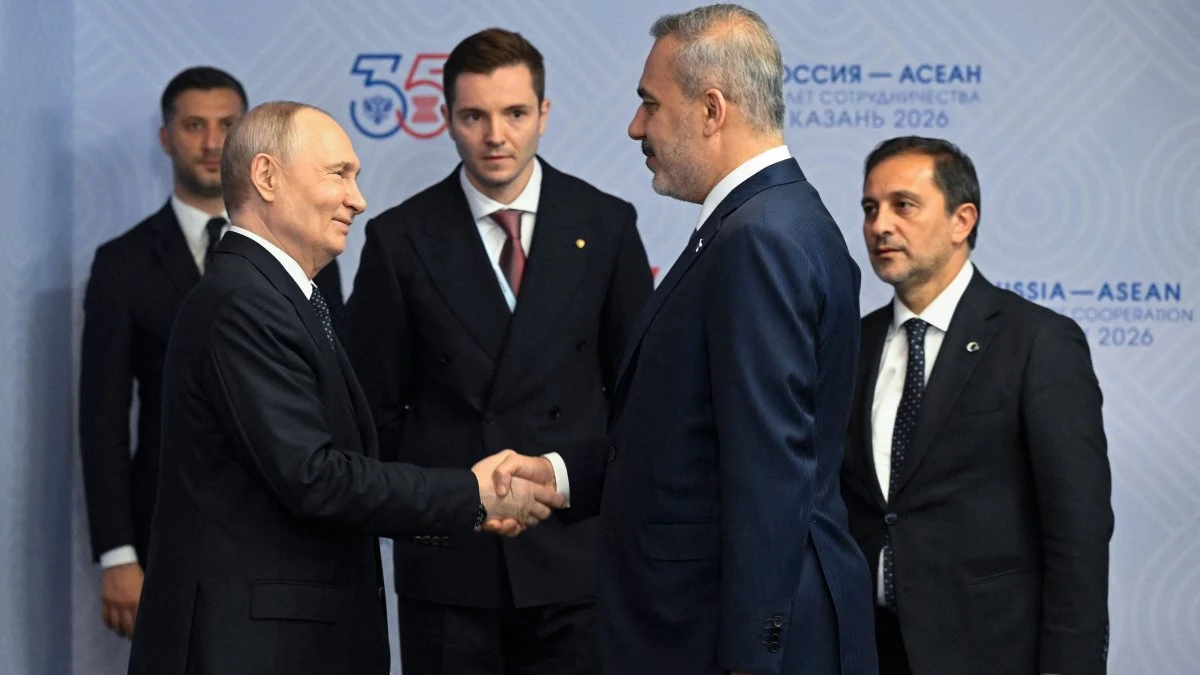
ANKARA, Turkey — Turkish Foreign Minister Hakan Fidan’s high-profile reception in Russia, including an honorary doctorate from MGIMO and a meeting with Vladimir Putin, has revived questions about how global powers view his role in Turkey’s future.
Fidan’s visit was formally diplomatic: he received an honorary doctorate from the Moscow State Institute of International Relations, met senior Russian officials and was received by Russian President Vladimir Putin in Kazan. Yet the symbolism of the visit went beyond routine diplomacy. In Turkey, it immediately fed a broader debate: why is Russia paying such visible attention to Fidan, and does this signal anything about his possible future role in Turkish politics?


A visit with unusual symbolism
Hakan Fidan’s Russia visit stood out for two reasons. First, he was awarded an honorary doctorate by MGIMO, one of Russia’s most prestigious institutions in diplomacy and international relations. Second, he was received by Vladimir Putin during the same trip.
A foreign minister being received by a head of state is not unprecedented, especially when the countries involved have complex strategic relations. But in Fidan’s case, the optics mattered. He was not simply treated as a routine diplomatic visitor. The ceremony in Moscow, the academic robe, the formal recognition and the Putin meeting all created a picture of a figure whom Moscow sees as highly important.
That does not mean Russia officially sees Fidan as Turkey’s future president. There is no verified public evidence for such a conclusion. But it does show that Moscow regards him as one of the most consequential figures in Ankara’s foreign policy and security architecture.


Why Russia takes Fidan seriously
Russia’s interest in Fidan is not mysterious if his background is considered. Before becoming foreign minister, Fidan served for years as head of Turkey’s National Intelligence Organization. He was one of the closest officials to President Recep Tayyip Erdoğan on security, intelligence and regional crisis management.
For Moscow, that profile matters. Turkey-Russia relations are not limited to embassy diplomacy. They include the Black Sea, the war in Ukraine, Syria, the South Caucasus, energy, trade, sanctions pressure, NATO dynamics and intelligence-sensitive security files.
Fidan sits at the intersection of these fields. He knows Turkey’s security bureaucracy, Erdoğan’s strategic priorities and the operational language of crisis diplomacy. For Russia, that makes him more than a foreign minister. He is a direct channel into Turkey’s state mind.
This is why Putin’s reception of Fidan should be read primarily through strategic necessity. Moscow needs senior Turkish interlocutors who can speak with authority, interpret Ankara’s red lines and carry messages from Erdoğan.
Was Fidan treated like a head of state?
Some commentary in Turkey described Fidan’s reception as resembling “head-of-state treatment.” That interpretation may capture the symbolic weight of the images, but it is not a formal diplomatic category.
Fidan was not received as a president. He was received as Turkey’s foreign minister and as a senior envoy carrying Erdoğan’s messages. Still, the political message was clear: Moscow wanted to show that it values direct communication with him.
In diplomatic terms, the distinction matters. A high-level reception does not automatically imply support for a future political role. However, it does raise Fidan’s visibility and confirms that he is among the Turkish officials foreign capitals watch most closely.
The real significance lies not in protocol labels, but in access. Fidan has access to Erdoğan, to Turkey’s security files and to global leaders. That combination makes him a rare figure in Ankara.
The MGIMO doctorate and its message
MGIMO is not an ordinary university in the Russian system. It is one of the core institutions of Russian diplomatic formation. Many major Russian and post-Soviet political figures have passed through its halls, including Russian Foreign Minister Sergey Lavrov.
Awarding Fidan an honorary doctorate was therefore more than an academic gesture. It was a diplomatic signal. MGIMO presented the honor as recognition of Fidan’s contribution to international diplomacy and relations between peoples.
Fidan, in his remarks, reportedly framed the title not merely as a personal honor but as a sign of respect for Turkey-Russia relations. That was a careful diplomatic message. He did not convert the ceremony into a personal political moment; instead, he placed it inside the broader state-to-state relationship.
For Russia, the gesture served a parallel purpose. It highlighted Turkey as an important partner and Fidan as a serious strategic actor. But again, there is a difference between recognition and political endorsement. The doctorate signals respect and interest, not a confirmed succession project.
The Russian book about Fidan
The debate around Fidan’s future is not new. One of the most striking episodes was the publication in Russia of a book about him, written by Armenian authors, including a former intelligence-linked figure, with a title presenting Fidan as a possible future president of Turkey.
The title itself was enough to trigger controversy in Turkish political circles. It suggested that some Russian, Armenian or regional strategic circles were already thinking about Fidan not only as a diplomat or intelligence veteran, but as a possible long-term political figure.
Yet this point also requires caution. A book published in Russia does not equal Kremlin policy. Its authors’ views cannot be automatically treated as Moscow’s official position. The book is evidence that Fidan is being studied and discussed in strategic circles, not evidence that Russia has chosen him as Turkey’s future leader.
The more careful conclusion is this: Fidan has become a figure of interest for regional analysts, intelligence watchers and foreign policy communities because he represents continuity, security expertise and high-level state access.
What about Britain and the United States?
The question is not limited to Russia. Fidan has also gained visibility in Western diplomacy. Britain has worked with Turkey on a strategic partnership framework covering security, defense, NATO, trade, science and technology. In that context, Fidan has been one of Ankara’s key diplomatic faces.
The United States also sees Fidan as a serious interlocutor. In major regional files, including Gaza, Ukraine, NATO, Syria and broader crisis diplomacy, Washington needs Turkish officials who can speak for Erdoğan’s government and understand the security dimension of policy.
This does not mean Britain or the United States are positioning Fidan for Turkey’s presidency. There is no open, verifiable evidence that London or Washington wants Fidan to become president.
What is visible is different: Western capitals, like Moscow, recognize Fidan as one of the central operators of Turkish foreign policy. They deal with him because he is powerful inside the existing system, not because they can publicly shape Turkey’s next leadership.
The Erdoğan-İmamoğlu scenario and succession talk
The timing of these discussions is important. Turkish political debate is increasingly focused on transition scenarios. One recent column by Nuray Babacan reported Ankara rumors about a possible “soft transition” formula: Erdoğan remaining as a symbolic president under a restored parliamentary system, while Ekrem İmamoğlu could become prime minister.
That scenario does not place Fidan at the center. But it reflects a wider reality: Turkey’s political system is entering a period in which post-Erdoğan possibilities, institutional redesign and elite bargaining are being discussed more openly.
Fidan’s name appears in a different lane of the same debate. While İmamoğlu represents an opposition-based transition scenario, Fidan represents a state-security continuity scenario. That is why foreign attention to Fidan becomes politically sensitive inside Turkey.
He is not just another minister. He is a former intelligence chief, a current foreign minister and a trusted Erdoğan-era operator. In any future transition, figures with that profile naturally attract attention.
Does Fidan have presidential ambitions?
There is no public evidence that Hakan Fidan has declared presidential ambitions. He has not launched a political movement, built a public electoral campaign or positioned himself openly as Erdoğan’s successor.
His rise has been institutional rather than populist. He moved from intelligence leadership to foreign ministry, not from party campaigning to mass politics. That makes him powerful, but not necessarily electorally tested.
For a presidential path in Turkey, bureaucratic prestige alone is not enough. A candidate needs party machinery, public recognition, electoral appeal, alliance support and Erdoğan’s political blessing or at least a favorable power vacuum.
Fidan has international stature and state experience. Whether that can translate into domestic political leadership is a separate question.
The real mystery: succession or state continuity?
The central mystery is not whether Russia, Britain or the United States “want” Fidan as president. There is no reliable public evidence for that claim.
The real question is why all these actors watch him closely. The answer lies in state continuity. Fidan represents Turkey’s security-diplomacy bridge. He understands intelligence, regional crises, Erdoğan’s decision-making style and great-power bargaining.
Foreign capitals are not necessarily choosing Turkey’s future leader. They are identifying the people who matter in Ankara now and may matter even more in a transition.
That is a major distinction. International interest does not equal international design. It can simply reflect strategic realism.
How should the signals be read?
The strongest verified signals are these: Russia gave Fidan a prestigious diplomatic honor; Putin received him; Russian intellectual circles have discussed him as a possible future political figure; Britain and the United States treat him as a high-level Turkish interlocutor.
The unverified claim is this: that Russia, Britain or the United States actively want Fidan to become Turkey’s president.
A responsible reading must separate these two layers. The first is factual and politically significant. The second remains speculative.
Fidan’s global visibility is real. His position inside Turkey’s state system is real. The succession debate is also real. But the idea of a coordinated foreign plan to elevate him to the presidency has not been proven.
A powerful figure in a changing Turkish landscape
Hakan Fidan’s Russia visit should therefore be read as part of a larger geopolitical and domestic picture. Turkey is a NATO member that speaks directly with Russia. It is a regional power involved in Ukraine, Syria, Gaza, the Caucasus and the Black Sea. Its internal political future is being watched closely by all major powers.
In that environment, Fidan is one of the most important figures foreign capitals can engage. He carries Erdoğan’s messages, manages strategic files and embodies continuity between intelligence and diplomacy.
Whether this visibility eventually turns into a political future depends not on Moscow, London or Washington, but on Turkey’s internal political dynamics.
For now, the clearest conclusion is this: Hakan Fidan is not proven to be the preferred presidential candidate of any foreign power. But he is clearly one of the Turkish officials most closely watched by them.
That, in itself, explains the attention.
Yusuf Inan
Yusuf Inan is a journalist and writer. He serves as Editor-in-Chief of UAPresa.com, WiseNewsPress.com, SehitlerOlmez.com and YerelGundem.com, and specializes in strategic and political analysis of Turkish and global affairs.
What's Your Reaction?
 Like
0
Like
0
 Dislike
0
Dislike
0
 Love
0
Love
0
 Funny
0
Funny
0
 Wow
0
Wow
0
 Sad
0
Sad
0
 Angry
0
Angry
0

Editor | Wise News Press — Delivering accurate, timely global news with integrity, insight, and editorial responsibility.












Comments (0)