



Aegean Exporters’ Association records $1.55 billion in March
The Aegean Exporters' Association hit $1.55 billion in March 2026, showing resilience with a 51% export share to the EU despite a 48% drop in Gulf region trade.



By Ahmet Taş | Wise News Press
IZMIR, TÜRKİYE — The Aegean Exporters' Association (EİB) recorded $1.552 billion in exports for March 2026, demonstrating significant resilience as it outperformed the general decline in Turkey's national export figures despite escalating geopolitical tensions in the Gulf.
While the association’s performance was 2% lower than the $1.583 billion recorded in March 2025, it stood in stark contrast to the 6.4% drop in Turkey’s overall exports, which fell from $23.4 billion to $21.9 billion in the same period. For the first quarter of 2026, the EİB matched its previous year’s performance with $4.468 billion in exports, while its rolling annual export value rose by 2%, climbing from $18.2 billion to $18.5 billion.
Industrial and agricultural sector performance
The breakdown of the EİB’s March figures reveals the diverse strength of the Aegean region’s economy. Industrial sectors led the way with $869 million in exports, followed by agricultural sectors contributing $574 million. The mining sector added another $110 million to the total. Despite the overall slight contraction, three out of the twelve unions under the EİB umbrella managed to increase their export values.
The Aegean Iron and Non-Ferrous Metals Exporters' Association maintained its top position with $210 million in exports. However, the standout performer was the Aegean Fisheries and Animal Products Exporters' Association, which saw a 13% increase, reaching $135 million. This sector became the fastest-growing union within the EİB for the month. The mining union followed in third place with $110 million, while fresh fruit and vegetable exports brought in $98.6 million. Other notable contributions came from ready-to-wear apparel ($97 million), cereals and pulses ($86 million), and tobacco ($61.8 million), the latter seeing a 7% increase compared to last year.
Impact of geopolitical conflict in the Gulf
The most significant downward pressure on March figures came from the Middle East. Ongoing conflicts involving the USA, Israel, and Iran, which have turned the Gulf into a "ball of fire," led to a sharp 48% decline in exports to that region. In March 2025, the EİB exported $102 million to Gulf nations; in March 2026, this figure plummeted to just $53.3 million.


The impact was felt across nearly every country in the region. Exports to the United Arab Emirates fell by 55.5%, dropping to $7.7 million. Trade with Qatar decreased by 78%, while Bahrain saw a staggering 85% loss. Saudi Arabia, a key market, experienced a 28% decline, falling to $11.5 million. These regional losses underscored the vulnerability of trade routes to sudden geopolitical shifts, forcing exporters to rely more heavily on traditional Western markets.
The European Union remains the primary trade partner
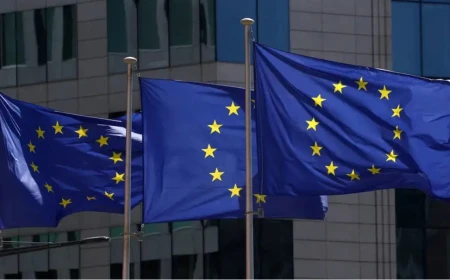
As the Gulf market contracted, the European Union (EU) emerged as a vital "loyal partner" for Aegean exporters. Exports to EU member states rose by 10%, increasing from $722 million to $792 million in March 2026. Consequently, the EU's share in the EİB’s total export portfolio jumped from 45.5% to 51%.
Germany remained the top destination for Aegean goods, accounting for $150 million in trade. While exports to the United States fell by 12% to $128 million, the U.S. remained the second-largest buyer. Italy saw a 9% increase to $114.6 million, and Spain showed remarkable growth. With a 37.5% surge, exports to Spain reached $89.8 million, allowing it to overtake the United Kingdom as the fourth-largest export market for the EİB. Overall, the association exported to 193 different countries in March, increasing its volume in 93 of those markets.


Regional city-based export figures
Performance varied across the provinces within the Aegean region. According to Turkish Exporters Assembly (TIM) data, the region's total exports for March amounted to $2.31 billion, a 3.2% decrease from the previous year. Izmir and Usak were the only provinces to record growth. Izmir’s exports rose by 4% to $1.202 billion, representing 52% of the region’s total trade. Usak saw a 3% increase, reaching $25.9 million.
Conversely, other provinces faced declines. Balikesir suffered the sharpest drop, with exports falling 25% to $58 million. Denizli and Manisa remained competitive, recording exports of $389.8 million and $389.2 million, respectively. Muğla, which usually sets records for growth, remained flat at approximately $100 million. Substantial drops were also noted in Afyonkarahisar (12% decrease to $29.2 million) and Aydın (4% decrease to $79.8 million).
Calls for extended economic support
Jak Eskinazi, Coordinator President of the Aegean Exporters' Association, assessed the first-quarter results by noting that while global and regional crises have created a negative atmosphere, there are opportunities to be seized. He emphasized that the current economic climate requires proactive government intervention to support the manufacturing and export sectors, which have struggled under high costs and exchange rate pressures for three years.
Eskinazi called for the extension of specific financial support mechanisms to provide exporters with much-needed stability. "The 3,500 TL employment support provided by the Ministry of Industry should be reviewed, and the Central Bank's 3% currency conversion support, which is set to expire in April, should be extended for at least another year," Eskinazi stated. He argued that such steps would boost morale and provide the necessary financial cushion for exporters to navigate the ongoing volatility in global markets.
What's Your Reaction?
 Like
0
Like
0
 Dislike
0
Dislike
0
 Love
0
Love
0
 Funny
0
Funny
0
 Wow
0
Wow
0
 Sad
0
Sad
0
 Angry
0
Angry
0

Editor | Wise News Press — Delivering accurate, timely global news with integrity, insight, and editorial responsibility.



















Comments (0)