



Turkish-origin leaders gain influence across Europe’s power centers
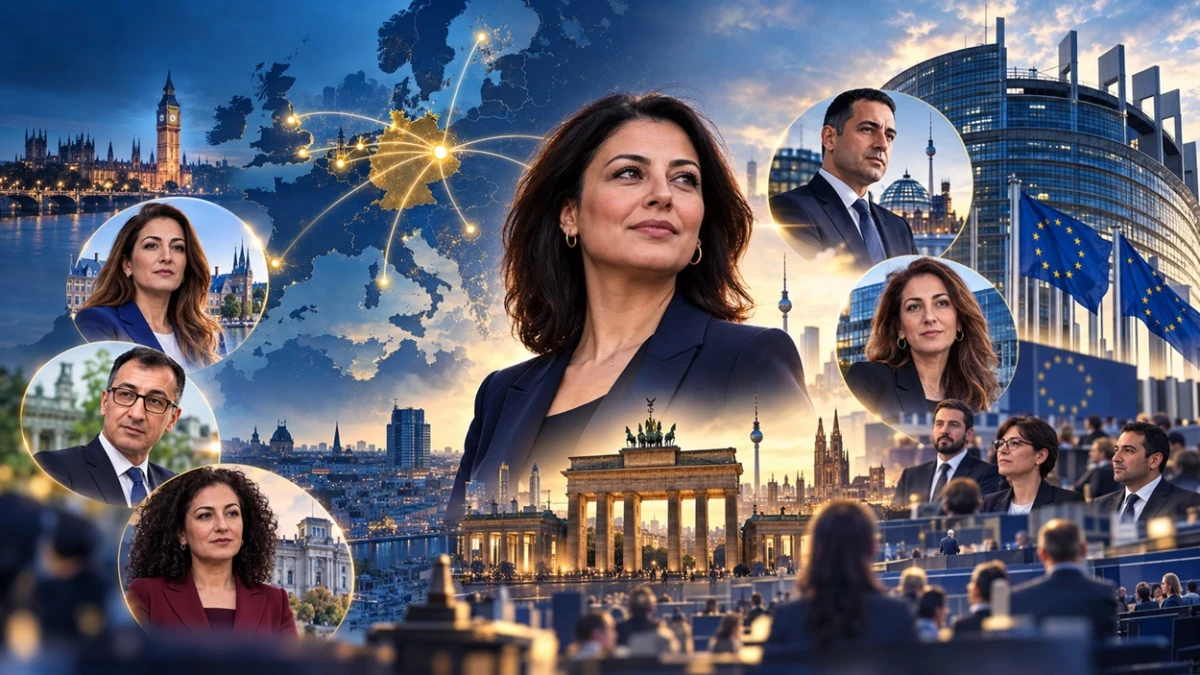
Elif Eralp, Sinan Selen and other Turkish-origin figures reflect a new phase of political and institutional influence across Europe.


By Yusuf İnan | Wise News Press
Journalist and Author | Political and Strategic Analyst
BERLIN, Germany — The rise of Elif Eralp in Berlin and Sinan Selen at the top of Germany’s domestic intelligence service has brought renewed attention to Turkish-origin figures shaping European politics and public institutions.
Their emergence is not an isolated story of representation. It reflects a broader transformation across Europe: the children and grandchildren of migration are no longer only community voices or local activists. They are lawmakers, ministers, party leaders, senior bureaucrats and policy-makers in countries including Germany, the Netherlands, Belgium, the United Kingdom and Sweden.


Elif Eralp and the Berlin breakthrough
Elif Eralp has become one of the most visible symbols of this new political moment. A lawyer of Turkish origin, she rose to prominence in Berlin through a campaign centered on housing, rent pressure, social inequality and urban justice.
Her political strength lies in the fact that she speaks to issues that directly affect Berlin’s younger and lower-income voters. Housing has become one of the most decisive political questions in the German capital, and Eralp’s message turned that pressure into electoral momentum.
If she takes the role of Berlin’s governing mayor, the symbolism would be powerful. Berlin is not only Germany’s capital but also one of the most important centers of the Turkish diaspora in Europe. A Turkish-origin politician leading the city would mark a historic moment in Germany’s migration and political history.


Sinan Selen and the state security dimension
Sinan Selen represents a different kind of influence. Unlike elected politicians, Selen comes from the state bureaucracy and security establishment. His appointment as head of Germany’s Federal Office for the Protection of the Constitution places a Turkish-born figure at the center of domestic intelligence, extremism monitoring and counter-espionage.
That role carries major institutional weight. It shows that Turkish-origin professionals are not only entering parliaments and city halls, but also sensitive state structures traditionally seen as closed and security-focused.
Selen’s rise also complicates simplistic narratives about integration. It is one thing for people of migrant background to become cultural representatives or local politicians; it is another for them to lead institutions responsible for protecting the constitutional order.
Germany remains the main center of Turkish-origin representation
Germany remains the most important arena for Turkish-origin political representation in Europe. This is partly because of demographics: the country has Europe’s largest Turkish-origin population. But it is also because that community has now produced several generations of politically active citizens.
After the 2025 federal election, Turkish media and European outlets reported that 19 Turkish-origin candidates entered the Bundestag. The Social Democratic Party and the Left Party each secured seven Turkish-origin lawmakers, while the CDU, the Greens and the CSU also elected candidates from Turkish-origin backgrounds.
Among the SPD figures are Hakan Demir, Metin Hakverdi, Macit Karaahmetoğlu, Mahmut Özdemir, Aydan Özoğuz, Derya Türk-Nachbaur and Serdar Yüksel. The Left Party’s group includes Gökay Akbulut, Ateş Gürpınar, Ferat Koçak, Cansın Köktürk, Cansu Özdemir, Cem Hamit İnce and Mirze Edis.
The conservative and green camps also show growing diversity. Serap Güler and Tijen Ataoğlu represent the CDU; Ayşe Asar and Filiz Polat represent the Greens; Hülya Düber became notable as the first Turkish-origin lawmaker from the CSU.
Cem Özdemir, Cansel Kızıltepe and Aydan Özoğuz
Cem Özdemir remains one of the most prominent Turkish-origin politicians in Germany. A veteran Green politician and former federal minister, Özdemir has built a career that reaches far beyond symbolic representation. His role in Baden-Württemberg politics, one of Germany’s most economically important regions, gives him strategic relevance in debates on industry, environment, migration and governance.
Cansel Kızıltepe is another major figure in Berlin. As a senior state-level official responsible for labor, social affairs, equality, integration, diversity and anti-discrimination, she operates at the intersection of social policy and migration. Her work shows that Turkish-origin politicians are no longer limited to speaking about identity; they are shaping core policy areas.
Aydan Özoğuz represents institutional experience. Known for her long-standing work on integration and migration policy, she has been one of the most recognizable Turkish-origin figures in federal politics. Her career helped normalize the presence of politicians with migrant backgrounds in senior parliamentary and government roles.
The Netherlands, Belgium and Britain: ministerial-level influence
Beyond Germany, several Turkish-origin figures have reached ministerial or near-ministerial status.
In the Netherlands, Dilan Yeşilgöz-Zegerius is among the most powerful Turkey-born politicians in Europe. Born in Ankara, she became leader of the VVD and served as Minister of Justice and Security. Her later role in defense and senior government leadership placed her at the center of Dutch security and strategic policy.
Her profile is especially important because she does not fit a predictable political pattern. Yeşilgöz is a right-liberal and security-focused politician, showing that Turkish-origin identity does not correspond to one ideological direction.
In Belgium, Zuhal Demir has become a major figure in Flemish politics. A politician from the N-VA, Demir has held ministerial responsibilities in justice, environment, energy, tourism and education. Her career demonstrates how politicians with roots in Turkey can become influential inside regional governments, even in sharply polarized political environments.
In the United Kingdom, Feryal Clark and Nesil Caliskan represent a growing Turkish and Turkish-Cypriot presence in Westminster. Clark served as Minister for AI and Digital Government, connecting migration-origin representation with one of the most strategic policy areas of the future. Caliskan, elected as MP for Barking after a strong local government career, reflects another path: from municipal politics into national government and parliament.
European Parliament and Nordic representation
The European Parliament also includes Turkish-origin voices. Özlem Demirel, elected from Germany, works on foreign affairs, security, employment and EU-Turkey relations. Her role matters because it places Turkish-origin representation inside the EU’s institutional machinery.
Engin Eroğlu is another German politician of Turkish origin associated with the European Parliament. Together, these figures show that the political presence of Turkish-origin Europeans is not confined to national systems; it extends to the EU level.
In Sweden, Kadir Kasirga serves in the Riksdag and has worked on transport, EU affairs and local governance. Earlier figures such as Mehmet Kaplan and Ibrahim Baylan also showed that people with links to Turkey could enter ministerial office in Sweden.
Austria has had figures such as Nurten Yılmaz, Alev Korun, Berivan Aslan and Efgani Dönmez. Some are more associated with previous parliamentary periods, but they remain part of the longer history of Turkish-origin political visibility in Europe.
Influence, not a single political bloc
The key point is that Turkish-origin politicians in Europe do not form one ideological camp. They are social democrats, conservatives, liberals, greens, leftists and regional nationalists. Some are close to Turkish communities; others keep distance from diaspora politics. Some strongly criticize Turkey’s government; others focus almost entirely on domestic policy in their own countries.
This diversity matters. It means Turkish-origin representation is no longer a narrow community issue. It has become part of normal European politics.
The rise of Elif Eralp, Sinan Selen, Cem Özdemir, Dilan Yeşilgöz-Zegerius, Zuhal Demir, Cansel Kızıltepe and dozens of lawmakers across Germany and Europe shows a deeper shift: the Turkish diaspora is no longer outside Europe’s decision-making structures. It is already inside them.
Yusuf İnan
WiseNewsPress.com
Yusuf İnan is a journalist, author, and political and strategic analyst. He serves as editor-in-chief of UAPresa.com, WiseNewsPress.com, SehitlerOlmez.com, SiyasetinSesi.com and YerelGundem.com. His work focuses on strategic and political analysis concerning developments in Türkiye and around the world.
What's Your Reaction?
 Like
0
Like
0
 Dislike
0
Dislike
0
 Love
0
Love
0
 Funny
0
Funny
0
 Wow
0
Wow
0
 Sad
0
Sad
0
 Angry
0
Angry
0
Yusuf İnan is a journalist, columnist, strategic analyst and head of the Wise News Press Media Group. His work focuses on international affairs, geopolitics, security and major social issues. Through his journalism, he promotes peace, dialogue, mutual understanding and responsible reporting while contributing to the development of international media projects.













Comments (0)