



Erdogan: Makkah defense pact targets no country, strengthens deterrence
President Recep Tayyip Erdogan says the Makkah defense pact with Saudi Arabia and Pakistan targets no country and is designed to strengthen deterrence.


By Ahmet Taş | Wise News Press
ANKARA, TURKEY — President Recep Tayyip Erdogan said the Makkah Joint Defense Agreement signed by Turkey, Saudi Arabia and Pakistan is not directed against any country, describing its main purpose as strengthening collective deterrence and regional stability.
In written responses to the London-based Asharq Al-Awsat newspaper, Erdogan said the three-country agreement should not be viewed simply as a military alliance or as a short-term reaction to current regional tensions. Instead, he presented it as part of a broader effort to deepen security cooperation, strengthen solidarity among participating states and encourage regional countries to take greater responsibility for their own security.
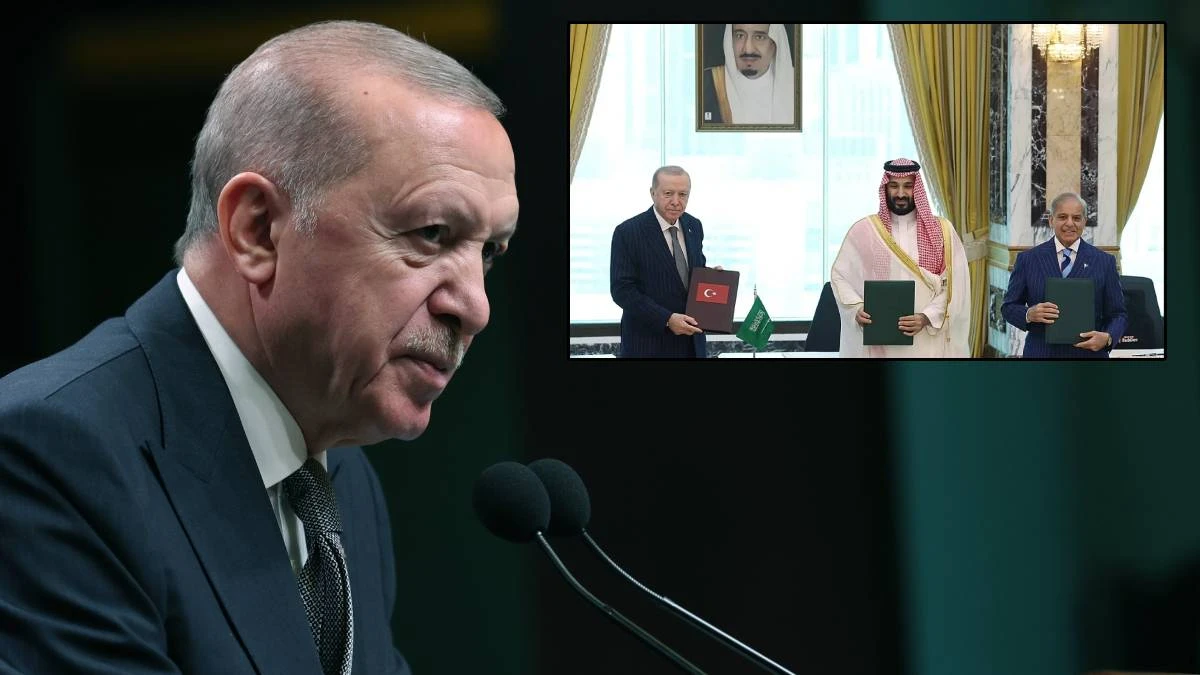
The agreement was signed in Makkah on August 7, 2026, by Erdogan, Saudi Crown Prince and Prime Minister Mohammed bin Salman and Pakistani Prime Minister Shehbaz Sharif. Its central principle is collective defense: a security threat against one participating country is to be treated as a common security concern by the others.
Agreement built around collective deterrence
Erdogan said the Makkah Joint Defense Agreement was created in response to changing regional conditions and a growing awareness among Turkey, Saudi Arabia and Pakistan of their shared responsibilities.
He argued that regional problems should primarily be addressed by countries in the region rather than through solutions imposed from outside. According to Erdogan, recent crises have highlighted the importance of closer consultation and cooperation among states with shared security interests.


The Turkish president described collective deterrence as the foundation of the agreement.
Under the framework, the three countries aim to expand cooperation in security and defense, develop joint defense-industry projects and strengthen coordination in combating terrorism. Erdogan said the pact is intended to support peace, stability and prosperity rather than create a threat to another state.
Anadolu Agency has similarly described the agreement as a defense-focused cooperation framework built around shared security and burden-sharing, with the stated aim of supporting regional and international peace and stability.


Erdogan says pact is not aimed at any country
One of the main questions surrounding the agreement has been whether it was created in response to escalating tensions involving Iran and the United States.
Erdogan acknowledged that those tensions are important for regional security but rejected the idea that the Makkah agreement should be interpreted simply as a response to one confrontation.
He said discussions about deeper regional security cooperation had been underway before the latest escalation and had been raised repeatedly with Saudi Arabia, Pakistan and other countries in the region.
Erdogan also linked the agreement to Article 51 of the United Nations Charter, which recognizes the inherent right of individual or collective self-defense when a UN member is subjected to an armed attack.
The president stressed that Turkey does not see the mechanism as an alliance directed against Iran or any other specific country.
Rather, he said Ankara views the agreement as a strategic response to a changing security environment and as a structure that could eventually include additional regional states.
Attack on one party treated as common security concern
The agreement contains a mutual-defense principle under which a threat or attack affecting one signatory is treated as a security issue for all participating countries.
Asked directly about that provision, Erdogan confirmed that collective defense is at the heart of the agreement.
He said, however, that the provision should not be interpreted exclusively in terms of military action. The broader objective, according to the Turkish president, is to increase deterrence, reinforce security through mutual solidarity and preserve regional stability.
The structure therefore bears similarities to established collective-defense arrangements in the sense that the security of one participant is connected to the security of the others, although Erdogan presented the agreement primarily as a regional cooperation mechanism rather than an exclusionary military bloc.
He said the signatories were also sending a message that they would not pose threats to one another and would instead work to strengthen each other's security.
Agreement remains open to additional countries
Erdogan also signaled that Turkey, Saudi Arabia and Pakistan do not intend the Makkah framework to remain permanently limited to three members.
He said countries seeking peace and stability could potentially join the mechanism and expressed hope that the agreement could develop into a broader regional security structure.
According to Erdogan, the trilateral pact represents the beginning of a new phase of cooperation among Ankara, Riyadh and Islamabad rather than a closed alliance.
He said Turkey was prepared to keep the framework open to other states willing to contribute to regional peace and stability.
That position also reflects Turkey's broader argument that Middle Eastern countries should establish more institutional forms of cooperation among themselves instead of depending solely on external powers for regional security.
Erdogan said the ultimate aim should not be the formation of rival or exclusionary blocs but a regional system based on sovereignty, territorial integrity, mutual confidence and shared interests.
Regional countries urged to take greater responsibility
The Turkish president used the agreement to outline a wider vision for Middle Eastern security.
Erdogan said countries in the region are increasingly required to assume responsibility for their own security, stability and future, arguing that local states and societies understand regional challenges better than outside actors.
He said stronger institutional cooperation could help turn existing bilateral and multilateral relationships into permanent regional mechanisms.
In Erdogan's view, closer cooperation between regional powers could also contribute to global stability because security in the Gulf and wider Middle East directly affects energy supplies, maritime routes, international commerce and the global economy.
The president said Turkey favors diplomacy over escalation and dialogue over conflict and intends to continue communicating with different regional actors even during periods of heightened tension.
Makkah signing formalized growing defense cooperation
Erdogan, Mohammed bin Salman and Shehbaz Sharif signed the Makkah Joint Defense Agreement on August 7 during a trilateral meeting in Saudi Arabia. Photographs released from the ceremony showed the three leaders together following the signing.
The deal formalized a defense relationship that had been developing through consultations among Turkey, Saudi Arabia and Pakistan well before the signing ceremony, according to Erdogan.
Turkey had also been participating in broader consultations with Pakistan, Saudi Arabia and other regional states during the preceding months, including ministerial-level meetings focused on security and regional crises.
Erdogan said the agreement should therefore be viewed as the result of a longer strategic process rather than an arrangement created solely by the latest regional confrontation.
For Ankara, he said, the central message of the Makkah agreement is that strengthening one country's security should contribute to the security of the wider region.
The next phase will test how the collective-defense provisions are implemented in practice, whether joint defense projects deepen and whether additional countries respond to Erdogan's invitation to participate in the framework. The Turkish president, however, has presented the pact's stated objective as clear: stronger deterrence without designating another country as an enemy.
WiseNewsPress.com
What's Your Reaction?
 Like
0
Like
0
 Dislike
0
Dislike
0
 Love
0
Love
0
 Funny
0
Funny
0
 Wow
0
Wow
0
 Sad
0
Sad
0
 Angry
0
Angry
0

Editor | Wise News Press — Delivering accurate, timely global news with integrity, insight, and editorial responsibility.












Comments (0)