



Is Melania Trump preparing for politics? Why a 2028 bid is impossible
Melania Trump’s growing role in Ukraine diplomacy has raised political questions, but the U.S. Constitution bars her from running for president in 2028.


By Yusuf İnan | Wise News Press
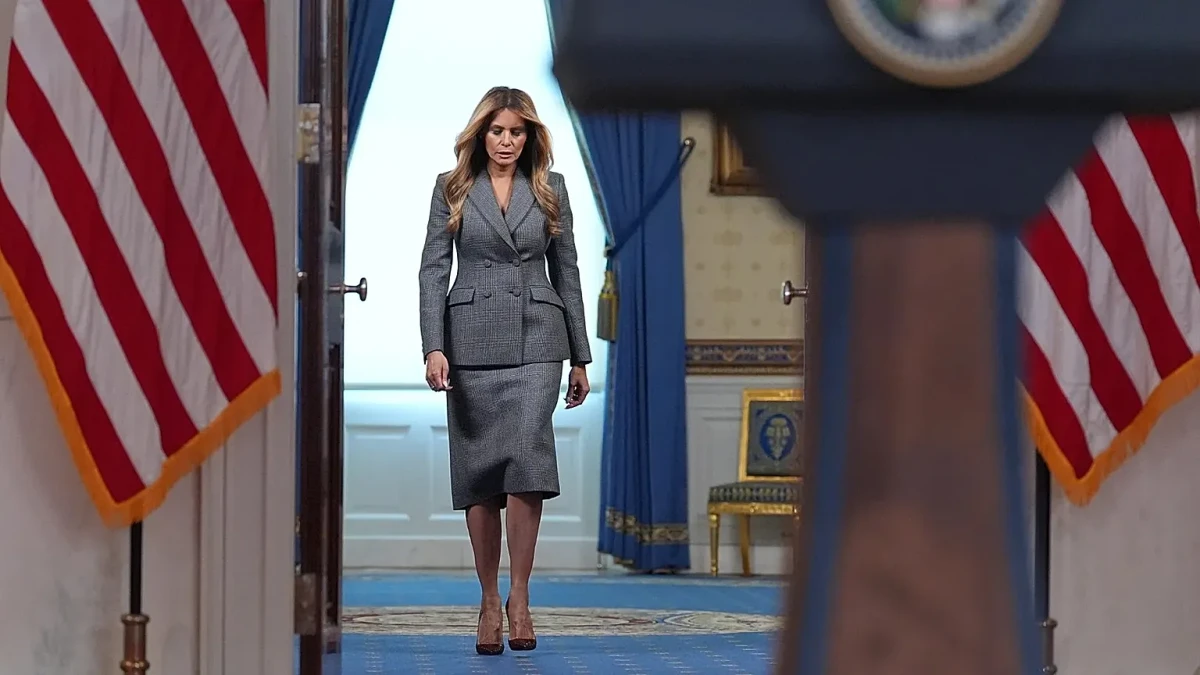
WASHINGTON, UNITED STATES — Melania Trump’s role in securing a humanitarian ceasefire in Oleshky has raised her political profile, but constitutional requirements make a 2028 presidential or vice-presidential campaign legally impossible.
The first lady’s meeting with Ukrainian and Russian representatives at the White House marked an unusual diplomatic intervention at a time when President Donald Trump’s promises to end major wars remain unfulfilled. Yet increased visibility should not be confused with evidence that she is preparing to seek elected office.
The Oleshky ceasefire created a new diplomatic role
According to a November 5 statement from the White House, Melania Trump acted as an intermediary in arranging a localized ceasefire in Russian-occupied Oleshky, in Ukraine’s Kherson region.
The six-day pause in fighting was designed to allow humanitarian assistance into the area and enable civilians to leave through a designated safe passage. The first lady said nearly 800 people were able to evacuate during the operation.
Melania Trump said she had reviewed demining plans, aerial images, road conditions, evacuation routes, hospital access, transportation requirements and available medical resources during preparations for the mission.
She later hosted Ukrainian representatives Davyd Arakhamia and Dmytro Lubinets, along with Russian representatives Kirill Dmitriev and Yana Lantratova, at the White House.
The meeting was not presented as a formal round of peace negotiations. Nevertheless, it gave the first lady an unusually direct role in wartime diplomacy and placed her at the centre of an initiative involving officials from two countries actively at war.
Does diplomatic visibility indicate political ambition?
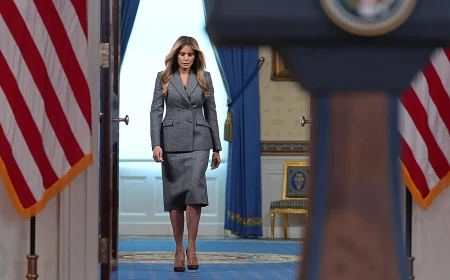
The Oleshky operation represents a significant departure from Melania Trump’s traditionally limited presence in electoral politics. She appeared only occasionally during Donald Trump’s 2024 campaign and did not maintain the schedule normally expected of a presidential candidate’s spouse.
The Washington Post reported that she also stayed away from the Republican Party’s September 2026 midterm convention, continuing a pattern of carefully selected public appearances.
Her recent Ukraine-related activities therefore appear notable. She has delivered foreign-policy remarks, communicated with the leaders of Ukraine and Russia, hosted officials at the White House and received a Ukrainian state decoration.
However, none of those actions establishes that she is preparing a presidential campaign. She has not publicly announced an intention to run, introduced an electoral programme or begun campaigning among Republican primary voters.
The available evidence points more strongly to the development of an independent first-lady platform focused on humanitarian diplomacy than to preparations for elected office.
The constitutional barrier is decisive
Even if Melania Trump wanted to run in 2028 and received significant support from Republican voters, she would face an insurmountable constitutional obstacle.
Article II of the U.S. Constitution requires the president to be a “natural born Citizen.” This generally means that the individual must have held U.S. citizenship from birth rather than acquiring it later through naturalization.
Melania Trump was born in Slovenia on April 26, 1970. According to her official White House biography, she became a naturalized American citizen after moving to the United States. She received U.S. citizenship in 2006.
This places her outside the Constitution’s presidential eligibility requirement. The legal debate surrounding the term “natural born Citizen” has largely concerned people born abroad who acquired American citizenship automatically at birth through an American parent. That ambiguity does not apply to someone who became a citizen through naturalization as an adult.
The 12th Amendment also states that a person constitutionally ineligible to serve as president cannot serve as vice president. Melania Trump therefore could not reach the presidency through a vice-presidential candidacy.
Changing this restriction would require a constitutional amendment supported by two-thirds of both chambers of Congress and ratified by three-quarters of the states. Under current political conditions, such a change is not considered realistic.
Donald Trump cannot seek another elected term either
Donald Trump has been elected president twice, serving as the 45th and 47th president of the United States. The 22nd Amendment prohibits anyone from being elected to the presidency more than twice.
His occasional references to a third term may generate political attention, energize supporters or reinforce his control over the Republican Party. They do not provide a lawful route to another presidential election under the existing Constitution.
The Trump family’s direct continuation in the White House would consequently have to involve another constitutionally eligible relative. Melania Trump cannot fill that role, regardless of her name recognition or popularity within parts of the Republican electorate.
Donald Trump Jr., who was born in the United States and is old enough to serve, does not face the same constitutional problem. He is already included in some Republican primary polling, although he remains behind the leading contenders.
Trump’s peace narrative faces a widening credibility gap
Donald Trump repeatedly claimed during the 2024 campaign that he could end the Russia-Ukraine war rapidly, sometimes saying it could be resolved within 24 hours. The war remained unresolved in November 2026.
His administration has also faced an eight-month conflict with Iran and continuing instability across the Middle East. Reuters reported that the Iran war, rising fuel prices and public dissatisfaction with foreign interventions contributed to Republican losses in the 2026 midterm elections.
Against that background, Melania Trump’s Oleshky initiative offers the administration a limited but visible diplomatic success. A temporary humanitarian truce that saves civilian lives is significant, but it is not equivalent to a nationwide ceasefire or a political settlement ending the Ukraine war.
The Oleshky arrangement expired after six days and applied only to a defined area. No timetable, enforcement mechanism or wider agreement was announced for extending it across the front.
Melania Trump’s call for something more enduring than a temporary ceasefire therefore carries humanitarian and symbolic importance. It does not resolve the broader strategic disagreements between Kyiv and Moscow.
The Republican field is led by Vance and Rubio
The early Republican contest for 2028 is currently centred on Vice President JD Vance and Secretary of State Marco Rubio, not Melania Trump.
The RealClearPolling national average covering surveys conducted between July 19 and November 1, 2026, placed Vance at approximately 39% and Rubio at about 26%. Donald Trump Jr. followed with nearly 10%, while former Florida Governor Ron DeSantis registered roughly 8%.
These numbers should not be treated as a reliable forecast two years before the election. The economy, the Iran conflict, the outcome of Ukraine negotiations and Donald Trump’s eventual endorsement could substantially reshape the Republican field.
Nevertheless, the polling reveals where party activists currently see plausible succession options. Melania Trump is not included among the principal candidates, while Vance and Rubio already possess national campaign networks, executive experience and established relationships with Republican donors.
Melania Trump could still become politically influential
Constitutional ineligibility for the presidency does not prevent Melania Trump from exercising political influence or holding most other public positions.
Naturalized citizens may serve in Congress if they meet the relevant age, residency and citizenship-duration requirements. They can also undertake diplomatic, advisory and administrative roles that do not require presidential eligibility.
Melania Trump could continue building a portfolio involving humanitarian corridors, displaced children, civilian evacuations, prisoner exchanges and localized ceasefires. Additional successful operations could strengthen her international reputation and give her a distinctive position within the Trump political network.
She could also influence the 2028 Republican nomination by endorsing a candidate, campaigning on humanitarian issues or helping define how the party presents Donald Trump’s foreign-policy legacy.
The evidence therefore supports a more limited conclusion than speculation about a presidential campaign. Melania Trump appears to be developing an independent diplomatic identity and may become a more influential political figure. Under the current U.S. Constitution, however, her probability of becoming the Republican presidential nominee is not merely low: she is legally ineligible to serve as president.
WiseNewsPress.com
What's Your Reaction?
 Like
0
 Dislike
0
 Love
0
 Funny
0
 Wow
0
 Sad
0
 Angry
0
Yusuf İnan is a journalist, columnist, strategic analyst and head of the Wise News Press Media Group. His work focuses on international affairs, geopolitics, security and major social issues. Through his journalism, he promotes peace, dialogue, mutual understanding and responsible reporting while contributing to the development of international media projects.














Comments (0)