



Far-right AfD surges five points ahead of conservatives in Germany
A new poll shows Germany's far-right AfD party reaching 27 percent, pulling five points ahead of the conservative bloc amid growing economic dissatisfaction.


By Ahmet Taş | Wise News Press
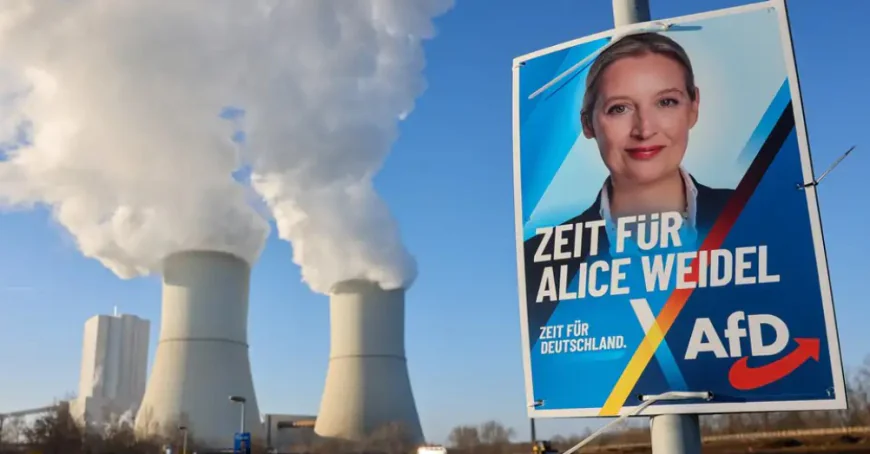
BERLIN, GERMANY — Germany's far-right Alternative for Germany (AfD) party has surged to 27 percent in a new public opinion poll, opening a decisive five-point lead over Chancellor Friedrich Merz's conservative bloc.
Fueled by mounting inflation tied to the Iran war and widespread public dissatisfaction with the ruling coalition's domestic reforms, the AfD's continued rise underscores a profound shift in the country's political landscape. As the traditional center-right struggles to maintain its voter base, the populist party is capitalizing on economic anxieties and foreign policy debates to solidify its position as the leading political force in national surveys.
Forsa poll reveals widening gap
The latest data, gathered by the Forsa institute for RTL television between April 21 and 27, highlights a dramatic shift in voter preferences among the 2,503 participants. According to the results, support for the AfD increased by one point to reach 27 percent. In contrast, the conservative bloc comprising the Christian Democratic Union and the Christian Social Union (CDU/CSU) lost two points, falling to 22 percent.
This upward trajectory for the far-right is not an isolated finding. A separate survey conducted by INSA for the Bild newspaper over the weekend measured the AfD's vote share at a record-breaking 28 percent. Despite being under surveillance by German intelligence services due to extremist tendencies, the party—which emerged as the second-largest force in last year's elections and secured its status as the largest opposition group—continues to expand its reach.
Chancellor Merz faces record disapproval
The polling data also reveals a severe crisis of confidence regarding the country's leadership. Satisfaction with the performance of CDU Chancellor Friedrich Merz is rapidly declining. Only 15 percent of respondents stated that they were satisfied with Merz, marking a sharp three-point drop compared to the previous week.


Conversely, the proportion of Germans who explicitly disapprove of the Chancellor's performance has climbed to a staggering 83 percent. Political analysts point out that Merz's inability to project stability during ongoing economic crises has alienated both centrist voters and the conservative base, directly benefiting the AfD.
Economic anxiety and foreign policy shifts
The growing interest in the AfD is heavily driven by domestic financial concerns and geopolitical fatigue. Dissatisfaction with Merz's coalition government regarding economic management, coupled with inflation fears triggered by the war in Iran, has pushed voters toward alternative solutions in recent weeks.
In this climate, the AfD's populist platform is gaining significant traction. The party's promises include halting military support to Ukraine, reaching an agreement with Russia to secure cheap natural gas, and returning to nuclear energy alongside increased fossil fuel usage to guarantee supply security. However, these proposals have sparked intense concern among a broad segment of society, with critics warning that such policies would mean stepping back from international law, European security commitments, and vital climate goals.


Coalition struggles over domestic reforms
Further complicating the political environment is the intense infighting within the current coalition government over structural reforms. Recent weeks have seen bitter disputes regarding the national budget.
Planned regulations aimed at enforcing austerity measures within the health insurance and pension systems have drawn fierce backlash from citizens. The government's push for savings in these critical social safety nets has left many voters feeling economically vulnerable, creating a fertile ground for the AfD's anti-establishment rhetoric.
Shifting political landscape
The Forsa poll also sheds light on the standing of other political factions amidst this polarization. The Greens currently hold the third position with 15 percent of voter support.
Meanwhile, the Social Democratic Party (SPD), a partner in the government coalition, is languishing at 12 percent. The Left Party (Die Linke) saw a one-point increase, tying with the SPD at 12 percent. These figures suggest an ongoing fragmentation of Germany's traditional political center, as both left-wing and right-wing alternatives absorb voters frustrated by the current administration's policies.
What's Your Reaction?
 Like
0
Like
0
 Dislike
0
Dislike
0
 Love
0
Love
0
 Funny
0
Funny
0
 Wow
0
Wow
0
 Sad
0
Sad
0
 Angry
0
Angry
0

Editor | Wise News Press — Delivering accurate, timely global news with integrity, insight, and editorial responsibility.





















Comments (0)