



Who is Olena Zelenska? From Kiyashko to Ukraine’s First Lady role
Born Olena Kiyashko, Olena Zelenska moved from architecture and screenwriting to a public role shaped by social reform, diplomacy and wartime advocacy.


By Ahmet Taş | Wise News Press
ANKARA, TÜRKİYE — Born Olena Kiyashko in Kryvyi Rih, Olena Zelenska followed a path from architectural studies and television screenwriting to becoming one of Ukraine’s most visible figures in social diplomacy.
Her life can be divided into three principal stages: her work with Studio Kvartal 95 from 2003, her public responsibilities after becoming First Lady on May 20, 2019, and her wartime humanitarian advocacy following Russia’s full-scale invasion.
Kiyashko and Zelenska are the same person
Olena Volodymyrivna Zelenska was born Olena Kiyashko on February 6, 1978, in Kryvyi Rih, a city in Ukraine’s Dnipropetrovsk region. The names Olena Kiyashko and Olena Zelenska do not refer to two different people; they identify the same woman at different stages of her life.
She adopted the surname Zelenska after marrying Volodymyr Zelenskyy in 2003. As a result, biographical information covering her childhood, education and early career may appear under Kiyashko, while later public records predominantly use Zelenska.
Kiyashko and Zelenskyy grew up in the same city. Although they attended the same school in different classes, they became closely acquainted during their university years. Their marriage took place long before Zelenskyy entered politics or announced his presidential candidacy.
Searches for Olena Kiyashko therefore lead to the early chapters of the same life story that later became internationally known under the name Olena Zelenska.
From architecture to screenwriting
Zelenska attended School No. 95 in Kryvyi Rih before enrolling in the civil engineering faculty of Kryvyi Rih Technical University. She studied architecture and completed her university education in 2000 but did not pursue a professional career in the field.
Her career took a different direction when she became involved in television, comedy and script development. She joined the creative team formed by Volodymyr Zelenskyy and his colleagues, contributing as a writer rather than appearing in front of the camera.
After Studio Kvartal 95 was established in 2003, Zelenska became part of its writing team. She worked for years on television and entertainment productions, including the comedy programme “Vechirniy Kvartal,” widely known in English as “Evening Kvartal.”
Her work remained largely behind the scenes. While performers became familiar faces to television audiences, Zelenska helped develop scripts, story structures and the language used in the studio’s productions.
This experience later became relevant to her public responsibilities. Years spent working with texts, narratives and audiences gave her a background in preparing messages, shaping campaigns and communicating complex subjects to different sections of society.
A new public role began in 2019
Volodymyr Zelenskyy was inaugurated as president on May 20, 2019, making Olena Zelenska the First Lady of Ukraine. The change brought a screenwriter who had spent most of her professional life behind the camera into a highly visible national role.
Her responsibilities were not limited to official ceremonies, diplomatic receptions or accompanying the president during state events. Children’s nutrition, accessibility, equal opportunities and cultural diplomacy became central parts of her public programme.
The position of First Lady is not a separately elected state office. Its scope is largely shaped by the initiatives adopted by the person holding the role. Zelenska developed projects involving government ministries, local authorities, civil society organisations and international partners.
Her public identity consequently became associated not only with being the president’s wife but also with social programmes carrying specific goals. The transition from a relatively private working life to continuous public responsibility marked one of the most significant changes in her personal and professional journey.
School nutrition and a barrier-free society
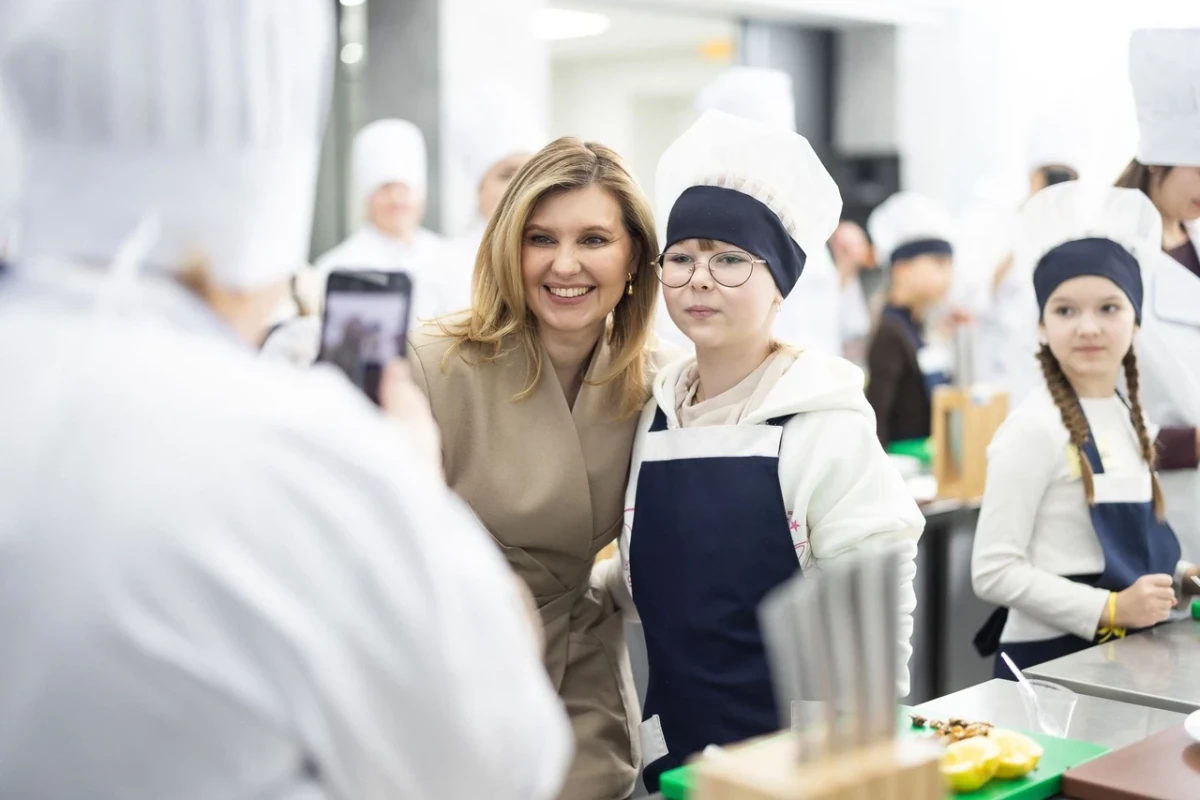
One of Zelenska’s most prominent initiatives has been Ukraine’s school nutrition reform, launched in 2020. The programme aims to provide children with healthier and more balanced meals while modernising school kitchens and improving food preparation standards.
The reform also seeks to encourage healthy eating habits among children and their families. Its implementation requires cooperation among educational institutions, health authorities, local governments, school administrations and catering professionals.
Russia’s full-scale invasion created serious challenges for schools across Ukraine. Educational buildings were damaged, millions of people were displaced and many children were forced to continue their studies under emergency conditions. Despite the war, the nutrition programme continued in safer regions and institutions serving displaced pupils.
Another major area of Zelenska’s work has been the development of a barrier-free society. The concept extends beyond the removal of physical obstacles from buildings and public spaces. It also covers equal access to education, employment, information, digital services and public institutions.
The issue became more urgent during the war as the number of civilians, veterans and children living with injuries or disabilities increased. Accessibility is therefore presented not as a limited social policy but as an essential principle for Ukraine’s future reconstruction.
The objective is to ensure that rebuilt cities, schools, hospitals and public institutions can be used safely and independently by people of different ages, physical conditions and social backgrounds.
Ukrainian-language audio guides abroad
Cultural diplomacy has formed another significant part of Zelenska’s programme. One of its most visible projects involves introducing Ukrainian-language audio guides at museums, galleries, historic monuments and tourist attractions around the world.
By April 2025, the initiative had produced 97 Ukrainian-language audio guides across 52 countries. The project allows Ukrainians living or travelling abroad to learn about international cultural sites in their native language.
The programme has also helped increase the presence of Ukrainian in major cultural institutions. It represents an effort to present Ukraine’s language and identity internationally beyond daily reports about war and political developments.
Ukrainian bookshelves established in foreign libraries complement the audio-guide initiative. These collections make Ukrainian literature, history and cultural works more accessible to readers abroad while supporting Ukrainians displaced by the war.
Together, the audio guides and bookshelves illustrate how language can be used as an instrument of cultural diplomacy. They also contribute to the international recognition of Ukrainian as a language of culture, education and historical memory.
Responsibilities transformed by war
Russia’s full-scale invasion on February 24, 2022, significantly altered Zelenska’s priorities. Her existing work on education, nutrition and culture expanded to include humanitarian assistance, mental health, medical support and the protection of children affected by war.
She addressed the United States Congress on July 20, 2022, calling for stronger protection of Ukrainian civilians and additional air defence systems. She became the first spouse of a foreign head of state to address the US Congress.
Her speech focused on the human consequences of the invasion, particularly its effects on children, parents and families. She presented Ukraine’s request for military assistance as a matter of protecting civilian lives, homes and the basic right to live in safety.
The appearance showed how her public position had expanded from domestic social initiatives to international wartime advocacy. She subsequently participated in meetings and events in several countries, urging governments and international organisations to maintain humanitarian and political support for Ukraine.
Mental health also became a major concern. Millions of Ukrainians were exposed to displacement, bereavement, air raids and prolonged uncertainty. Programmes addressing psychological well-being were therefore incorporated into broader recovery efforts.
The Olena Zelenska Foundation
Zelenska presented the charitable foundation bearing her name at an event in New York on September 22, 2022, during the 77th session of the United Nations General Assembly.
The foundation initially focused on education, healthcare and humanitarian assistance. Its work later expanded to include access to education, school shelters, family-based care and psychosocial support for children and young people.
It has supported projects designed to help pupils continue their education in safer conditions, including the restoration and equipment of learning facilities damaged during the war. Assistance for foster families and family-based alternatives to institutional care has also become an important part of its programme.
The foundation works with international partners, donors and organisations seeking to support Ukrainian children. Its projects reflect the principle that childhood and education cannot simply be postponed until the war ends.
Zelenska’s wartime public role also attracted international recognition. She was included in the BBC’s 100 Women list in 2022 and was named among TIME magazine’s 100 most influential people in 2023.
The journey from Olena Kiyashko to Olena Zelenska is not a collection of unrelated careers. Her architectural education, years of screenwriting, public responsibilities after 2019 and international humanitarian work after 2022 represent successive stages of a continuing transformation.
Today, Zelenska’s public identity is shaped by more than the title of First Lady. It is also associated with school nutrition, accessibility, cultural diplomacy, child protection and international efforts addressing the human consequences of war.
WiseNewsPress.com
What's Your Reaction?
 Like
0
 Dislike
0
 Love
0
 Funny
0
 Wow
0
 Sad
0
 Angry
0
Ahmet Taş is a journalist, editor and Turkey Office Manager of the Wise News Press Media Group. He works across news, digital media and international publishing, focusing on accurate, responsible and accessible journalism. He contributes to the development of media projects that bring important political, social and global developments to a wider international audience.









Comments (0)