



Putin says Sarmat missile will enter combat duty this year
Vladimir Putin said Russia’s Sarmat intercontinental ballistic missile will enter combat duty by the end of 2026, raising new security concerns in the West.


By Ahmet Taş | Wise News Press
ANKARA, TÜRKİYE — Russian President Vladimir Putin said Russia will place its Sarmat intercontinental ballistic missile system on combat duty by the end of 2026.
The announcement came as Russia’s war in Ukraine continues and security tensions between Moscow and the West remain high. Putin described Sarmat as “the most powerful missile system in the world” after Russia said it had successfully tested the heavy liquid-fueled intercontinental ballistic missile. Reuters reported that Putin claimed the missile could have a range of more than 35,000 kilometers and could penetrate existing and future missile defense systems.
Kremlin says test was successful
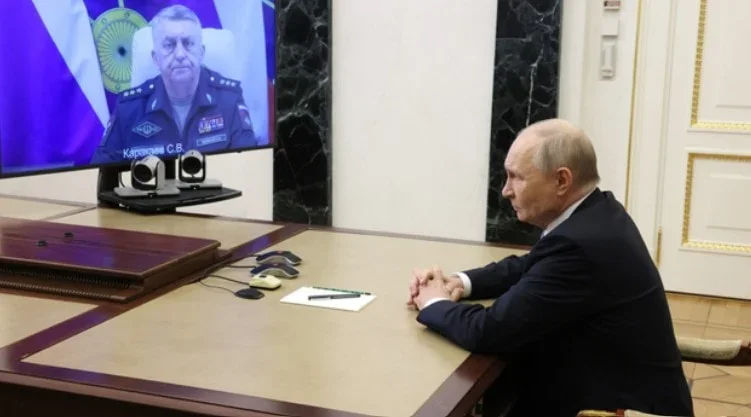
Sergei Karakayev, commander of Russia’s Strategic Missile Forces, reported to Putin on May 12 that the latest Sarmat test launch had been completed successfully.
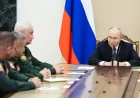
Russian state media showed Karakayev briefing Putin by video link. According to Russian accounts, Karakayev said the launch mission had been completed and that the results confirmed the correctness of the missile’s design and technological solutions.
Putin described the test as a major success and said the system would be placed on combat duty by the end of the year. Ukrainska Pravda, citing Russian state media, reported that the missile is expected to be deployed in the Uzhur formation in Krasnoyarsk Krai.
Putin calls Sarmat the world’s most powerful missile
Putin said Sarmat would strengthen Russia’s strategic deterrence capabilities. He claimed the missile could fly not only on a ballistic trajectory but also along a suborbital path.


According to Sky News, Putin said the missile’s range could exceed 21,750 miles, or 35,000 kilometers, and that it could penetrate all current and future anti-missile defense systems. Sky News also reported that Karakayev told Putin the deployment of Sarmat-equipped launchers would significantly enhance Russia’s ground-based strategic nuclear forces.
The RS-28 Sarmat, known in the West as “Satan II,” was developed to replace the Soviet-era Voyevoda missile system. AP reported that Sarmat is part of Russia’s broader effort to modernize its nuclear triad, which includes intercontinental ballistic missiles, submarine-launched ballistic missiles and strategic bombers.
Security concerns rise in the West
The announcement comes at a time when European security has been reshaped by Russia’s war in Ukraine. Moscow’s repeated emphasis on nuclear capability has deepened concerns in Western capitals about escalation and a possible renewed arms race.


Reuters reported that Sarmat is designed to deliver nuclear warheads over long distances, including against targets in the United States and Europe. The same report noted that the system has faced years of delays and previous failures, including a reported 2024 test failure that left a crater at a launch site, according to Western experts.
Western security analysts have also cautioned that some of Putin’s claims about Russia’s new-generation nuclear weapons may be exaggerated. Still, the political message of the Sarmat announcement is considered significant regardless of the missile’s precise technical performance.
Strategic message amid the Ukraine war
Putin’s remarks came as Moscow continues to send mixed messages about war, diplomacy and deterrence. While Russia has at times spoken about possible negotiations, it has also repeatedly highlighted its strategic weapons.
Analysts view this as a dual message. On one hand, Moscow seeks to show that diplomatic options remain possible. On the other, it uses nuclear deterrence language to remind Ukraine and the West of Russia’s military capabilities.
AP noted that the announcement followed Putin’s claims that the war in Ukraine was nearing an end and came after a more subdued Victory Day parade that did not feature heavy weapons. The timing adds political weight to the Sarmat statement, which can be read as both a domestic message of strength and an external warning.
Why the Sarmat system matters
Sarmat is a heavy intercontinental ballistic missile designed to carry nuclear warheads across very long distances. Russia says it can carry multiple warheads and evade missile defense systems through range, trajectory and payload capacity.
For Moscow, the system is not only a new missile but also a symbol of strategic modernization. It is intended to replace the older Voyevoda system and reinforce Russia’s land-based nuclear forces.
Karakayev said deployment of the system would increase the combat capabilities of Russia’s strategic nuclear forces by improving their ability to guarantee target destruction and fulfill strategic deterrence tasks. That message is central to the Kremlin’s public framing of Sarmat.
Technical claims remain disputed
Russia has presented Sarmat as a breakthrough system with exceptional range and destructive capacity. Putin said the missile’s warhead yield is more than four times greater than that of any powerful Western equivalent, according to reports cited by Sky News and Ukrainska Pravda.
However, independent verification of such claims is difficult. Military analysts often warn that official statements about strategic weapons can serve political and psychological purposes as much as technical ones.
Reuters noted that Sarmat’s planned deployment follows years of delays and setbacks. For Moscow, the announcement of a successful test therefore carries domestic significance as well, offering a message of technological achievement and national strength.
Arms race fears return
The planned deployment of Sarmat is likely to intensify debate over global nuclear security. Uncertainty around arms control agreements between Russia and the United States has already made strategic weapons modernization a more sensitive issue.
AP reported that Russia is also advancing or promoting other systems, including the Avangard hypersonic glide vehicle, the Poseidon underwater drone, the Burevestnik nuclear-powered cruise missile and the Oreshnik missile system. These programs reflect Moscow’s effort to maintain strategic parity with Washington and respond to U.S. missile defense developments.
Experts say such developments may push Europe to increase defense spending, strengthen NATO deterrence planning and deepen the long-running trust crisis between Russia and the West.
Political impact likely to continue
Putin’s Sarmat announcement matters not only for military capability but also for its political and psychological effect. While the Ukraine war continues, Moscow is using strategic weapons language to project strength and influence Western decision-making.
For Russia, Sarmat is presented as a symbol of military power and nuclear deterrence. For Western governments, it is another reminder of the nuclear risks surrounding the war in Ukraine and the fragile state of global arms control.
The missile’s planned deployment at the end of 2026 will therefore be watched closely by governments, security analysts and NATO planners. Whether seen as a genuine technological leap or a strategic message, Sarmat has again placed nuclear deterrence at the center of the Russia-West confrontation.
What's Your Reaction?
 Like
0
Like
0
 Dislike
0
Dislike
0
 Love
0
Love
0
 Funny
0
Funny
0
 Wow
0
Wow
0
 Sad
0
Sad
0
 Angry
0
Angry
0

Editor | Wise News Press — Delivering accurate, timely global news with integrity, insight, and editorial responsibility.

















Comments (0)