



Solar eclipse in Aquarius triggers global tensions and seismic risks
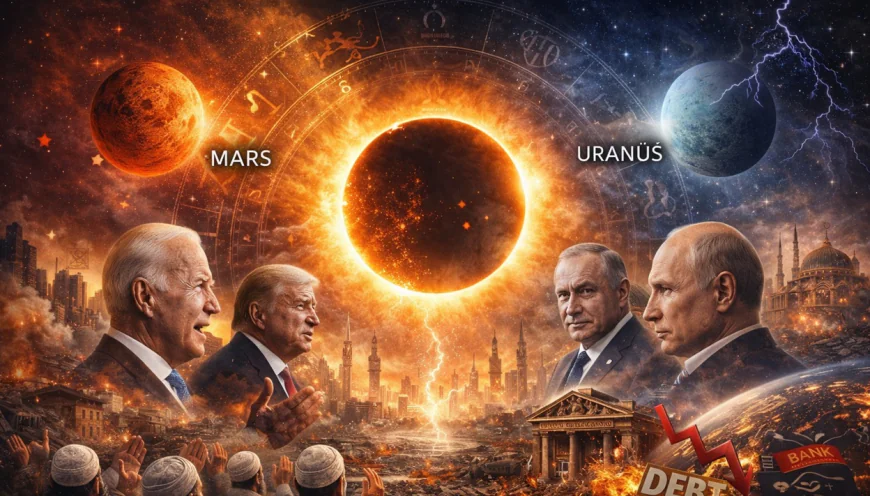
The February 17 solar eclipse in Aquarius signals a period of military tension, seismic activity, and major political shifts affecting world leaders.


By Ahmet Taş | Wise News Press
ANKARA, TÜRKİYE — The first solar eclipse of 2026, occurring on February 17 in the sign of Aquarius, has initiated a series of significant astrological triggers that experts warn could result in heightened military tensions, financial volatility, and increased seismic activity globally. While the annular eclipse was not visible from Turkey, its astrological influence is expected to persist for over two years, impacting international relations and systemic structures.
The eclipse reached its peak at 15:01 (Turkey time) at 28 degrees of Aquarius. According to astrological analyses, the prominent role of Mars in this event points toward harsh, aggressive, and military-focused energies that may dominate the coming weeks.
Heightened Global Military and Political Risks
The geopolitical landscape appears particularly vulnerable as the eclipse triggers sensitive degrees in the charts of several world leaders and nations. The "Mars line" associated with this event passes through the United Kingdom, Spain, and North Africa, suggesting potential for civil unrest, protests, and reactive movements in cities like London, Paris, and Madrid.
Furthermore, the astrological charts of Donald Trump and Benjamin Netanyahu are specifically triggered, indicating a highly active and aggressive period for the U.S. and Israel. Analysts suggest an increased risk of security breaches or military escalations in regions including Palestine, Greece, Poland, and the European Union. In Russia, the chart of Vladimir Putin is also under influence, hinting at more coercive actions toward NATO and Europe.
Seismic Activity and Digital Infrastructure Crises
A critical trigger point is expected around March 1, when Uranus—currently positioned near the fixed star Algol—squares the eclipse degree. This configuration is historically associated with significant seismic activity, raising the possibility of major earthquakes between February 16-20 and peaking again toward the end of the month.


Beyond geological risks, the harsh interaction between Mars and Uranus on February 27-28 could lead to crises in digital systems, communication networks, and large-scale power outages. This "electric" atmosphere is expected to challenge the stability of modern infrastructure.
Economic Stress and Diplomatic Opportunities
For Turkey, the eclipse falls into the 8th house of the national astrology chart, which governs external debts, banks, and credits. This suggests a stressful period for the management of the economy, with potential crises regarding credit card debt, individual bankruptcies, and payment balances.
However, a more positive alignment involving a Venus-Jupiter trine on February 22 may provide a window for diplomatic breakthroughs. This period could bring opportunities for foreign-linked trade, export incentives, and new financial agreements that may help alleviate current fiscal stresses.


A New Era: The Shift Toward Collective Ideals
Despite the immediate tensions, the Aquarius eclipse emphasizes themes of equality, democracy, and freedom. It is viewed as a catalyst for revolutionary reforms in technology, aviation, and space sciences. This period marks a transition where outdated rules are expected to be replaced by modern, progressive structures.
The transition is further solidified by the conjunction of Saturn and Neptune at 0 degrees Aries on February 20, signaling the start of a completely new cycle that demands realistic courage and the pursuit of genuine ideals.
What's Your Reaction?
 Like
0
Like
0
 Dislike
0
Dislike
0
 Love
0
Love
0
 Funny
0
Funny
0
 Wow
0
Wow
0
 Sad
0
Sad
0
 Angry
0
Angry
0

Editor | Wise News Press — Delivering accurate, timely global news with integrity, insight, and editorial responsibility.





















Comments (0)