



Drone strike hits Mykolaiv power grid as water threat looms
Russian Shahed drones targeted Mykolaiv's energy infrastructure causing power outages, while officials warn of impending summer attacks on the water supply.



By Ahmet Taş | Wise News Press
MYKOLAIV, UKRAINE — Russian forces launched a coordinated wave of "Shahed" drone attacks on the southern Ukrainian city of Mykolaiv on Wednesday afternoon, striking a critical energy facility and leaving residential districts in the dark.
As emergency crews scramble to restore electricity to the affected areas, Ukrainian intelligence and utility authorities are sounding the alarm over an even more severe impending crisis. With the grueling summer months rapidly approaching, the systematic targeting of the power grid is widely viewed as a precursor to a broader Russian military campaign aimed at crippling the country's highly vulnerable water supply networks, threatening to leave millions without access to clean drinking water.
Shahed drones disable power grid
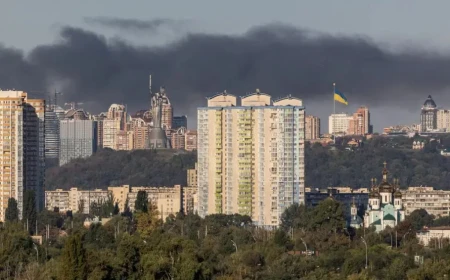
The immediate crisis unfolded on Wednesday afternoon when Iranian-designed kamikaze drones penetrated the regional airspace, making a direct hit on a vital energy installation. The strike triggered a localized blackout, disrupting daily life and essential services across various parts of the city and its surrounding rural communities. Following the explosion, residents documented thick plumes of black smoke rising over the city's skyline.
Vitalii Kim, the Head of the Mykolaiv Regional Military Administration, confirmed the incident in an official statement, noting that the Russian military deliberately targeted the region's energy infrastructure. He stated that the strike caused immediate power disconnections for numerous subscribers within the Mykolaiv district. However, Kim provided a note of relief, adding that rapid repair operations were already underway and, as of the initial assessments, no casualties had been reported. Mykolaiv Mayor Oleksandr Senkevych further clarified the situation, indicating that the power outages were primarily concentrated in the city's Korabelnyi district. Senkevych urged residents to remain calm, assuring the public that the municipal government continues to operate normally and the situation remains under control.
Second wave targets the Black Sea coast
The threat to the region did not subside with the initial afternoon strike. As repair crews worked to stabilize the grid, the Ukrainian Air Force issued fresh warnings. At exactly 17:28 local time, air raid sirens wailed once again across the Mykolaiv region.


Military officials reported that a new swarm of hostile unmanned aerial vehicles (UAVs) had been launched from the waters of the Black Sea, heading directly toward the Mykolaiv operational zone. Independent monitoring channels tracked the trajectory of the incoming drones, indicating that they were heavily concentrated on the strategic coastal city of Ochakiv. This persistent aerial harassment highlights Russia's ongoing strategy to exhaust local air defenses and maintain psychological and physical pressure on southern Ukraine's civilian populations.
Summer threat to vulnerable water nodes
While the energy sector currently bears the brunt of the drone strikes, Ukrainian officials are bracing for a catastrophic shift in Russian targeting parameters. According to defense analysts and reports gathered by RBC-Ukraine, the primary objective of the upcoming summer offensive will likely be the nation's critical water intake nodes and pumping stations.



The destruction of these highly specialized facilities would immediately halt the delivery of piped water. Unlike the power grid, which can sometimes reroute electricity through alternative lines, severe damage to a primary water intake facility cannot be bypassed easily. Authorities estimate that restoring a destroyed water pumping station could take several weeks, during which entire cities would be entirely reliant on emergency water distributions in extreme summer heat.
The fragility of single-intake systems
The fundamental vulnerability of Ukraine's water infrastructure lies in its centralized design. Artem Shyra, Vice President of the Ukrainian Water Association, explained the dire architectural reality facing utility companies. He noted that most municipal systems operate on a single primary water intake mechanism.
Even in locations where a backup system was built, the secondary infrastructure is almost always situated immediately adjacent to the main facility. According to Shyra, a single accurate missile or drone strike at these coordinates would simultaneously obliterate both the primary and backup systems, resulting in an instantaneous and complete collapse of the local water supply.
Widespread risk across major cities
This infrastructural fragility is not limited to a single region. The Ukrainian government has identified a massive geographical arc of vulnerability that spans the entire eastern and southern fronts, as well as northern population centers.
The designated high-risk zones currently include the Mykolaiv region, Odesa, Kherson, Zaporizhzhia, Dnipropetrovsk, Kharkiv, Sumy, Chernihiv, the broader Donbas area, and the capital city, Kyiv. In these regions, a successful attack on the water grid would necessitate the immediate implementation of strict water rationing schedules. Because the water sector lacks a unified, centralized operator similar to the national energy grid, emergency response and rationing decisions will fall entirely on overwhelmed local municipal authorities.
Mobile stations and defense fortifications
To mitigate this existential threat, a nationwide campaign to fortify water infrastructure is actively underway. Critical pumping stations are being heavily reinforced with dense concrete structures, massive sandbag walls, and stone-filled gabions designed to absorb shrapnel and blast waves. Additionally, mobile air defense units are being strategically repositioned to shield these essential lifelines.
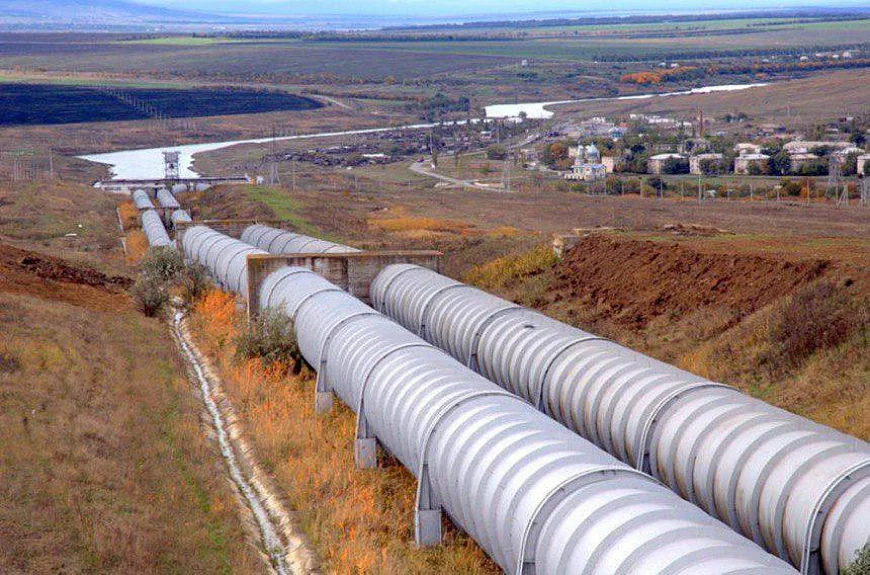
In the short term, municipal planners are evaluating the deployment of high-capacity mobile water intake stations. These portable units, capable of processing up to 300,000 cubic meters of water per day, are intended to act as rapid-response replacements if stationary facilities are destroyed. Looking toward long-term resilience, the Ukrainian Water Association is advocating for a complete architectural overhaul of the national water grid, pushing for a transition to multiple, decentralized water sources to eliminate the reliance on single, easily targeted nodes.
Newly built pipelines face renewed danger
For the residents of Mykolaiv, the prospect of losing running water brings back traumatic memories of the early days of the 2022 invasion, when Russian forces destroyed the primary Dnipro water pipeline. After enduring over a year of relying on corrosive, salty water that decimated indoor plumbing, the city finally secured a new lifeline.
The newly constructed main water pipeline into Mykolaiv was just activated on October 7, 2025. This massive engineering feat restored clean drinking water to the war-weary population. Now, as Russian Shahed drones once again darken the skies over the city and target nearby energy grids, the safety of this newly built water pipeline is severely threatened, leaving the city in a tense state of anticipation as the summer months draw near.
What's Your Reaction?
 Like
0
Like
0
 Dislike
0
Dislike
0
 Love
0
Love
0
 Funny
0
Funny
0
 Wow
0
Wow
0
 Sad
0
Sad
0
 Angry
0
Angry
0

Editor | Wise News Press — Delivering accurate, timely global news with integrity, insight, and editorial responsibility.




















Comments (0)