



Artemis II crew returns to Earth after successful lunar flyby
The historic Artemis II mission successfully concluded as the Orion capsule carrying four astronauts safely splashed down in the Pacific Ocean after nine days.


By Ahmet Taş | Wise News Press
HOUSTON, USA — The historic Artemis II mission, which carried humanity further from Earth than any previous expedition, has successfully concluded with the safe Pacific Ocean splashdown of the Orion capsule, named Integrity, and its four-person crew.
Touching down off the coast of San Diego, California, at approximately 20:07 EDT on Friday, April 10, the mission spanned exactly nine days, one hour, and 32 minutes. NASA officials hailed the flawless return as a "textbook landing," confirming that all four astronauts were in excellent medical condition. The successful completion of this lunar flyby marks a monumental milestone in the agency's renewed deep-space exploration efforts, definitively setting the stage for future crewed landings on the Moon's surface.
"Through a fireball": The intensity of re-entry
Following the splashdown, five specialized airbags immediately deployed to keep the spacecraft upright and stable in the water. Recovery teams patiently waited for the exterior of the capsule to cool down significantly before opening the hatch, as the re-entry phase through Earth's atmosphere is widely considered one of the most perilous segments of the entire mission.
Speaking from space prior to the descent, Artemis II pilot Victor Glover reflected on the gravity of their return. "Since April 3, 2023, when we were assigned to this mission, I have actually been thinking about the return to Earth," Glover stated. Admitting that he had not yet fully processed the magnitude of their journey, he added, "Passing through the atmosphere inside a fireball is quite impressive in itself."
A minute-by-minute anatomy of the descent
The Artemis II crew splashed down in the Pacific Ocean just 14 minutes after re-entering the Earth's atmosphere. According to data shared by NASA and global space monitors, the descent sequence was executed with absolute precision:


-
Separation: The Orion capsule detached from its service module, which had successfully guided the astronauts around the Moon and back. The service module subsequently burned up harmlessly in Earth's atmosphere.
-
Atmospheric Entry: Hurtling toward the landing zone at 35 times the speed of sound, the Orion spacecraft hit the upper atmosphere. The intense friction caused a buildup of electrically charged plasma around the capsule, resulting in a planned six-minute communications blackout with mission control.
-
Initial Deceleration: At an altitude of approximately 7,132 meters, the first set of drogue parachutes deployed to aggressively slow and stabilize the rapidly descending spacecraft.


-
Main Deployment: The three massive main parachutes unfurled, reducing Orion's velocity to under 61 meters per second and preparing the craft for its final descent phase.
-
Splashdown: The crew gently hit the waters of the Pacific Ocean right on schedule. NASA later confirmed that the capsule landed within a mere mile of its exact target coordinate.
-
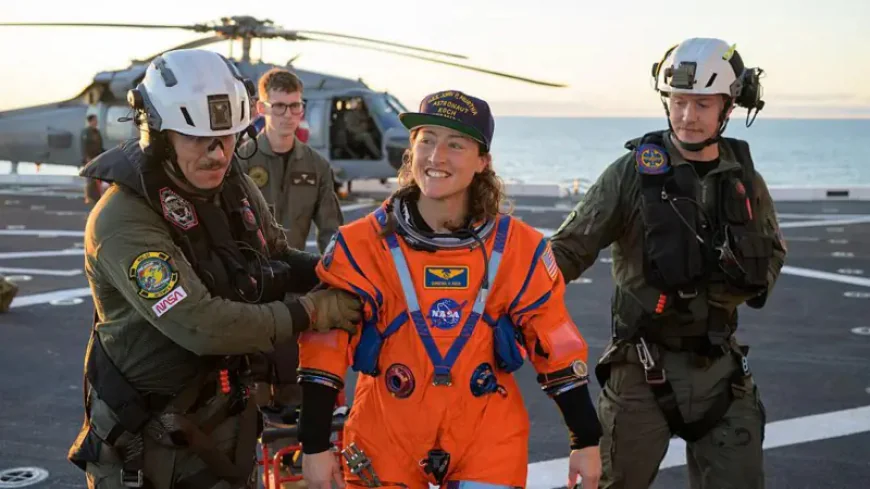
Recovery: For the first time in 10 days, the astronauts exited the spacecraft and were safely transferred to an inflatable recovery raft before being hoisted aboard the USS John P. Murtha naval ship for immediate medical evaluations.
The physical toll of deep space travel
Following their arrival on the Navy vessel, the astronauts underwent rigorous preliminary examinations by specialized medical teams. They were subsequently transported by helicopter to the mainland and flown directly to NASA's Johnson Space Center in Houston.
The physical demands of spaceflight are notoriously harsh on the human body. The absence of gravity during the Artemis II mission leads to rapid muscle and bone density loss. Medical experts note that the muscles most severely affected are those responsible for maintaining posture, specifically in the back, neck, and calves. Despite adhering to strict, mandatory exercise regimens while aboard the spacecraft, astronauts cannot completely prevent this atrophy. In a mission lasting just under two weeks, crew members can experience up to a 20 percent reduction in overall muscle mass.
In the final days leading up to their return, the crew meticulously prepared for the effects of Earth's gravity. Beyond reviewing splashdown protocols, they tested specialized pressure suits designed to mitigate the severe dizziness and blood pooling that often accompany the sudden reintroduction to a gravitational environment.
Precision engineering and the 2,700°C heat shield test
The success of the landing relied heavily on flawless physics and engineering. About 20 minutes before hitting the upper atmosphere, Orion positioned itself precisely so that its state-of-the-art heat shield would bear the brunt of the extreme thermal loads, protecting the astronauts inside.
Dr. Chris James from the Centre for Hypersonics at the University of Queensland highlighted the razor-thin margin for error during this phase. Pointing out that the spacecraft had to enter at a highly specific angle, he explained, "If they enter at the wrong angle, the vehicle burns up in the atmosphere. If they enter too high and generate a bit of lift, they can bounce right off the atmosphere. So it has to be a dead-on hit."
Rick Henfling, the flight director for Artemis II, noted during a pre-landing briefing that as Orion tore through the atmosphere at over 40,000 km/h, the friction heated the shield to an astonishing 2,700°C—roughly half the temperature of the surface of the Sun. This component had been heavily scrutinized after sustaining unexpected damage during the uncrewed Artemis I mission, but engineers were highly confident that optimized entry trajectories had resolved the vulnerability.
To prevent the crew from experiencing lethal G-forces, the spacecraft's entry angle was mathematically stretched, turning what could have been a brutal one-minute deceleration at 100 Gs into a manageable, albeit intense, five-minute atmospheric braking maneuver. Summarizing the high stakes of the operation, Dr. James concluded, "This is the fastest atmospheric entry by humans returning to Earth in the last 50 years. But still, a part of me won't completely relax until I see them safely back on Earth."
What's Your Reaction?
 Like
0
Like
0
 Dislike
0
Dislike
0
 Love
0
Love
0
 Funny
0
Funny
0
 Wow
0
Wow
0
 Sad
0
Sad
0
 Angry
0
Angry
0

Editor | Wise News Press — Delivering accurate, timely global news with integrity, insight, and editorial responsibility.




















Comments (0)