


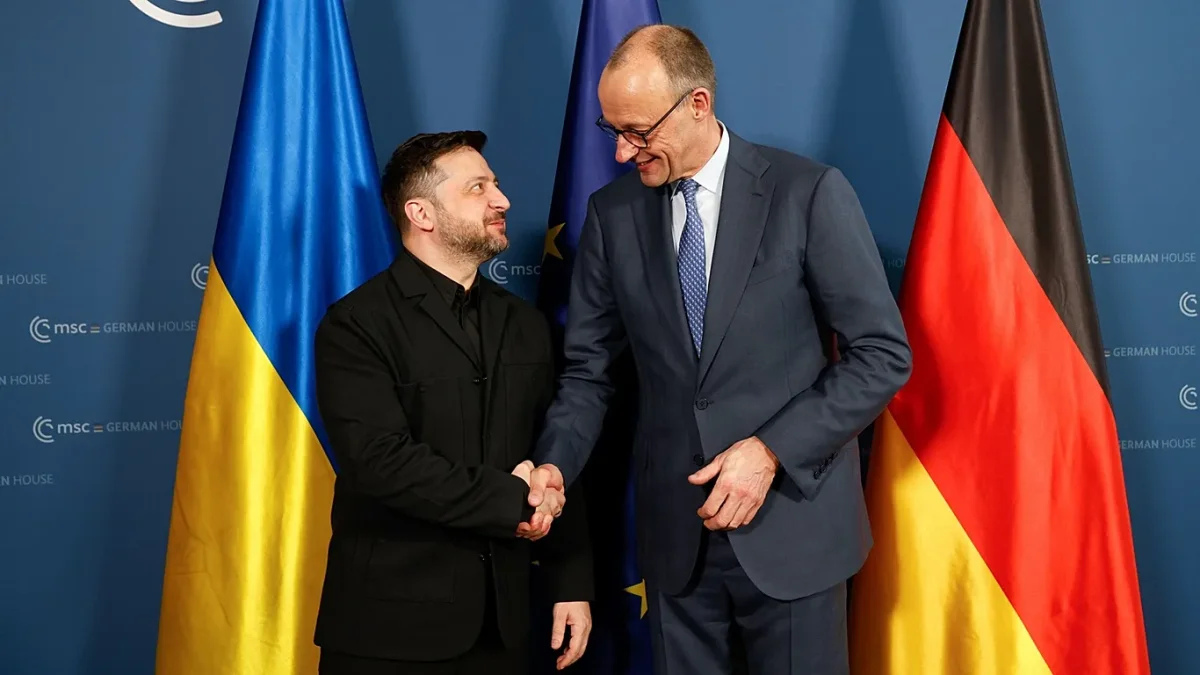
Merz proposes EU associate membership for Ukraine
German Chancellor Friedrich Merz has proposed an associate EU membership model for Ukraine before full accession, including access to security support.


By Yusuf İnan | Wise News Press
ANKARA, Turkey — German Chancellor Friedrich Merz has proposed that Ukraine become an “associate member” of the European Union before full accession, in a bid to break a two-year deadlock in Kyiv’s EU path.
According to a letter sent to EU leaders and seen by Euronews, Merz said it was clear that the accession process could not be completed quickly because of numerous obstacles and the political complexity of ratification procedures in several member states.
Merz argued that the EU must now move forward with “innovative solutions” to advance Ukraine’s integration as an urgent step.
Merz proposes an associate membership model
The “associate membership” model envisioned by Merz would give Ukraine closer access to EU decision-making structures before full membership.
Under the proposal, Kyiv would be able to participate in institutions such as the European Council, the European Commission and the European Parliament, but without voting rights or a dedicated commissioner portfolio.

The German chancellor’s plan is designed as an intermediate step between candidate status and full EU membership. It would not replace the normal accession procedure, but would run alongside it.
Merz said the model could provide Ukraine with opportunities “substantially equivalent” to membership in the medium term, especially given the difficulties and delays expected in the formal ratification process.
Gradual access to EU-funded programs
Another element of the proposal is gradual access to certain EU-funded programs.


This would allow Ukraine to become more closely integrated with EU systems in areas such as administration, reconstruction, institutional reform and public policy before full membership is achieved.
For Kyiv, such access could provide practical benefits during wartime and in the postwar reconstruction period. It could also help align Ukrainian institutions more closely with EU standards while formal membership negotiations continue.
Merz’s proposal therefore goes beyond symbolic support. It seeks to create a structured interim status that would provide Ukraine with more tangible political, financial and institutional links to the EU.
Security guarantee is central to the proposal
The most significant element of the proposal is its possible security dimension.
According to Merz, associate membership would allow Ukraine to request assistance from other EU countries in the event of a renewed Russian attack. This would be done under Article 42.7 of the EU treaties.
The provision requires EU member states to provide aid and assistance if another member state is the victim of armed aggression. Although its wording and legal scope differ from NATO’s Article 5, it is often compared to the alliance’s collective defense clause.
Article 42.7 gives countries wide flexibility over the type of assistance they provide. Support could include military, economic, medical, diplomatic or logistical aid.
Merz believes this could amount to a “significant security guarantee” for Ukraine at a time when its long-term security relationship with Europe remains unresolved.
A rollback mechanism would be included
The proposal would also include a “rollback mechanism” if Ukraine reverses course on key reforms.
According to Merz, associate membership could be suspended if Kyiv backtracks on fundamental rights, the rule of law or structural reforms.
This element appears intended to reassure EU members that the proposed status would not weaken the bloc’s merit-based enlargement process. EU leaders have repeatedly stressed that Ukraine’s accession must remain linked to reforms and legal standards.
The rollback mechanism would therefore serve as a safeguard, ensuring that closer integration remains conditional on continued progress.
Zelenskyy has rejected symbolic membership
Merz’s proposal may not fully align with Ukrainian President Volodymyr Zelenskyy’s position.
At an informal EU leaders’ summit in Cyprus last month, Zelenskyy repeated his demand for fast-tracked full membership and rejected proposals he viewed as merely symbolic. He said Ukrainians were not dying “symbolically” and wanted the same full membership enjoyed by every EU country.
Zelenskyy said Ukraine’s only request was the acceleration of full membership with a clear starting date.
That means Merz’s associate membership idea may be acceptable to Kyiv only if it is seen as a real bridge toward full accession, not as a substitute for it. The security guarantee and institutional access elements could make the proposal more attractive, but Ukrainian officials are likely to seek clarity that it does not delay full membership.
A strong political message
Merz acknowledged that his unprecedented proposal would raise political, technical and legal questions.
However, he argued that those questions could be resolved if EU leaders adopted a constructive approach to a special status designed for a country still at war.
The German chancellor said the proposal would send a strong political message to Ukraine and its citizens as they continue their fight against Russian aggression.
He also argued that the model could help support ongoing peace talks as part of a negotiated settlement. According to Merz, this is vital not only for Ukraine but for the security of the entire European continent.
Moldova and Western Balkans should not be affected
Merz stressed that his proposal should not disrupt the accession processes of Moldova or Western Balkan countries.
Moldova’s EU path is informally linked to Ukraine’s accession process, so any special status for Kyiv could raise questions among other candidate countries.
According to Merz, other candidates should also benefit from privileged access to the single market and closer links with institutions in Brussels.
Austria, Czechia, Italy, Slovakia and Slovenia have separately presented a proposal for sectoral integration for all candidate countries, according to documents seen by Euronews.
Hungary’s position may be shifting
Merz’s proposal comes at a time when Hungary’s position on Ukraine’s EU accession may be changing.
Former Prime Minister Viktor Orbán had been one of the strongest opponents of Ukraine’s EU membership. His successor, Péter Magyar, has signaled readiness to lift the veto and allow Kyiv to open the first negotiation cluster, known as “fundamentals.”
However, Magyar reportedly wants to discuss the issue of the Hungarian minority in Ukraine with Zelenskyy before taking that step. Orbán had frequently used the minority issue in previous disputes with Kyiv.
Budapest and Kyiv began formal consultations on the matter this week.
If enough progress is made, Ukraine could open its first negotiation cluster before EU leaders meet in Brussels on 18–19 June. The remaining five clusters could be opened later in 2026.
EU searches for a new enlargement model
Merz’s associate membership proposal raises a broader question: whether the EU is ready to move beyond its traditional enlargement model for Ukraine.
Full accession is unlikely to be completed quickly while Ukraine remains at war. At the same time, the EU wants to keep Kyiv firmly anchored to Europe, sustain reforms and create a stronger security framework.
If accepted, the proposal could give Ukraine a special status before full membership: closer access to EU institutions, gradual participation in programs and a stronger political security link with member states.
Whether Kyiv accepts the idea, and whether EU leaders can agree on the legal and political details, will become clearer in the coming weeks.
What's Your Reaction?
 Like
0
Like
0
 Dislike
0
Dislike
0
 Love
0
Love
0
 Funny
0
Funny
0
 Wow
0
Wow
0
 Sad
0
Sad
0
 Angry
0
Angry
0

Editor | Wise News Press — Delivering accurate, timely global news with integrity, insight, and editorial responsibility.













Comments (0)