



Nushirvan and Caliph Umar: A Lesson in Justice for a Broken World
A historical account of Nushirvan and Caliph Umar reopens the debate on justice, power and the world’s moral failure over Gaza.


By Ahmet Taş | Wise News Press
ANKARA, TURKEY — A historical essay on Nushirvan the Just and Caliph Umar has renewed a timeless question: can a world that praises justice still defend it when the oppressed are powerless?
In an article written for Independent Turkish, Ibrahim Altun revisits two powerful narratives of justice: the story of Nushirvan, the Sasanian ruler remembered for his uncompromising fairness, and Caliph Umar’s response to a complaint brought by a Jewish citizen against a Muslim governor. The article uses these accounts not merely as historical anecdotes, but as a mirror for today’s world, especially in the face of Gaza’s suffering and the global silence surrounding it.
A historical story with a modern question
Altun opens his essay with a moral principle often attributed to Malcolm X: the search for truth and justice must not depend on who speaks or who benefits. This framing sets the tone for the entire article.
The central question is not whether justice is admired in theory. Almost every society praises justice. The deeper question is whether justice survives when it challenges power, family, ideology or political interest.
That is why Nushirvan’s story still carries weight. He is remembered not simply as a strong ruler, but as a ruler who placed justice above personal attachment. In the moral imagination of the region, Nushirvan became a symbol of a leader who did not bend the law to protect his own circle.
Altun’s essay suggests that the modern world has lost precisely this quality: the courage to apply justice even when it hurts the powerful.


The land dispute under Caliph Umar
One of the central stories in the article takes place during the caliphate of Umar ibn al-Khattab.
According to the account, Sa‘d ibn Abi Waqqas, then governor of Damascus, wanted to build a large mosque. The project required land, and most property owners accepted compensation. But one Jewish resident refused to sell his plot.
The governor, unable to persuade him, took the land by force after paying a price he considered sufficient. The Jewish owner, believing his right had been violated, sought advice from a Muslim neighbor. He was told to go to Medina and present his complaint to Caliph Umar, who was known for his justice.


When the man arrived in Medina, he reportedly found Umar not in a palace or behind guards, but resting under the shade of a palm tree. The scene itself became a lesson: power did not need walls to be legitimate.
After hearing the complaint, Umar wrote a short message on a piece of bone and told the man to take it to the governor.
The message was brief but devastating: Umar reminded the governor that he was no less just than Nushirvan.
Why one sentence frightened a governor
The Jewish complainant did not understand why such a short sentence would matter. But when the governor read it, he was shaken. His face reportedly turned pale, and he immediately returned the land to its owner.
The reason lay in a memory from before Islam. Sa‘d and Umar had once traveled to Iran for trade. Their 200 camels were seized by a group connected to powerful people. When they complained to Nushirvan, the truth was initially hidden from the king by a corrupt interpreter.
After the real story emerged, Nushirvan discovered that the theft involved his own son and a vizier. According to the account, he ordered punishment against them, refusing to protect even his own family from justice.
That memory gave Umar’s message its force. By invoking Nushirvan, Umar was telling his governor that injustice against a powerless man would not be tolerated, even if the wrongdoer was a high official.
The lesson is clear: justice is not proven by punishing the weak. It is proven when the strong are held accountable.
Justice does not ask who the victim is
The most powerful part of the Umar story is the identity of the complainant. He was Jewish. The accused was a Muslim governor. The authority hearing the complaint was the Muslim caliph.
Yet the question was not religious identity. The question was whether a man’s property had been taken without consent.
This is the essence of justice. If the value of a right changes according to the identity of the victim, then what remains is not justice but tribal loyalty. If a ruler protects his own official against a weaker citizen, the law becomes a servant of power.
Altun’s article reminds readers that both Nushirvan and Umar are remembered because they refused to let rank, identity or personal loyalty replace justice.
That message is deeply relevant today. Modern political language often claims to defend human rights, but in practice, the suffering of some people is treated as less urgent than the suffering of others.
From historical justice to Gaza
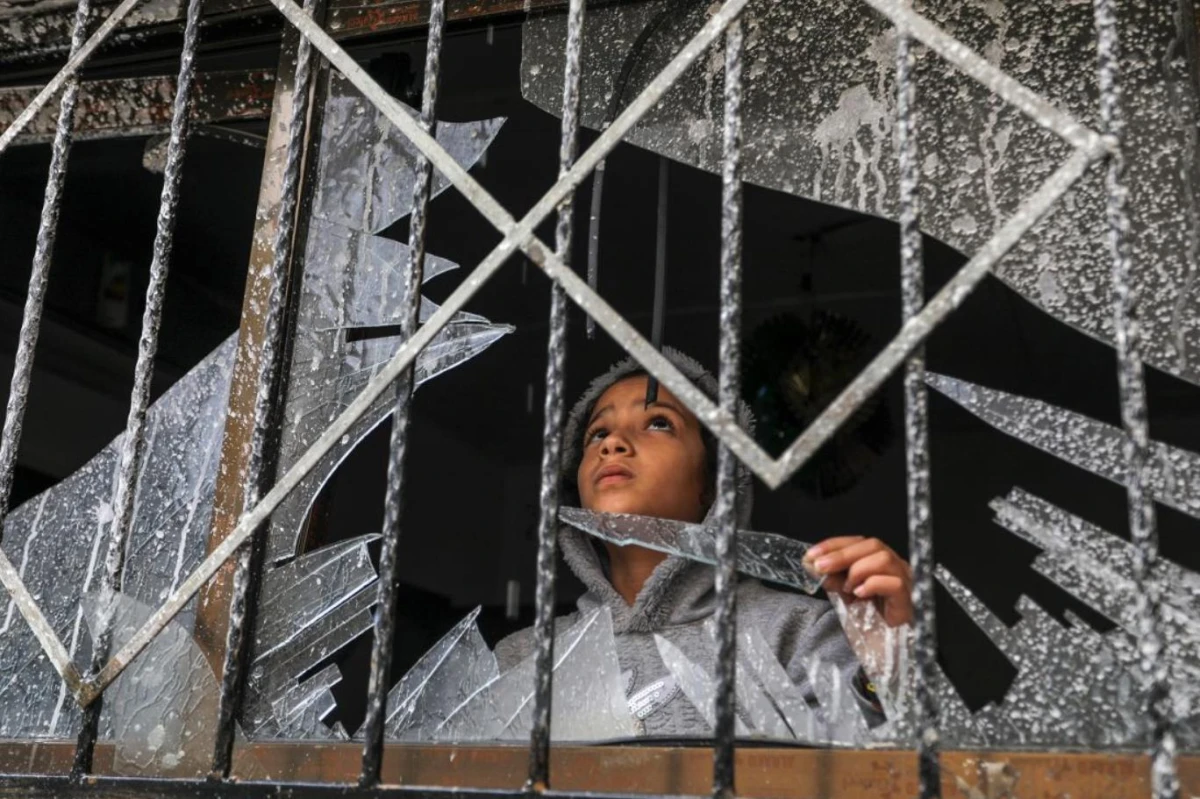
The article then turns from history to Gaza, where Altun frames the current humanitarian catastrophe as a test of the world’s conscience.
He contrasts the past, when a ruler could act decisively for the rights of an unknown foreign trader or a minority citizen, with the present, where millions may suffer while political leaders, media institutions and international powers debate terminology, alliances and strategic interests.
Altun’s comparison is not simply emotional. It is a moral indictment. If past rulers are remembered for sacrificing even their closest relatives for justice, what does it say about today’s world when governments cannot sacrifice political convenience to defend civilians?
The essay argues that the crisis is not only about war. It is about the collapse of moral language. Words such as justice, human rights and international law become hollow when they are applied selectively.
The false interpreter and the modern media
One of the striking parallels in Altun’s essay is the role of the false interpreter in the story of Nushirvan.
In the historical account, the interpreter concealed the truth in order to protect the powerful. By mistranslating the complaint, he tried to shield the king’s son and the vizier from accountability.
Altun sees a modern equivalent in media systems that obscure the suffering of the oppressed, soften the language used for the powerful and reshape public perception. The problem is not only silence; it is distortion.
When a victim’s suffering is minimized, when the aggressor’s actions are framed as unavoidable, when children’s deaths are reduced to numbers, the role of the interpreter has returned in a new form.
The article suggests that injustice survives not only through weapons and political decisions, but also through language. Whoever controls the story can delay justice.
Power without justice becomes fear
Nushirvan’s example shows that justice gives power moral legitimacy. Without justice, power may still command armies, courts and institutions, but it loses its ethical authority.
The same applies to modern states. A state may have laws, police, courts and borders. But if the law protects the powerful and abandons the weak, it becomes a mechanism of fear rather than justice.
This is why the story of Umar and the Jewish landowner remains important. The caliph’s power was not displayed by defending his governor. It was displayed by correcting him.
A ruler who cannot confront injustice within his own administration cannot credibly speak of justice elsewhere.
A world searching for its lost conscience
Altun’s essay ends with a dark conclusion: humanity appears to be living in an age without Nushirvan, an age in which the world continues to search for the justice it claims to admire.
That conclusion is painful because it speaks beyond one historical story. It points to a broader crisis of conscience. The modern world has institutions, declarations, courts and diplomatic forums. Yet the moral courage to defend justice consistently often appears absent.
The lesson from Nushirvan and Umar is not nostalgia. It is a demand. Justice must be stronger than family, office, identity, wealth and political convenience.
If the oppressed must first belong to the right group before their suffering matters, then justice has already been defeated.
The question left by the article is therefore simple but heavy: who today is willing to lose something for justice?
What's Your Reaction?
 Like
0
Like
0
 Dislike
0
Dislike
0
 Love
0
Love
0
 Funny
0
Funny
0
 Wow
0
Wow
0
 Sad
0
Sad
0
 Angry
0
Angry
0

Editor | Wise News Press — Delivering accurate, timely global news with integrity, insight, and editorial responsibility.






















Comments (0)