



Taiwan to hold five-day combat readiness drills as China pressure rises
Taiwan will stage five days of combat readiness drills to test rapid wartime transition as China increases military activity near the island.


By Ahmet Taş | Wise News Press
TAIPEI, Taiwan — Taiwan will hold a five-day combat readiness drill this week as its military shifts toward more realistic training for a possible rapid escalation with China.
Taiwan’s Ministry of National Defense said the “Immediate Combat Readiness Exercise” will run from Monday to Friday as part of the armed forces’ annual joint operations training. The drill comes amid rising pressure from Beijing, which claims Taiwan as part of its territory despite the objections of the democratically governed island’s government.
Taiwan prepares for rapid wartime transition
The upcoming exercise is designed to test how quickly Taiwanese forces can move from peacetime readiness to wartime deployment. According to the defense ministry, the drill will focus on combat practices, battlefield familiarity and priority deployment actions.
The training reflects a broader modernization effort in Taiwan’s military planning. Rather than relying mainly on scripted events and predictable scenarios, Taipei is increasingly building exercises around conditions that resemble a real conflict.
That shift is important because Taiwanese officials believe China could use one of its routine military drills around the island as cover for a sudden attack. In such a scenario, the first hours would be critical. Taiwan’s command system, logistics, reserve mobilization and frontline units would need to respond before Beijing could turn pressure into control.


Exercise to use real troops and real terrain
The defense ministry said the exercise will be carried out with real troops, real equipment and real-time implementation on actual terrain. The aim is to strengthen the ability of units at all levels to operate under combat conditions.
The drill will place particular emphasis on joint operations command and control, logistics support and battlefield preparation. These are among the most important areas for Taiwan, whose defense depends on fast coordination between the army, navy, air force, missile units, reserves and civil defense structures.
Taiwan’s military has long trained for an attempted Chinese landing, missile strikes, air assaults, naval blockade and gray-zone pressure. But the new approach suggests a sharper focus on speed, decentralization and surprise.


China increases aircraft activity near Taiwan
The announcement came on the same day Taiwan reported a new wave of Chinese military aircraft activity near the island.
Taiwan’s defense ministry said China sent 21 aircraft, including J-16 fighter jets, KJ-500 airborne early warning and control aircraft, and Y-20 aerial refueling aircraft. Nineteen of the aircraft entered airspace to Taiwan’s southwest and moved into the Western Pacific for long-distance training over open seas, according to the ministry.
Taipei said its own forces monitored the activity and responded appropriately. Taiwan regularly uses similar language when describing its response to Chinese military movements near the island.
Beijing has significantly increased military pressure around Taiwan in recent years. Chinese aircraft and warships now operate near the island on an almost daily basis, often crossing sensitive areas or conducting coordinated air-sea patrols.
Beijing’s pressure campaign remains central
China views Taiwan as its own territory and has not ruled out the use of force to bring the island under its control. Taiwan’s government rejects Beijing’s sovereignty claims and says only the island’s people can decide their future.
The military pressure campaign is not limited to direct invasion scenarios. China has used aircraft, naval vessels, coast guard ships and other gray-zone tactics to test Taiwan’s defenses and exhaust its resources.
Taiwanese officials worry that gray-zone activity could gradually blur the line between peace and war. A Chinese drill, blockade rehearsal or patrol could suddenly become a real military operation. That is why Taiwan has started designing more exercises around the possibility of a rapid transition from routine Chinese activity into open conflict.
Modern drills focus on realistic battlefield conditions
Taiwan has been reforming its military exercises to reflect the changing character of modern warfare. The war in Ukraine, the rise of drones, the importance of resilient communications and the need for rapid logistics have all shaped defense planning across the Indo-Pacific.
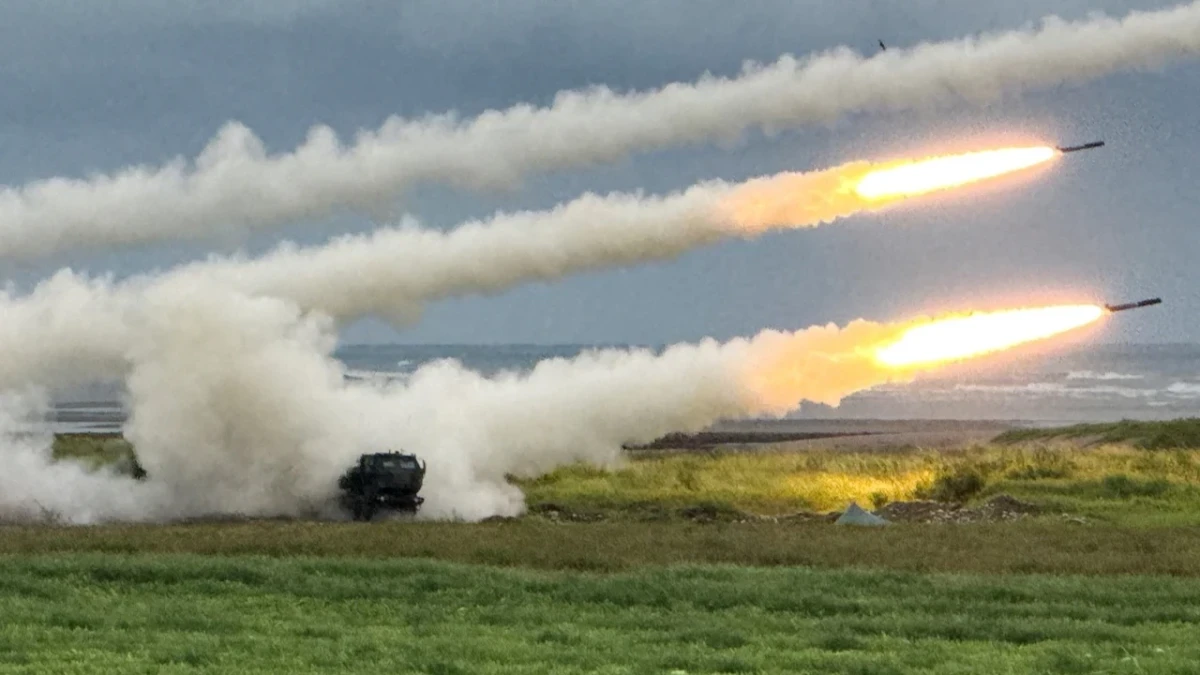
Earlier this month, Taiwan used its new U.S.-made HIMARS rocket system in a live-fire drill into the Taiwan Strait. The system, widely used by Ukraine, is part of Taiwan’s effort to improve mobile, long-range strike capabilities and strengthen its ability to disrupt an invading force before it reaches the island’s interior.
The shift toward more realistic training also reflects a lesson from recent conflicts: forces must be able to move quickly, operate under pressure and keep fighting even when command centers, communications networks or supply lines are targeted.
Han Kuang exercises remain the main test
Taiwan’s main annual Han Kuang military exercises are expected later this summer. The five-day readiness drill is part of the broader training cycle leading toward those larger war games.
The Han Kuang exercises are Taiwan’s most important annual military drills and are designed to test the island’s ability to resist a major Chinese attack. In recent years, they have increasingly included unscripted elements, civil defense coordination, reserve mobilization and scenarios involving Chinese gray-zone activity turning into a full invasion.
This year’s reforms are intended to better prepare Taiwan for modern battlefield conditions. The military is also working to improve coordination with civilian agencies, local authorities and infrastructure operators, since any conflict in the Taiwan Strait would affect the entire society, not only the armed forces.
Regional stakes continue to rise
The Taiwan Strait remains one of the world’s most dangerous flashpoints. Any conflict there would have consequences far beyond Taiwan and China. It could disrupt global shipping, damage semiconductor supply chains, pull in the United States and regional allies, and reshape the security balance in the Asia-Pacific.
For Taiwan, the goal of the new drill is deterrence. By showing that its forces can move quickly from normal readiness to wartime posture, Taipei hopes to make any Chinese attack more difficult, costly and uncertain.
For China, the continued use of aircraft and naval activity around the island sends a different message: Beijing wants to demonstrate that it can apply constant pressure and that Taiwan’s security environment can be shaped by Chinese military power.
The coming five-day exercise will therefore be watched closely, not only as a routine military drill but as part of a wider contest over readiness, deterrence and control in the Taiwan Strait.
What's Your Reaction?
 Like
0
Like
0
 Dislike
0
Dislike
0
 Love
0
Love
0
 Funny
0
Funny
0
 Wow
0
Wow
0
 Sad
0
Sad
0
 Angry
0
Angry
0

Editor | Wise News Press — Delivering accurate, timely global news with integrity, insight, and editorial responsibility.














Comments (0)