



Turkey’s Gold Shield: Central Bank gains $54 billion from reserves
Turkey's strategic shift toward gold, accelerated by Berat Albayrak’s repatriation policies, has resulted in a record $54 billion gain as prices hit $4,750.


By Ahmet Taş | Wise News Press
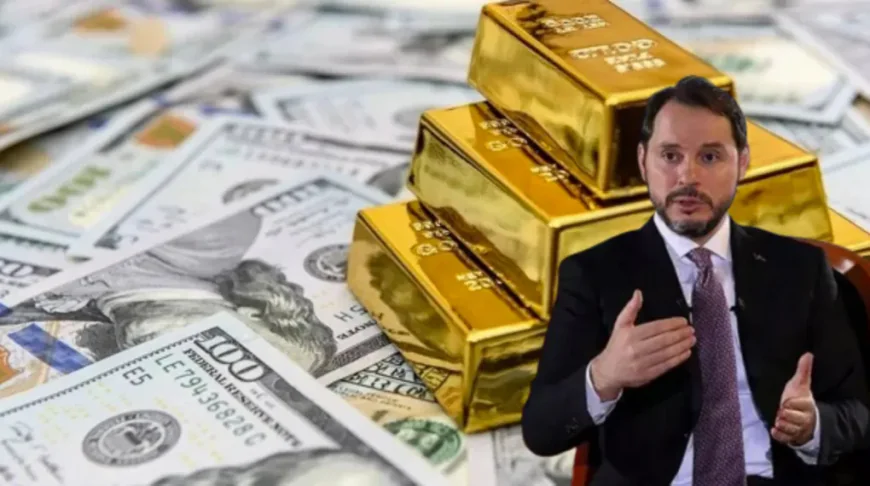
ANKARA, TURKEY — Turkey’s long-term strategic pivot toward gold reserves has paid off handsomely, yielding a massive paper gain of approximately $54 billion as global gold prices reached historic highs. This "Gold Shield," built over a decade and accelerated by a major policy shift to repatriate national assets from abroad, has positioned the Turkish Central Bank (TCMB) as a dominant player in the global bullion market.
The surge in the value of the national treasury comes as gold prices jumped from $2,624 in early 2025 to nearly $4,750 per ounce by February 2026. This 81% increase in dollar terms has transformed Turkey’s gold holdings into a vital pillar of economic stability during a period of global fiscal volatility.
The Albayrak Legacy: Bringing Gold Home
The foundation of this current windfall was laid nearly a decade ago. While Turkey’s gold reserves were once modest by global standards, a strategic macro-level change was implemented in 2017. During the tenure of then-Minister of Treasury and Finance, Berat Albayrak, the TCMB shifted its focus from dollar-weighted reserves to "safe haven" gold.
One of the most significant moves in Turkey's economic history was the physical repatriation of gold reserves stored in international financial centers. Under Albayrak’s leadership, approximately 350 tons of gold held in the United States, Switzerland, and the United Kingdom were brought back to Turkish soil. This move not only ensured national control over these assets but also protected them from potential international geopolitical fluctuations. By the end of 2018, the reserves had grown to 488.9 tons, eventually climbing to approximately 800 tons by the end of 2025.
A Decade of Strategic Accumulation
The journey from a mid-tier holder to a global top-10 gold-storing nation is reflected in the Central Bank's data. In 2011, Turkey held a mere 195 tons of gold. By 2020, that figure had surged to 716 tons. Despite minor fluctuations in the following years due to local demand and market interventions, the long-term trend remained upward.


Official Gold Reserves by Year (TONS):
| Year | Gold Reserve (Tons) |
| 2011 | 195 |
| 2013 | 520 |
| 2015 | 516 |
| 2017 | 565 |
| 2020 | 716 |
| 2022 | 787 |
| 2025 (Sept) | 799 |
This consistent accumulation ensured that Turkey entered the 2025-2026 global rally with one of the most robust precious metal cushions in its history.
Outperforming the Dollar: An 81% Surge
The most striking aspect of the "Gold Shield" is its performance relative to the U.S. dollar over the last twelve months. In January 2025, the gold ounce was trading at roughly $2,624. Fast forward to February 2026, and the price is testing the $4,750 resistance level.


To put this in perspective: if an investor had set aside $1,000 in cash a year ago, it would still be $1,000 today (with its purchasing power likely diminished by inflation). However, if that same $1,000 had been invested in gold, it would now be worth approximately $1,810. This 81% return underscores why the Central Bank’s decision to move away from a purely dollar-centric reserve model was a masterstroke in risk management.
The $54 Billion Windfall for the Treasury
With current holdings hovering around 800 tons—equivalent to approximately 25.7 million ounces—the impact on Turkey's balance sheet is staggering. The price of an ounce has increased by $2,126 since the beginning of 2025.
A baseline calculation shows that the value of the TCMB’s gold reserves has increased by more than $54 billion on paper through price appreciation alone. This figure represents a massive fiscal and psychological "insurance policy" for the Turkish economy. It provides a significant buffer against foreign trade imbalances and offers a layer of protection that the U.S. dollar could not provide during its recent period of market instability.
Gold as the Ultimate Economic Armor
As the global economy faces ongoing "fictional" currency debates and inflation spikes, Turkey’s decision to hoard physical bullion appears increasingly prescient. The "Gold Shield" is no longer just an economic theory; it is a tangible $54 billion success story.
While the "pillow-under-the-bed" tradition has always been a staple for Turkish citizens, it has now become the state’s most rational economic defense. As the dollar stumbles in international markets, gold has declared its own empire, proving that Turkey’s strategic pivot toward the "eternal currency" was the ultimate armor against the global economic storm.
What's Your Reaction?
 Like
0
Like
0
 Dislike
0
Dislike
0
 Love
0
Love
0
 Funny
0
Funny
0
 Wow
0
Wow
0
 Sad
0
Sad
0
 Angry
0
Angry
0

Editor | Wise News Press — Delivering accurate, timely global news with integrity, insight, and editorial responsibility.





















Comments (0)