



Ukraine families ask Zelenskyy for law on fallen defenders’ status and rights
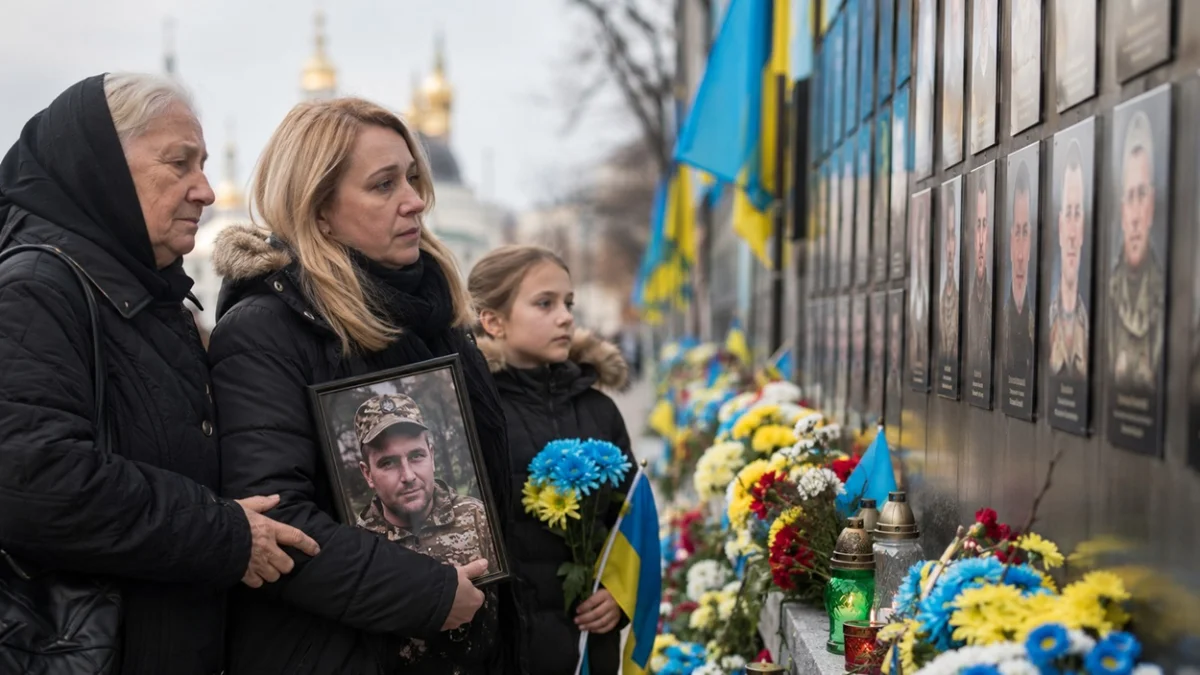
Families of fallen Ukrainian defenders and civilians are calling for a law to define wartime status, remembrance and automatic support rights.


By Yusuf Inan | Wise News Press
KYIV, Ukraine — Families of Ukrainian soldiers, law enforcement officers, rescuers, volunteers, critical infrastructure workers and civilians killed as a result of Russia’s aggression are calling on the state to adopt a separate law defining the status of those who died in the war and automatically granting their families the rights provided by law.
The issue resurfaced after an interview with Zarem Saribiliyalova, the daughter of Crimean Tatar defender Asan Dlyaverovych Seidametov, who had fought for Ukraine since 2016 and was killed on January 23, 2023, in Donbas, near the village of Kurdyumivka in the Bakhmut area.
Saribiliyalova appealed to Ukrainian President Volodymyr Zelenskyy not to leave the families of the fallen alone with petitions, bureaucracy and the burden of proving the obvious: everyone who gave their life for Ukraine, or was killed because of Russia’s war, must be recognized by the state, and their family must automatically receive the rights to which they are entitled.
Families seek a law on the status of those killed in war
The key idea increasingly voiced by families of the fallen is not limited to honorary titles. They are calling for a separate law that would clearly define the status of people killed as a result of Russia’s aggression, the procedure for state remembrance and the rights of their families.
Such a law could establish a transparent and automatic mechanism: once the death of a soldier, police officer, rescuer, medic, volunteer, critical infrastructure worker or civilian as a result of the war is officially confirmed, the state would begin the process of recognition, support and commemoration without forcing the family through additional humiliation.


For families, this is not a formal matter. It is a question of dignity, justice and national memory.
“Hero of Ukraine” and family rights are separate issues
In the public debate, it is important to distinguish between two concepts: the highest state title, “Hero of Ukraine,” and the basic official status of a person killed because of the war.
“Hero of Ukraine” is the country’s highest state title and usually requires a separate procedure and an individual decision. But families of the fallen are raising a broader and more practical issue: everyone who gave their life for Ukraine or became a victim of Russian aggression should receive official state recognition, while their family should automatically receive the package of rights provided by law.


This approach does not necessarily mean that the highest award would be automatically granted to every person killed. It means the state should not force families to collect signatures, seek media attention or wait for years to obtain documents before receiving support, memory and respect.
Petitions should not be the only path to remembrance
Today, many families of fallen soldiers create petitions, collect votes, appeal to officials, write letters and seek support from journalists and civil society organizations.
For families who have lost a husband, father, son, brother, daughter or mother, this struggle becomes a second pain after the loss itself.
Saribiliyalova said in her appeal that the title of Hero is often given to those whose stories receive public attention, or to those whose families manage to collect the required number of signatures under a petition.
“Everyone who died in battle for Ukraine is a Hero. And since this should not be up for debate, I believe that granting such recognition should be automatic. So that people know. So that people remember,” she said.
Her words reflect the feelings of many families: the memory of a person killed in war should not depend on popularity, media visibility or a family’s ability to fight bureaucracy.
The example of Asan Seidametov
The story of Asan Seidametov is one example of this broader problem.
Seidametov was a Crimean Tatar, a Muslim and a Ukrainian defender. His call sign was “Tatar.” He went to serve in 2016, passed through Pisky, took part in the battles for Donetsk airport and received medals and commendations.
According to his daughter, he was fair, honest, brave, courageous, a true patriot, a loving father and a beloved husband.
He dreamed of liberating Crimea and eastern Ukraine. After the start of Russia’s full-scale invasion, he evacuated his family and parents from occupied Henichesk, then returned to the front line.
In the Muslim tradition, people who give their lives defending their land, family and people are called shahids. In Ukraine’s civic tradition, they are fallen Heroes.
For his daughter, state recognition is not only about an award. It is a way to preserve her father’s name in Ukraine’s memory.
Families want automatic rights, not new trials
Families of the fallen expect that, once a war-related death is officially confirmed, the state will automatically open access to all rights provided by law.
These include social payments, support for children, educational guarantees, medical assistance, psychological rehabilitation, legal support, housing-related assistance, support for the parents of the fallen and official memorial recognition.
Protection for children is especially important. A child who has lost a father or mother because of the war should not depend on whether the family can quickly collect documents, gather signatures or prove an obvious tragedy.
The state should come to such families first, rather than wait for them to search for help on their own.
The status should cover more than soldiers
Another important issue is civilian victims of the war.
Russian missiles, drones, artillery and air strikes kill not only soldiers. Volunteers, medics, rescuers, energy workers, municipal workers, journalists, drivers, critical infrastructure employees, children, elderly people and ordinary residents of towns and villages are also killed.
That is why a future law should clearly answer several questions: which categories of the dead receive state recognition, what rights their families have, which authorities make decisions and within what timeframe.
For society, it is important that no person killed because of Russia’s war becomes a dry statistic. Behind every loss there is a name, a family, a story and pain.
A law would require clear legal criteria
At the same time, such an initiative would require clear legal criteria.
The state would need to define which cases qualify as deaths resulting from the war, which documents confirm this status, which authorities are responsible for automatically granting rights to families and how quickly the procedure must be completed.
This is necessary so that any future law would not only be an emotional response to the pain of families, but also a real working mechanism. It must protect families of the fallen while remaining legally precise, transparent and equal across all regions of Ukraine.
For this reason, families are not speaking only about awards. They are calling for a systemic law that would reduce chaos, inequality and dependence on petitions.
Why this matters for the army
For Ukrainian service members, such an initiative also carries moral significance.
Every soldier, officer, police officer or volunteer who is on the front line or carrying out combat missions needs to know that if they do not return, their family will not be left alone.
This is a matter of trust between the state and those who defend it.
An automatic mechanism for recognition and support for families of the fallen could become not only a social guarantee, but also a moral pillar for the military. It would show that the state remembers the price of defense and accepts responsibility for the families of those who gave their lives.
Why this matters for Zelenskyy and the state
For President Volodymyr Zelenskyy, such an initiative could become an important response to a public demand.
As Supreme Commander-in-Chief, Zelenskyy often speaks about honoring Ukrainian warriors and about the state remembering each of them. Families of the fallen are asking that this memory be turned into a systematic law that works automatically, not only case by case.
Such a law could also reduce public tension around petitions, queues, paperwork and unequal treatment of families in different regions.
For the state, it would be an opportunity to create a single standard: every family that has lost a loved one because of the war has the right to respect, support and a prompt decision.
A four-level state mechanism
A future law could include several levels.
The first would be automatic official recognition of the fact that a person died because of the war, along with the granting of the relevant status to the family.
The second would be automatic access to social, educational, medical, psychological and legal rights.
The third would be a state remembrance system: an electronic register, memorial pages, support for local communities in creating memorial signs, and school and community remembrance programs.
The fourth would be a separate and transparent procedure for the highest state awards, including the title “Hero of Ukraine,” so that families would not be forced to fight for consideration through petitions.
Such an approach would combine realistic state procedure with the moral demand of society.
Memory cannot be selective
The most painful issue for families is the feeling of inequality.
If one story receives public attention, the whole country hears about it. If another family lives in a small village or has no access to the media, its pain may remain invisible.
But a life given for Ukraine has the same value regardless of how many people know the name of the person who died.
That is why families of the fallen speak about automatic recognition. Not because they want to bypass the state, but because they want justice without humiliation.
A call heard from many families
Saribiliyalova’s appeal is not only the voice of one daughter.
It is the voice of many wives, mothers, fathers, children, brothers and sisters who have lost the people closest to them.
They are not asking for privileges. They are asking the state to recognize the obvious: those who died for Ukraine or because of Russia’s aggression must be officially honored, and their families must receive their rights without an additional fight.
For them, this is not a political issue. It is a question of memory, dignity and humanity.
The state must remember first
Ukraine is fighting not only for territory. It is fighting for the right to be a state that remembers its people.
If the country wants to win not only on the front line but also in the future, it needs a fair system of remembrance for everyone who gave their life.
The story of Asan Seidametov, a Crimean Tatar Muslim, Ukrainian defender, father and husband, shows why this matters. He wanted to return Crimea. He did not want his children to know war. But for the sake of his children, his family, Crimea, eastern Ukraine and the future of the state, he went to the front.
Today, his daughter is asking for something that lives in the hearts of many families: do not force them to prove that their loved ones are Heroes.
They have already proved it with their lives.
Yusuf Inan
Yusuf Inan is a journalist and writer. He is editor-in-chief of UAPresa.com, WiseNewsPress.com, SehitlerOlmez.com and Yerelgundem.com. He specializes in strategic and political analysis of events in Turkey and around the world.
What's Your Reaction?
 Like
0
Like
0
 Dislike
0
Dislike
0
 Love
0
Love
0
 Funny
0
Funny
0
 Wow
0
Wow
0
 Sad
0
Sad
0
 Angry
0
Angry
0

Editor | Wise News Press — Delivering accurate, timely global news with integrity, insight, and editorial responsibility.










Comments (0)