



BBC probe links attacks on Starmer properties to Russian campaign
A BBC investigation says arson attacks linked to Keir Starmer were part of a wider Russian-linked campaign of sabotage and provocation.


By Ahmet Taş | Wise News Press
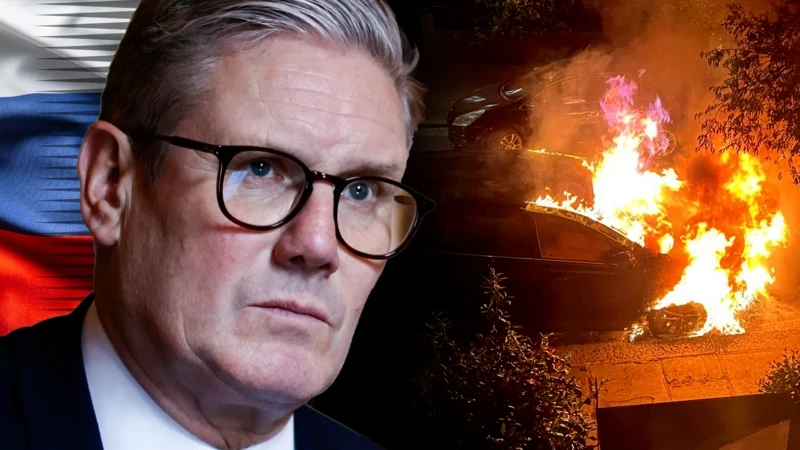
LONDON, United Kingdom — A BBC investigation has claimed that arson attacks on properties linked to UK Prime Minister Sir Keir Starmer were part of a broader Russian-linked campaign of sabotage, provocation and disinformation.
According to BBC News and BBC Panorama, the attacks were not isolated acts of criminal damage, but one element in a wider effort to stir fear and social division in Britain. The investigation points to Telegram recruitment, fake extremist groups, paid vandalism, anti-Muslim provocation and online disinformation. Russia’s embassy in London denied any attempt to link Moscow or the Russian Foreign Ministry to illegal activity, saying Russia posed no threat to the United Kingdom or its people.
Arson attacks targeted properties linked to Starmer
The case centered on three incidents involving properties or assets connected to Sir Keir Starmer. The first fire involved a Toyota vehicle in north London that had previously belonged to the prime minister. Two further arson attacks followed, one at the entrance to a flat where Starmer had once lived and another at a house rented to his sister-in-law after he moved into Downing Street.
Roman Lavrynovych, a 22-year-old Ukrainian construction worker, and Stanislav Carpiuc, a 27-year-old Romanian citizen born in Ukraine, were found guilty at the Old Bailey of conspiring to target properties and a vehicle linked to the prime minister. A third man, Petro Pochynok, 35, was cleared of conspiracy to commit arson.
The court case focused mainly on financial motivation. But the BBC investigation argues that the bigger question was left largely outside the courtroom: who was directing the attacks, and why?


The anonymous handler known as “EL”
The man behind the instructions was known in court as “EL Money,” based on how he appeared in Lavrynovych’s phone. On Telegram, he used only the initials “EL.”
BBC investigators said EL recruited Lavrynovych through a Telegram group used by Ukrainians looking for work in London. The tasks appeared minor at first. Lavrynovych was allegedly asked to put up posters and later to spray graffiti. Over time, the instructions escalated into arson attacks.
Messages obtained by the BBC suggest EL knew the political importance of the target. In one message, he reportedly told Lavrynovych that he had attacked the home of a very senior person in Britain and needed to leave the city. Within hours, Lavrynovych was arrested.


The BBC says the limited messages shown in court were only part of a wider online footprint. Open-source research showed EL praising Russia and President Vladimir Putin, insulting Ukrainians and promoting Russian narratives. In some messages, he allegedly offered money and even Russian citizenship as rewards for carrying out arson attacks.
Evidence points toward a young Russian diplomat
The BBC investigation identified a possible figure behind the EL account: Evgeny Lyukshin, a 23-year-old Russian linked to elite diplomatic circles in Moscow. The BBC did not state that it had proven Lyukshin was EL, but said multiple clues pointed in his direction.
Lyukshin is the son of a senior Russian diplomat who previously served as a counsellor at the Russian embassy in Denmark. That detail is significant because EL had claimed in Telegram conversations that his father leaked some NATO and CIA-related material to him and had been in Europe.
The BBC also reported that Lyukshin studied at the Moscow State Institute of International Relations, known as MGIMO, a prestigious institution closely linked to Russia’s Foreign Ministry. He was also connected to Rybar, a Russian media and influence operation sanctioned by the UK and associated with pro-Kremlin information campaigns.
When the BBC contacted Lyukshin with detailed questions, he did not respond. Soon after, several Telegram channels connected to the investigation disappeared.
A fake far-right group called Direct Action UK
A key part of the alleged campaign was the creation of a fake far-right group called Direct Action UK. The group presented itself as a homegrown British nationalist movement, but BBC investigators said its digital traces pointed toward Russian-linked operators.
The group’s messages showed signs of being run from the Moscow time zone. Some messages contained Cyrillic characters. Even the way currency was written reflected Russian-style formatting rather than normal British usage.
Direct Action UK used social media to spread videos portraying Starmer as a traitor. It encouraged anti-Muslim hatred, offered money for violence and vandalism, and promoted attacks on mosques and police. It also praised far-right activist Tommy Robinson.
Although Direct Action UK appeared to be fake, its effects were real. The BBC reported that after the group offered money for Islamophobic graffiti in London, six mosques and an Islamic school were targeted with slogans such as “Stop Islam” and “remigration.”
Anti-Muslim provocation and staged outrage
The BBC investigation said the same network also created or supported a fake Islamic organization called Takbir Foundation. On the surface, it appeared to encourage Muslims to carry out religiously themed graffiti. But the real aim, according to the investigation, was to provoke far-right anger.
This showed a two-sided provocation model. On one side, fake Islamic messaging was used to create outrage. On the other, fake far-right channels amplified anti-Muslim anger and called for retaliation.
In one example, two graffiti artists in Bristol were reportedly offered money to paint Islamic phrases on public buildings. The artists refused because they believed the request was illegal. The BBC said the method resembled the approach used in anti-Muslim graffiti cases, where targets and designs were sent in advance.
The same network allegedly spread a hate leaflet near Southall Central Mosque, then circulated images of the leaflet through a fake Muslim-facing account to create fear and resentment inside Muslim communities.
Disinformation after the attacks
After the arson attacks on Starmer-linked properties, Russian-based accounts allegedly spread false claims about the suspects and the motive. One story falsely claimed that the Ukrainian suspects were male sex workers and that the fires were linked to a personal scandal involving the prime minister.
The BBC said those claims were false. The suspects did not know Starmer personally, and they were not sex workers.
Despite that, the false story was picked up and amplified online. Tommy Robinson shared allegations about Starmer and Ukrainian men, including a fake image showing the prime minister with the suspects. Kirill Dmitriev, a special representative of Vladimir Putin, also reposted one of Robinson’s posts about the case.
The episode showed how an alleged act of sabotage could be followed by a second wave of disinformation designed to damage public trust and political authority.
A wider pattern of Russian hybrid warfare
The BBC said the Starmer-linked attacks resembled a wider pattern of Russian-backed sabotage and influence operations across Europe. These have included attempts to damage transport infrastructure, set fires, recruit proxies and create confusion among Western allies of Ukraine.
The method often relies on “proxy actors” recruited online. Young people, migrants or financially vulnerable individuals may first be offered simple paid tasks, such as taking photographs, putting up posters or painting graffiti. Later, the tasks become more serious. Those who try to back out can be pressured or blackmailed.
Ukrainians have been frequent targets for recruitment in such networks. Ukrainian investigators told the BBC that using Ukrainians in sabotage operations also helps Russia damage Ukraine’s image in the eyes of European partners.
This approach allows Moscow to deny involvement while still benefiting from confusion, social tension and political disruption.
Rights groups say warnings were ignored
Anti-racism group Hope Not Hate investigated Direct Action UK and said it warned counterterrorism police months before the attacks on Starmer-linked properties. The organization concluded that Russians were behind the group and warned that its operators may have been trying to direct people toward attacks on mosques or Muslim targets.
Tell Mama, which monitors anti-Muslim hate crimes, also submitted evidence to police and concluded that Direct Action UK appeared to be a Russian operation. Its director, Iman Atta, warned that such campaigns do not remain online but can turn into property damage, violence and terrorism-related activity on the streets.
London’s Metropolitan Police told the BBC it was investigating seven incidents of criminal damage as anti-Muslim hate crimes. It said no arrests had yet been made and that all possibilities were being considered.
Police and former ministers differ on the Russian link
Helen Flanagan, head of London’s Counter Terrorism Command, said the purpose of the attacks was clear: to frighten the prime minister, cause alarm and attack the United Kingdom. However, she said police had not proven who EL was or on whose behalf he was acting. She also said there was no evidence available to police that established a state-backed threat.
Other assessments were more direct. BBC sources said both UK and Ukrainian authorities had concluded internally that Russia was behind the arson attacks.
Former UK Defence Secretary Ben Wallace, who served during the Salisbury nerve agent attack and Russia’s full-scale invasion of Ukraine, said the evidence suggested a deliberate escalation by Russia against the British state. Wallace argued that targeting properties linked to the prime minister was not a decision likely to be made by a low-level operator.
Telegram channels vanished after BBC questions
One of the most striking developments came after the BBC contacted Lyukshin and said it knew he was a member of the Radio Southport Telegram channel, another channel associated with Russian-linked messaging.
Within hours, Radio Southport disappeared. Four other Rybar-created channels aimed at stirring hatred in Britain were also deleted. A photograph showing Lyukshin with a Russian deputy foreign minister was also removed from a Russian news website.
Those deletions do not prove legal responsibility. But they add to the picture of a sensitive network operating at the intersection of propaganda, sabotage, social media manipulation and plausible deniability.
The BBC investigation portrays the attacks on Starmer-linked properties as more than a criminal arson case. It presents them as a warning about modern hybrid warfare: a form of conflict that uses fake movements, paid proxies, online hatred and false stories to weaken societies from within.
What's Your Reaction?
 Like
0
Like
0
 Dislike
0
Dislike
0
 Love
0
Love
0
 Funny
0
Funny
0
 Wow
0
Wow
0
 Sad
0
Sad
0
 Angry
0
Angry
0

Editor | Wise News Press — Delivering accurate, timely global news with integrity, insight, and editorial responsibility.










Comments (0)