



Day 9: Iran strikes Gulf states as oil facilities burn in Tehran
On the ninth day of conflict, Iran launched retaliatory strikes across the Gulf while US-Israeli forces hit Tehran’s oil infrastructure amid leadership shifts.



By Ahmet Taş | Wise News Press
TEHRAN, IRAN — The Middle East conflict entered its ninth day on Sunday with a massive expansion of hostilities as Iran launched retaliatory strikes against Gulf nations and Israel. This wave of aggression follows a series of strategic US-Israeli air strikes that targeted critical oil facilities in Tehran, pushing the total death toll of the week-long war toward 1,500 people.
The escalation has brought the region to a fever pitch, with Iran reporting that a new Supreme Leader has been selected following the assassination of Ayatollah Ali Khamenei. However, the identity of the successor remains classified as Israel issues explicit warnings that it will continue to target any individual attempting to lead the "terrorist regime" in Tehran.
Iran’s retaliatory strikes against Gulf neighbors
Following threats from President Masoud Pezeshkian to intensify attacks on American interests, the Iranian military conducted a series of strikes across the Persian Gulf on Sunday. Bahrain's Ministry of Interior reported that an Iranian drone struck a water desalination plant, causing significant structural damage and injuring three people due to shrapnel.
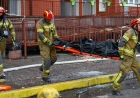
Kuwait was also heavily targeted by a combination of missiles and drones. Firefighting crews were deployed to Kuwait International Airport and a government office in the capital to combat blazes caused by the strikes. While no fatalities were reported in Kuwait, officials confirmed material damage to fuel storage tanks at the airport and the headquarters of the Kuwaiti social insurance institution.
The United Arab Emirates (UAE) faced the most intense barrage of the day. The UAE Ministry of Defense announced that its air defense systems successfully neutralized 16 missiles launched from Iran on Sunday, with a 17th missile falling into the sea. Despite these interceptions, four drones managed to breach the defenses and crash onto UAE territory. Simultaneously, Iranian missiles reached Israel, where civil defense teams reported that three people were injured in the afternoon attacks.


Tehran decries "chemical warfare" in oil strikes
The conflict took a devastating environmental turn over the weekend as US and Israeli forces conducted overnight bombing runs on at least five major oil facilities in and around Tehran. Iranian Foreign Ministry spokesperson Esmail Baghaei characterized the targeting of fuel infrastructure as "chemical warfare" against the Iranian populace.
Baghaei warned that the destruction of fuel storage sites releases toxic chemicals and hazardous materials into the atmosphere, creating a catastrophic environmental and humanitarian crisis. He emphasized that the consequences of these strikes would not be contained within Iranian borders, as the resulting pollution threatens the health of millions across the region. Social media footage from Tehran showed massive fireballs illuminating the night sky, with state television confirming that one of the primary targets was a refinery belonging to the Revolutionary Guard.
The rising humanitarian toll on children
The humanitarian cost of the war, which began with US-Israeli strikes on February 28, has reached staggering proportions in just nine days. The Iranian Ministry of Health reported on Sunday that the death toll within Iran has surpassed 1,200, including at least 200 children and approximately 200 women. More than 1,000 people have been injured, nearly 400 of whom are women.


A significant portion of these casualties is attributed to a controversial strike on a primary school early in the conflict, which resulted in the deaths of 168 students and teachers—an act currently attributed to US forces. Meanwhile, the Lebanese Ministry of Health reported that the parallel conflict between Israel and Hezbollah has claimed 394 lives, including 83 children, over the past week.
Israel vows to hunt Khamenei’s successor
In a significant political development, Iranian state media indicated that the 88-member Assembly of Experts has reached a consensus on a new spiritual leader. Mohsen Heydari, a member of the assembly, stated that the "most suitable candidate" has been approved by a majority, though the name remains a state secret.
The Israel Defense Forces (IDF) responded quickly to this news. Using its Persian-language social media accounts, the IDF warned that it is closely monitoring the succession process in the city of Qom. The message explicitly warned: "The hand of the State of Israel will continue to pursue the successors of [Khamenei] and those who seek to appoint them. We warn everyone planning to participate in the succession meeting: we will not hesitate to target you as well". These threats follow conflicting reports regarding the potential selection of Mojtaba Khamenei, the son of the late leader, and rumors that many assembly members may have been killed in earlier Israeli strikes.
Diplomatic evacuations and regional realignment
As the security situation in Lebanon deteriorates, diplomatic assets are being pulled from the region. Over 100 Iranians, including diplomats and embassy staff, were reportedly evacuated from Beirut on a Russian aircraft overnight. A Lebanese official confirmed to AFP that 117 individuals were part of the evacuation, which was pre-coordinated with the Iranian embassy.
This withdrawal comes after the Lebanese government banned all activities of the Iranian Revolutionary Guard within its borders and imposed strict visa requirements on Iranian citizens to pressure the group. Despite these diplomatic moves, the military front in Lebanon remains active; the IDF confirmed on Sunday that two of its soldiers were killed in southern Lebanon when their vehicle was hit by a Hezbollah anti-tank missile or mortar round—the first Israeli military fatalities in Lebanon since the start of the Iran war.
Pezeshkian’s aggressive pivot
Iranian President Masoud Pezeshkian has notably shifted his tone, moving away from a previous "apology" regarding strikes on Gulf neighbors. On Sunday, Pezeshkian asserted that Iran has no choice but to respond when attacked, stating that as pressure on the country increases, the Iranian response will naturally grow stronger.
He declared that the nation would not bow to "bullying, pressure, or aggression," effectively signaling a commitment to sustained conflict despite the heavy damage to Iran's infrastructure. This aggressive rhetoric was immediately followed by the new waves of drone and missile attacks on regional countries that host American military personnel, solidifying the conflict's status as a broad regional war.
What's Your Reaction?
 Like
0
Like
0
 Dislike
0
Dislike
0
 Love
0
Love
0
 Funny
0
Funny
0
 Wow
0
Wow
0
 Sad
0
Sad
0
 Angry
0
Angry
0

Editor | Wise News Press — Delivering accurate, timely global news with integrity, insight, and editorial responsibility.


















Comments (0)