



Iran's political structure: A guide to key figures and power
Following reports of leadership losses in Tehran, we analyze the complex power structure of Iran, from the Supreme Leader to the influential clerical councils.


BY AHMET TAŞ | WISE NEWS PRESS
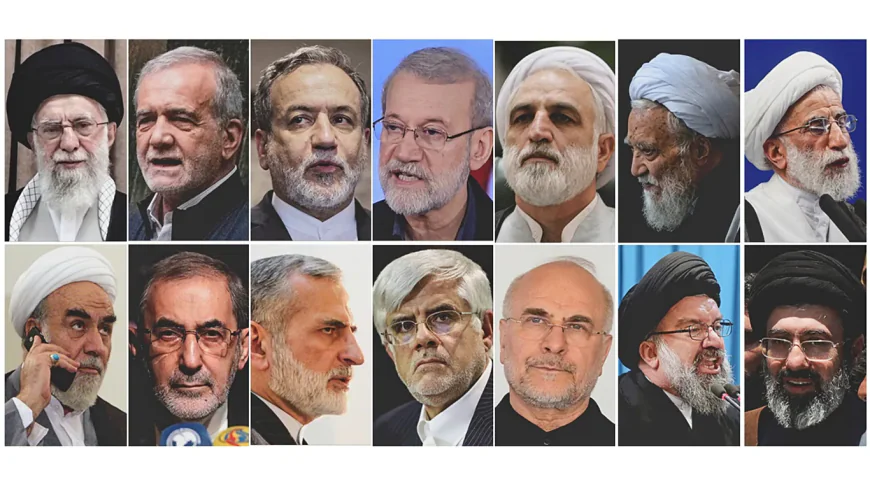
ANKARA, TÜRKİYE — Military operations launched by the United States and Israel against Iran have reportedly resulted in the death of Supreme Leader Ayatollah Ali Khamenei, a development that strikes at the very heart of the Islamic Republic’s complex and rigid power hierarchy.
As President Donald Trump calls on the Iranian people to "take control of their destiny" and rise against the leadership that has governed since 1979, the international community is closely monitoring the potential for a total regime collapse. However, the Iranian system—built on the principle of Velayat-e Faqih (Guardianship of the Jurist)—is a labyrinth of overlapping councils, clerical bodies, and paramilitary organizations designed to withstand the loss of individual figures. Understanding the roles of the remaining elite is essential to predicting the nation’s next moves in this historic crisis.
The Supreme Leader and the line of succession
At the apex of the Iranian system sits the Supreme Leader, a position held by Ayatollah Ali Khamenei since 1989. As the Commander-in-Chief of the Armed Forces and the ultimate arbiter of all political and religious matters, Khamenei was the singular "gatekeeper" of the regime. The Islamic Revolutionary Guard Corps (IRGC), the paramilitary force tasked with protecting the revolutionary system, reported directly to him.
According to reports from the Associated Press (AP) citing Israeli officials, Khamenei was killed in strikes that targeted his offices in Tehran. While President Trump confirmed the death via Truth Social, the regime's survival now hinges on the Assembly of Experts, an 88-member body of clerics responsible for electing the next leader. A name frequently surfacing in succession discussions is Mojtaba Khamenei, the Supreme Leader’s second son. Despite being a mid-level cleric, Mojtaba’s deep ties to the IRGC and his role as his father’s "gatekeeper" have made him a formidable, albeit controversial, candidate to maintain the current hardline trajectory.
Executive authority and the role of the President
In the Iranian hierarchy, the President is the second-highest official. Currently held by Masoud Pezeshkian, a cardiac surgeon and former health minister regarded by many as a reformist, the presidency is responsible for the daily administration of the country. Pezeshkian, who took office on July 28, 2024, manages economic policy and implements the decrees issued by the Supreme Leader.


Working alongside Pezeshkian is Foreign Minister Abbas Araghchi, a veteran diplomat and a key negotiator of the 2015 nuclear deal. Just days before the current strikes, Araghchi had warned that a confrontation with the U.S. would lead to a "devastating war." In the event of a leadership vacuum, Araghchi’s diplomatic experience may become a lifeline for the regime as it attempts to navigate international isolation. Supporting the executive branch is First Vice President Mohammad Reza Aref, who chairs cabinet meetings and coordinates between the parliament and the government.
The clerical oversight: Assembly of Experts and Guardian Council
The institutional resilience of the Islamic Republic is anchored in its powerful clerical councils. The Assembly of Experts, currently chaired by Mohammad Ali Muvahhedi Kermani, functions similarly to the College of Cardinals in the Vatican. Their immediate task following Khamenei's death is to convene and select a successor who meets the strict religious and political criteria of the state.
Equally critical is the Guardian Council, a 12-member body led by Ahmad Jannati. This council acts as the ideological filter of the state, ensuring that all legislation and electoral candidates adhere to Islamic principles. The Council has the power to disqualify presidential candidates who are not aligned with the Supreme Leader’s vision. Jannati, a steadfast loyalist, remains a key figure in ensuring that any transition of power remains within the rigid framework of the 1979 revolution.


Judicial and Legislative pillars
The Iranian judiciary and parliament (Majlis) represent the "hardline" enforcement and legislative wings of the regime. Gholam-Hossein Mohseni-Eje'i, a conservative jurist known for his uncompromising stance, has headed the Judiciary since 2021. Eje'i has been vocal about showing "no mercy" toward anti-regime protesters, and his role in maintaining internal order through the legal system is vital during periods of unrest.
In the legislative arena, Speaker of the Parliament Mohammad Bagher Qalibaf, a former IRGC general and Mayor of Tehran, represents the military-political elite. Re-elected as Speaker on May 27, 2025, Qalibaf has long been associated with the suppression of student movements and remains a key bridge between the civilian government and the Revolutionary Guards.
Strategic advisors and the IRGC command
Beyond the formal offices, a circle of veteran advisors continues to shape Iranian strategy. Ali Larijani, a former Speaker of the Parliament, was recently appointed as a senior advisor to Khamenei to manage nuclear negotiations. Despite being sanctioned by the U.S. for his role in domestic suppression, Larijani remains one of the regime's most experienced political minds. Other key advisors include Ali Akbar Velayati, a physician and former foreign minister, and Kamal Kharrazi, both of whom have provided the Supreme Leader with high-level guidance on international relations for decades.
The military response to the current crisis is coordinated by the Ministry of Defense and the IRGC. While Defense Minister Aziz Nasirzadeh was reportedly targeted in the initial strikes, the IRGC’s decentralized command structure is intended to remain operational. Figures like Ahmad Khatami, the hardline Friday Prayer Imam of Tehran, continue to serve as the ideological mouthpieces of the regime, calling for the execution of "enemies of the state" and rallying the faithful.
As Tehran reels from the loss of its most significant figures, the world watches to see if these institutions will manage a controlled succession or if the internal frictions between reformists like Pezeshkian and hardliners like Mojtaba Khamenei and the IRGC will lead to the regime's fragmentation.
What's Your Reaction?
 Like
0
Like
0
 Dislike
0
Dislike
0
 Love
0
Love
0
 Funny
0
Funny
0
 Wow
0
Wow
0
 Sad
0
Sad
0
 Angry
0
Angry
0

Editor | Wise News Press — Delivering accurate, timely global news with integrity, insight, and editorial responsibility.













Comments (0)