



Russia’s ‘Black August’: Sait Yılmaz on war, Crimea and Kremlin strain
Sait Yılmaz says war losses, refinery disruptions, manpower strain and Black Sea pressure have pushed Russia into a “Black August,” though collapse is unproven.


By Ahmet Taş | Wise News Press
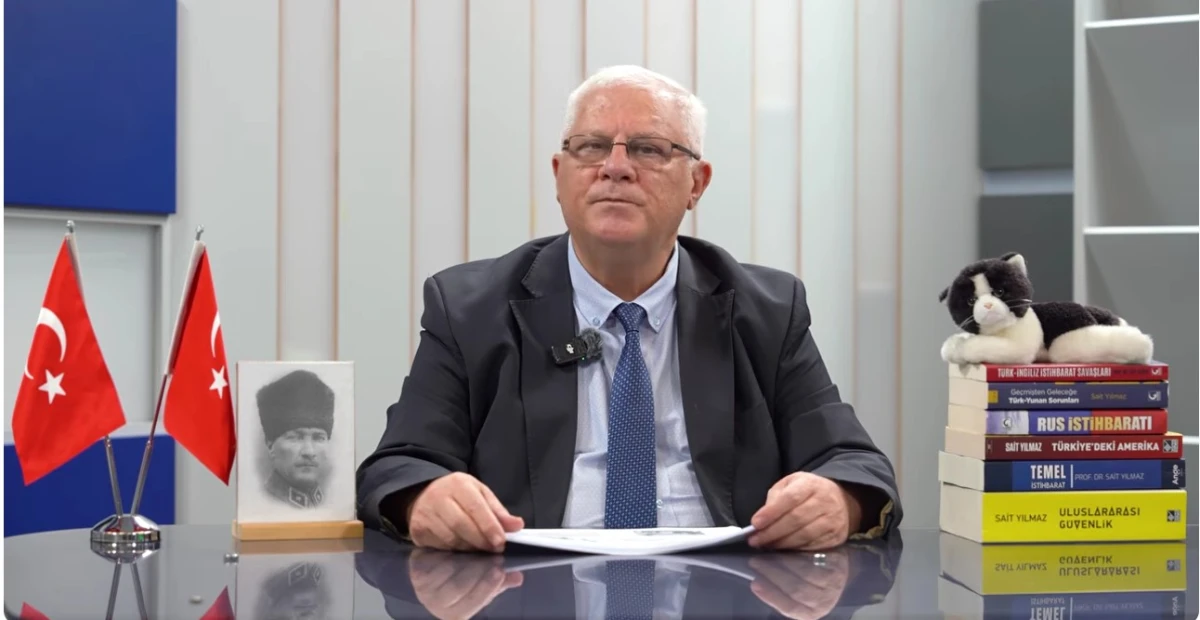
ANKARA, TÜRKİYE — Turkish security and strategy scholar Prof. Dr. Sait Yılmaz argues that Russia has entered a “Black August,” with military attrition, refinery disruptions, manpower pressure, strained finances and vulnerabilities from Crimea to the Black Sea converging at the same time.
In an Aug. 26 episode of his Kırmızı Klasör program, Yılmaz presented a much broader thesis than an immediate economic crisis. He described the Ukraine war as one part of a geopolitical fault line stretching from the Arctic through Eastern Europe, Ukraine, the Black Sea, the Caucasus and Central Asia, ultimately connecting with the strategic competition around China.
Yılmaz went so far as to say Russia is beginning to “crack” and raised the possibility of a post-Putin transformation.
Independent evidence confirms that Moscow faces significant military, fiscal and energy pressure. It does not, however, establish that Russia is approaching imminent state collapse.
Crimea and Sevastopol sit at the heart of Yılmaz’s Russia thesis
Yılmaz begins with Russian strategic culture.


He argues that Russia’s enormous territory has historically produced insecurity rather than strategic comfort: exposed approaches, enormous defensive costs and a persistent search for secure borders and access to warm-water seas.
That logic, he says, helps explain the historic Russian drive toward the Black Sea and the strategic importance of Crimea.
In particular, Yılmaz presents Sevastopol as central to Moscow’s ability to maintain naval power in the Black Sea and links Russia’s 2014 occupation and attempted annexation of Crimea partly to the military importance of the peninsula and its naval infrastructure.


The war has since complicated that strategic advantage.
Sustained Ukrainian missile and naval-drone attacks forced Russia to move many combat-capable Black Sea Fleet vessels away from Sevastopol toward Novorossiysk. A Russian official publicly acknowledged the relocation in 2024.
For Yılmaz, this matters beyond the loss of ships: Crimea was supposed to provide Russia with strategic depth, but parts of that depth have themselves become vulnerable.
From tanks to software: Yılmaz says the old Russian doctrine has been exposed
A major part of Yılmaz’s argument concerns the transformation of warfare.
He describes Ukraine as a global military laboratory in which drones, autonomous systems, digital mapping, electronic intelligence and networked targeting increasingly matter as much as — and sometimes more than — traditional numbers of tanks, artillery pieces and troops.
He places particular emphasis on Ukraine’s Delta battlefield-management system.
Yılmaz describes Delta as a digital backbone integrating target detection, surveillance, intelligence and weapons direction. He says he previously saw the system demonstrated by operators at a meeting in London and views this type of network-centric warfare as one of the clearest lessons of the conflict.
His broader conclusion is severe: Russia’s problem is not simply that it lost equipment, but that a traditional doctrine based heavily on massed armor, artillery and numerical superiority has struggled against a battlefield saturated with sensors and drones.
Yılmaz also points to Moscow’s growing reliance on external partners — North Korean manpower, Iranian drone technology and economic links with China — as evidence that Russia cannot sustain every dimension of the war alone.
Still, the claim that Russia has been comprehensively defeated technologically goes further than the battlefield evidence.
Ukraine has recently recovered more than 700 square kilometers in parts of the southeast, but Russian forces are simultaneously increasing pressure on Kostiantynivka, Kramatorsk and Sloviansk. The war remains a costly and contested attritional struggle.
‘Black August’ has a real economic foundation
The most measurable part of Yılmaz’s “Black August” thesis concerns Russia’s refining system and domestic fuel market.
He argues that Ukrainian deep strikes have turned refineries, airfields, logistics hubs and other economic targets inside Russia into part of the battlefield.
Current evidence strongly supports the existence of serious refinery disruption.
The International Energy Agency says Russian refining activity fell near a 20-year low in July as Ukrainian drone attacks continued to hit processing capacity.
Gasoline shortages have also reached Moscow and other regions. Major fuel companies imposed per-customer purchase limits, while the Russian government responded with export restrictions and other measures intended to secure domestic supplies.
The pressure has become serious enough that Putin issued an Aug. 24 decree allowing the state to assume temporary control of infrastructure judged inadequately protected against drone attacks or too slow to repair damage.
However, Yılmaz’s stated figure that roughly 43%–45% of Russian refinery capacity had been knocked out cannot currently be independently verified at that level.
The verified picture is nevertheless severe: refinery utilization is unusually low, fuel restrictions have spread and repair cycles are being complicated by sanctions and repeated attacks.
Budget, reserves and interest rates reveal a state under strain — not collapse
Russia’s fiscal position strengthens Yılmaz’s argument that the war is narrowing Moscow’s room for maneuver.
The federal budget recorded a deficit of 6.455 trillion rubles, or about 2.8% of GDP, in January-July 2026, already well above the full-year budget plan of 3.786 trillion rubles, or 1.6% of GDP.
Oil and gas revenue fell 16.8% year-on-year, while expenditure rose 14.5%.
Russia’s National Wealth Fund still remains substantial in headline terms, at about 12.72 trillion rubles on Aug. 1, but liquid assets amounted to only about 3.69 trillion rubles, or 1.6% of projected GDP.
The Bank of Russia’s key interest rate also remains high at 14%, despite a July rate cut — another indication that inflation and fiscal-war pressures remain important constraints.
These indicators show pressure.
They do not show economic disintegration.
Russia still has functioning financial institutions, significant energy income and the ability to finance major military spending.
That distinction is critical: a strained wartime economy is not automatically a collapsing economy.
Manpower is another pressure point in Yılmaz’s analysis
Yılmaz also argues that Russia’s ability to generate manpower has become increasingly costly.
He points to recruitment bonuses, pressure on poorer regions and efforts to attract fighters from outside Russia. He also claims the Russian military increasingly struggles to replace personnel as quickly as battlefield attrition requires.
Some of his specific numerical claims about the size and composition of Russian forces cannot be independently confirmed from public data.
But the broader manpower issue is real.
Ukrainian President Volodymyr Zelenskiy said on Aug. 23 that Putin intended to recruit another 300,000 troops after Russia’s September elections. Moscow has not publicly confirmed such a mobilization plan, so the figure remains a Ukrainian claim rather than an established fact.
Yılmaz links the manpower question to an even broader interpretation of Russia as a multiethnic imperial space. In characteristically blunt language, he calls Russia a “prison of nations” and argues that Turkic, Muslim and other non-Russian peoples bear part of the demographic and military burden of Moscow’s strategic ambitions.
That phrase represents Yılmaz’s political interpretation, not a neutral demographic description.
Eurasianism, the Caucasus and a geopolitical line stretching toward China
Yılmaz’s analysis extends well beyond Ukraine.
He is sharply critical of Russian Eurasianism, which he says is sometimes presented in Türkiye as a joint Russian-Turkish alternative to Western imperialism.
His interpretation is the opposite: he views Russian-led Eurasianism as an instrument through which Moscow seeks to preserve dominance over the post-Soviet and Turkic space.
He connects this concept to Russia’s policies toward Crimea, Abkhazia and South Ossetia, arguing that Moscow has repeatedly combined military presence, passport distribution and political integration to expand or consolidate influence.
Yılmaz then places these regional conflicts inside a much larger strategic map: Arctic competition, Scandinavia, NATO’s eastern flank, Ukraine, the Black Sea, the Caucasus and Central Asia, with the geopolitical competition eventually reaching the Indo-Pacific and China.
This is a strategic framework rather than a single independently demonstrable Western master plan, and it should be read as such.
Black Sea power may be the most important part of the argument
Yılmaz repeatedly returns to the Black Sea.
His argument is that Ukraine, despite not possessing a conventional fleet comparable with Russia’s, has used naval drones, missiles and intelligence systems to impose disproportionate costs on Moscow.
That assessment has substantial factual support.
Ukraine’s attacks have significantly reduced Russia’s freedom of operation around Crimea and forced many vessels away from Sevastopol.
For Yılmaz, this means the ultimate strategic question is not merely who controls individual trenches in Donetsk, but whether Russia can continue to use Crimea and the Black Sea as secure instruments of regional power.
At the same time, Russia retains major strike capabilities. On Aug. 27, Moscow launched another large missile-and-drone attack on Ukraine involving 258 drones and multiple missiles, damaging critical infrastructure in several regions.
So the Black Sea is not an area of uncontested Ukrainian dominance. It is a theater where Russia’s former dominance has been sharply challenged.
Putin after the war: Yılmaz’s most speculative scenario
The most controversial part of the program concerns Putin’s political future.
Yılmaz argues that two tendencies may now exist inside Russia: a hard-line camp committed to escalation and maximalist war aims, and a second elite current that may increasingly believe the war was misjudged and that Russia needs more achievable objectives.
He refers to security officials, generals, intelligence figures and oligarchic interests — broadly associated with the Russian elite — as possible actors in a future internal shift.
From this, he raises the possibility that change will eventually come from within and that a post-Putin Russia could become unavoidable.
Yılmaz also recounts claims about Western assassination scenarios and alleged efforts to target Putin personally.
Those claims cannot be treated as established facts. There is currently no reliable public evidence proving an active Western plan to assassinate Putin or demonstrating that Russian elites are preparing an imminent move against him.
The verified conclusion is narrower: war costs and economic constraints may increase elite tensions. What those tensions ultimately produce remains unknown.
Türkiye and the Turkic world could face the consequences of any Russian weakening
Yılmaz ends with Türkiye.
He sees Black Sea security as Ankara’s most immediate strategic concern and points to Türkiye’s cooperation with Romania and Bulgaria on mine countermeasures as an early element of a potentially broader regional security role.
For Türkiye, however, the equation is particularly complex.
Ankara is a NATO member, controls access to the Black Sea through the Turkish Straits under the Montreux framework, supports Ukraine’s territorial integrity and simultaneously maintains extensive diplomatic and economic relations with Moscow.
A weaker Russia could create opportunities for Turkish influence in the Black Sea, Caucasus and Central Asia — while also producing new instability.
Yılmaz’s final message focuses on the Turkic world.
He argues that possible changes in Russian power could have major consequences for Turkic peoples inside Russia and for the independent Central Asian states.
His criticism is pointed: he says Turkic cooperation must move beyond symbolic congresses and cultural displays and become a serious field of scientific and strategic planning.
He calls for academics, scientists and bureaucrats to work together on future scenarios and build institutional capacity for the Turkic world.
That may ultimately be the most important element of his “Black August” argument.
Yılmaz is not simply predicting a difficult month for Moscow.
He is asking what happens if Russia’s military, economic and imperial capacity continues to erode — and whether Türkiye and the Turkic world are intellectually and institutionally prepared for the consequences.
For now, the measurable evidence supports a cautious formulation:
Russia is experiencing serious simultaneous pressure in refining, fuel supply, public finances, manpower and Black Sea security. Whether those pressures become regime failure or state fragmentation remains uncertain. Sait Yılmaz’s “Black August” is therefore a strategic warning and scenario — not yet an established forecast of Russian collapse.
WiseNewsPress.com
What's Your Reaction?
 Like
0
Like
0
 Dislike
0
Dislike
0
 Love
0
Love
0
 Funny
0
Funny
0
 Wow
0
Wow
0
 Sad
0
Sad
0
 Angry
0
Angry
0

Ahmet Taş is a journalist, editor and Turkey Office Manager of the Wise News Press Media Group. He works across news, digital media and international publishing, focusing on accurate, responsible and accessible journalism. He contributes to the development of media projects that bring important political, social and global developments to a wider international audience.












Comments (0)