



Shanghai Cooperation Organization at 25: How Türkiye’s ties evolved
Türkiye’s ties with the SCO have grown since it became a dialogue partner in 2012, reflecting Ankara’s broader effort to balance relations with East and West.


By Ahmet Taş | Wise News Press
BISHKEK, KYRGYZSTAN — As the Shanghai Cooperation Organization marks its 25th anniversary at a summit in Bishkek, Türkiye’s expanding relationship with the China- and Russia-led bloc is again drawing attention to Ankara’s East-West balancing strategy.
Turkish President Recep Tayyip Erdoğan is attending the anniversary summit as Türkiye continues its status as an SCO dialogue partner, a relationship formally established in 2012. According to BBC Türkçe, Ankara has used its engagement with the organization both as part of its broader outreach to Asia and as a way of diversifying its diplomatic relationships during periods of tension with Western allies.
SCO grew from five countries into a 10-member organization
The foundations of the Shanghai Cooperation Organization were laid in 1996 with the creation of the “Shanghai Five” by China, Russia, Kazakhstan, Kyrgyzstan and Tajikistan.
The original framework focused largely on border security and disarmament.
In 2001, the grouping took its current name and expanded its objectives to include cooperation against terrorism, separatism and extremism. Uzbekistan joined as a full member in the same year.


Over the following 25 years, the organization expanded further.
India and Pakistan joined in 2017, Iran became a full member in 2023 and Belarus entered in 2024, bringing the SCO’s membership to 10 countries.
Afghanistan and Mongolia hold observer status, while Türkiye is among 15 dialogue partners. Other dialogue partners include Azerbaijan, Armenia, Saudi Arabia, Egypt and Qatar, according to BBC Türkçe.


The Bishkek summit is being held under the theme “25 Years of the SCO: Together Towards Sustainable Peace, Development and Prosperity.”
Chinese President Xi Jinping, Russian President Vladimir Putin and Iranian President Masoud Pezeshkian were also expected to attend the gathering, while Erdoğan was scheduled to hold bilateral talks with Putin.
Türkiye became an SCO dialogue partner in 2012
Türkiye followed developments within the SCO from the organization’s early years, but Ankara’s interest became more visible as relations with Russia strengthened during the 2000s.
The relationship gained a formal institutional dimension in 2012, when Türkiye was accepted as a dialogue partner at the SCO summit in Beijing.
According to Türkiye’s Foreign Ministry, Ankara follows SCO activities in areas including counterterrorism, transnational crime, energy and regional connectivity.
Türkiye’s participation at the leadership level also increased gradually after it became a dialogue partner.
Erdoğan attended the 2022 Samarkand summit as a special guest and later took part in SCO summits in Kazakhstan in 2024 and China in 2025.
The Bishkek meeting therefore represents the continuation of a relationship that has developed steadily for more than a decade without Türkiye becoming a full member.
Erdoğan’s early SCO remarks fueled debate
Türkiye’s relationship with the organization attracted considerably more attention after remarks made by Erdoğan when he was prime minister.
BBC Türkçe recalled that in July 2012 Erdoğan said he had jokingly raised the possibility of Türkiye joining what he referred to as the “Shanghai Five” during a conversation with Putin.
Erdoğan said Putin frequently questioned why Türkiye continued to pursue European Union membership and that he had responded by suggesting Russia should support Türkiye’s inclusion in the Shanghai grouping.
In 2013, amid continued difficulties in Türkiye-EU relations, Erdoğan again publicly referred to the possibility of looking for alternatives.
His remarks suggested that frustration with the slow EU accession process was influencing Ankara’s willingness to discuss other international partnerships.
Those statements received significant attention because Türkiye was, and remains, both a NATO member and a candidate for membership in the European Union.
Relations triggered an ‘axis shift’ debate in the West
Türkiye’s institutional relationship with an organization led by China and Russia led to repeated debate in Europe and the United States over whether Ankara was moving away from its traditional Western orientation.
The discussion became known in Türkiye as the “axis shift” debate.
Erdoğan’s comments in 2012 and 2013 about possible full membership in the SCO intensified such interpretations.
At the same time, tensions in Türkiye’s relations with the European Union, disagreements during the period of the Gezi protests and continued stagnation in EU membership negotiations contributed to the wider political context.
Türkiye’s Foreign Ministry, however, has maintained that relations with the SCO should not be interpreted as an alternative to NATO or the European Union.
Ankara’s official position has been that closer engagement with Asian organizations can coexist with Türkiye’s existing Western alliances and institutional commitments.
‘Asia Anew’ broadened Ankara’s eastern outreach
Türkiye’s interest in the SCO later became part of a broader foreign policy effort to deepen relations across Asia.
In 2019, Ankara launched its “Asia Anew” initiative, aimed at expanding political, economic and institutional ties with countries including China, South Korea, Singapore, Indonesia, Malaysia and India.
Türkiye has also shown growing interest in relations with BRICS, the grouping originally established by Brazil, Russia, India and China.
According to BBC Türkçe, these initiatives have been linked to a broader view in Ankara that global economic and political influence is increasingly shifting toward Asia and that the international system is becoming more multipolar.
From that perspective, Türkiye’s engagement with the SCO is not limited to relations with Moscow and Beijing.
It forms part of a wider effort to strengthen Türkiye’s presence in emerging political and economic networks across Asia while maintaining established relationships elsewhere.
Türkiye says SCO and BRICS are not alternatives to NATO
A central question surrounding Türkiye’s engagement with the SCO is whether closer ties with Asian-led organizations conflict with its NATO membership.
Erdoğan addressed that issue during the NATO summit in Washington in 2024.
According to BBC Türkçe, the Turkish president said Türkiye intended to maintain relations with both East and West and did not regard either the SCO or BRICS as alternatives to NATO.
He also argued that Türkiye’s engagement with these organizations could contribute to international peace.
That position reflects Ankara’s broader approach of maintaining its NATO-centered security policy while simultaneously expanding political and economic relations with Russia, China and other Asian powers.
Türkiye has therefore avoided defining its foreign policy choices as a decision between competing blocs.
Instead, Ankara has presented its strategy as an effort to maintain channels with different centers of global power.
Bishkek summit highlights Türkiye’s balancing strategy
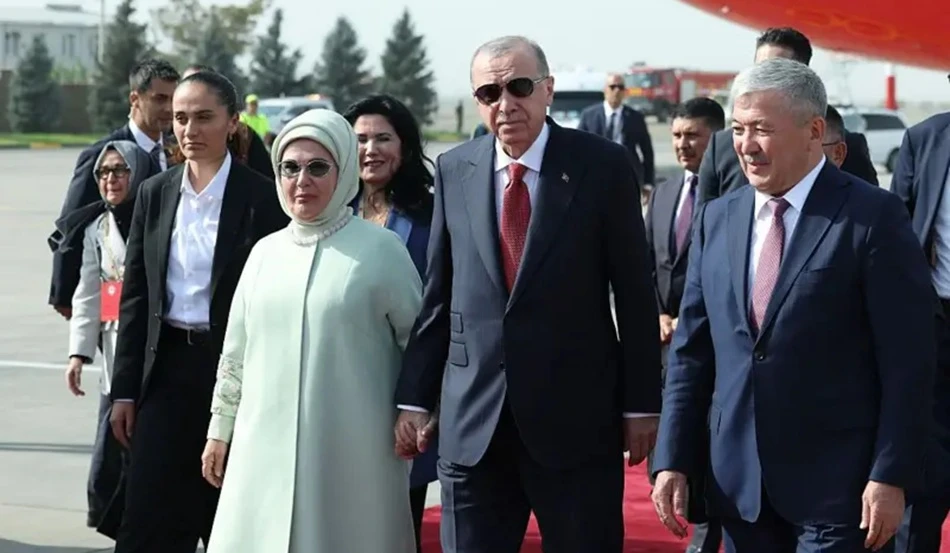
Erdoğan and first lady Emine Erdoğan arrived in Bishkek for the summit and were welcomed at Manas International Airport by Kyrgyz Prime Minister Adylbek Kasymaliev and Türkiye’s ambassador to Bishkek, Mekin Mustafa Kemal Ökem.
The anniversary summit brings together leaders from some of the world’s most influential non-Western powers at a time when debates over multipolarity, regional security and the future of international institutions are intensifying.
For Türkiye, the meeting again highlights a foreign policy strategy built around maintaining strong links with the West while developing deeper relationships with Asia.
Ankara remains a NATO member and an EU candidate while continuing dialogue with Russia, China and other SCO members.
Türkiye has not moved beyond dialogue-partner status in the organization, but its repeated participation at leadership summits shows that the SCO has become a regular component of its diplomatic engagement.
The evolution of the relationship since 2012 illustrates Ankara’s broader effort to diversify its international partnerships without formally presenting its Asian outreach as a replacement for its Western alliances.
As the SCO marks 25 years in Bishkek, Türkiye’s position continues to reflect that balancing act: maintaining its established place in Western institutions while seeking a larger diplomatic and economic role in an increasingly multipolar international system.
WiseNewsPress.com
What's Your Reaction?
 Like
0
Like
0
 Dislike
0
Dislike
0
 Love
0
Love
0
 Funny
0
Funny
0
 Wow
0
Wow
0
 Sad
0
Sad
0
 Angry
0
Angry
0

Ahmet Taş is a journalist, editor and Turkey Office Manager of the Wise News Press Media Group. He works across news, digital media and international publishing, focusing on accurate, responsible and accessible journalism. He contributes to the development of media projects that bring important political, social and global developments to a wider international audience.











Comments (0)