



Turkey’s Fighter Jet Strategy: The Push for Diversity with Eurofighter and KAAN
Following its exclusion from the F-35 program and the S-400 crisis, Turkey is diversifying its air defense inventory by acquiring Eurofighter jets and accelerating the domestic KAAN project to replace its aging fleet.


WISE NEWS PRESS / LONDON, UK — DEC. 13, 2025
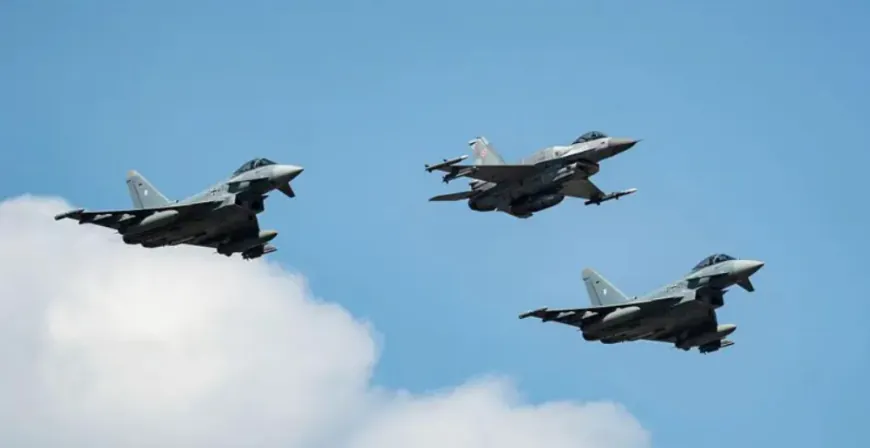
In the shadow of its exclusion from the US F-35 program and the crisis over the Russian-made S-400 system, Turkey has accelerated its efforts to diversify its air force inventory through Eurofighter acquisitions and the domestic KAAN production project.
Ankara, engaging in multi-faceted diplomacy to procure new fighter jets, is continuing talks with the US for F-16s and F-35s while simultaneously signing a deal with the UK for 20 Eurofighters. Negotiations are also underway for second-hand Eurofighters from Qatar and Oman. Experts attribute this strategy to an aging fleet, regional threats, and trust issues within NATO.
The S-400 Condition and the F-35 Deadlock
Tom Barrack, the US Ambassador to Turkey and Special Envoy for Syria, reiterated Washington's clear stance on Turkey's return to the F-35 program. In a statement on November 9, Barrack said, "Under US law, for Turkey to return to the F-35 program, it must no longer operate or possess the S-400 system."
While Barrack noted that the positive relationship between President Trump and President Recep Tayyip Erdoğan has created a new atmosphere for cooperation, the requirement to divest the Russian-made air defense system remains the biggest obstacle on the table.


Aging Fleet and Strategic Planning
Sinan Ülgen, Director of the Center for Economics and Foreign Policy Studies (EDAM), states that the primary reason for Turkey's simultaneous attempts to acquire multiple types of aircraft is the aging of the Turkish Air Force fleet. Turkey last purchased 30 F-16s in 2012; the rest of the inventory dates back to between 1987 and 2000.
Dr. Aaron Stein, President of the US-based Foreign Policy Research Institute (FPRI), characterizes the current situation as a "management weakness." Stein assessed, "The backbone of the Turkish Air Force was supposed to be the F-35s. But Turkey lost the F-35s. Since then, there hasn't been a clear and consistent plan."
While Stein criticized Turkey for getting itself removed from the F-35 supply chain only to try and buy the planes from the outside later, Ülgen argued that the consequences of the S-400 decision were not sufficiently calculated at the highest levels.


Distrust in NATO and Regional Competition
Experts answer the question of why Turkey does not fully rely on NATO's Article 5 (collective defense) until the KAAN project comes online in the 2030s with three main points:
-
Distrust in NATO: Sinan Ülgen noted that while NATO support is expected in the event of a Russian attack, there are doubts in Ankara about whether the same support would be provided in the face of a potential threat from Israel.
-
Power Projection: Turkey seeks aircraft not just for defense, but to maintain operational power in regions like Syria, Iraq, and Libya.
-
Competition with Greece: The risk of NATO ally Greece gaining air superiority in the Aegean with Rafale and F-35 jets is pushing Ankara to seek alternatives.
Although Russia's invasion of Ukraine in 2022 changed the West's view of Turkey and brought Eurofighter and F-16 sales back to the agenda, Turkey views the Eurofighter as a critical "interim solution" until its indigenous KAAN project is completed.
What's Your Reaction?
 Like
0
Like
0
 Dislike
0
Dislike
0
 Love
0
Love
0
 Funny
0
Funny
0
 Wow
0
Wow
0
 Sad
0
Sad
0
 Angry
0
Angry
0

Editor | Wise News Press — Delivering accurate, timely global news with integrity, insight, and editorial responsibility.
















Comments (0)