



Erdoğan says EU membership no longer a priority as regional ties expand
President Erdoğan said EU membership is no longer a Turkish priority while outlining Ankara’s plans on regional defense, Syria, Gaza and the F-35 program.


By Ahmet Taş | Wise News Press
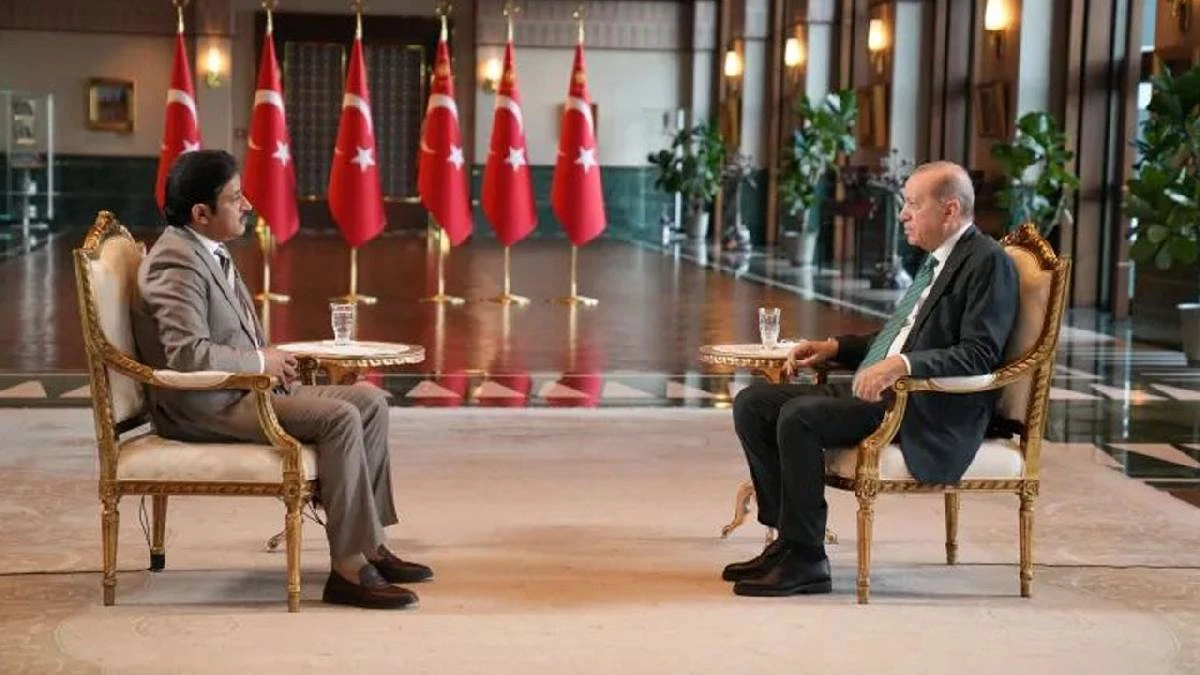
ANKARA, TURKEY — Turkish President Recep Tayyip Erdoğan said European Union membership is no longer among Ankara’s main priorities, while outlining a broader foreign policy agenda focused on regional defense cooperation, Syria, Gaza, the Strait of Hormuz and relations with the United States.
According to Turkish newspaper Karar, citing Erdoğan’s interview with Al Jazeera Arabic, the Turkish president argued that the European Union does not appear willing to admit Turkey as a member and said Ankara has consequently shifted its strategic priorities. Erdoğan also discussed a recently announced defense arrangement involving Turkey, Saudi Arabia and Pakistan, as well as the future of Turkey’s participation in the F-35 fighter jet program.
Erdoğan says EU membership is no longer Ankara’s priority
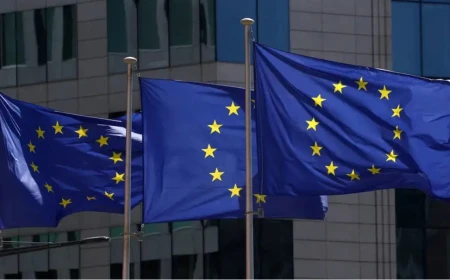
One of Erdoğan’s most notable statements concerned Turkey’s decades-long bid to join the European Union.
The president said the EU did not appear willing to accept Turkey as a member and stated that accession was therefore no longer a priority for Ankara.
Erdoğan argued that Europe would ultimately suffer from that position, saying that “Europe will be the loser.”


Turkey’s relationship with the European Union has for years combined formal accession aspirations with increasingly pragmatic cooperation in areas including trade, migration, security, energy and defense.
Erdoğan’s latest remarks suggest Ankara is placing less political emphasis on full membership while concentrating more heavily on bilateral and regional partnerships.
The statement does not mean that Turkey is ending its institutional relationship with the EU. Instead, it reflects Erdoğan’s assessment that Ankara’s foreign policy priorities are increasingly being shaped by developments beyond the formal accession process.


Turkey, Saudi Arabia and Pakistan discuss collective defense
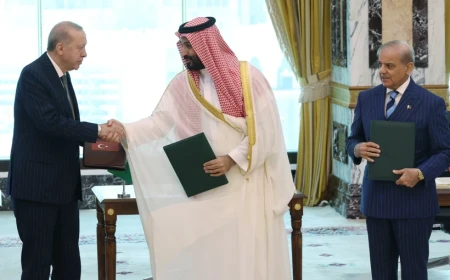
Erdoğan also spoke about a defense agreement involving Turkey, Saudi Arabia and Pakistan.
According to Karar’s account of the interview, Erdoğan said the arrangement provides for joint action if one of the participating countries comes under an external armed attack.
The agreement, described as the Mecca Joint Defense Agreement or “Mecca Pact,” was reportedly signed in Mecca by Erdoğan, Saudi Crown Prince Mohammed bin Salman and Pakistani Prime Minister Shehbaz Sharif.
Erdoğan said the agreement had sent an important message internationally and indicated that the framework could potentially expand in the future.
He specifically said Egypt could be among the countries considered for participation.
The reported collective-defense provision has led some observers to compare the agreement with NATO’s Article 5 principle, under which an attack on one ally is treated as an attack on all.
Pakistani officials, however, have reportedly cautioned against describing the arrangement as a new NATO-style alliance or as a bloc directed against any specific country.
Strait of Hormuz and Syria remain key regional concerns
Erdoğan also addressed tensions surrounding the Strait of Hormuz, one of the world’s most strategically important energy corridors.
He said reopening and maintaining access through the strait was a priority for Turkey, arguing that prolonged disruption would not serve the interests of any country.
The Turkish president also highlighted Qatar’s role in mediation efforts aimed at reducing regional conflicts.
On Syria, Erdoğan said Turkey would continue working toward stability and indicated that he planned to visit the country.
He also said Kurdish communities in Syria should benefit from peace and stability, while stating that Ankara intended to strengthen relations with Kurdish populations in the region and continue supporting their rights.
Turkey’s Syria policy remains one of the central components of its regional security strategy, involving border security, political relations with Damascus, refugee issues and developments involving Kurdish groups in northern Syria.
Erdoğan: Turkey will continue supporting Gaza
Gaza was another major topic in the interview.
Erdoğan said Turkey would continue supporting the territory and stressed that Ankara would not abandon Gaza.
He argued that Hamas had been acting in good faith in fulfilling its obligations, while accusing Israel of continuing the war.
Turkey has maintained a highly critical position toward Israeli military operations in Gaza and has repeatedly called for an end to the conflict and greater humanitarian access.
Erdoğan’s comments indicate that Gaza will remain a central issue in Ankara’s regional diplomacy.
The president also addressed Israeli military action in Lebanon, describing the continuing attacks as a serious concern for Turkey.
Ankara calls for US role in ending conflict in Lebanon
Erdoğan said he had discussed the situation in Lebanon with US President Donald Trump during Trump’s latest visit to Turkey.
According to Erdoğan, he told the US president that the conflict in Lebanon needed to be brought to an end.
He argued that Washington could play an important role in stopping regional hostilities and called for greater US engagement.
The Turkish president also addressed Sudan and Libya during the interview.
Erdoğan said Ankara would continue supporting Sudan and described his relationship with Sudanese Sovereignty Council Chairman Abdel Fattah al-Burhan as positive.
On Libya, he said relations between Ankara and Tripoli remained stable and reiterated that Turkey would continue supporting the country.
These statements reflect Turkey’s broader strategy of maintaining diplomatic, military and economic engagement across several conflict-affected countries in the Middle East and North Africa.
Erdoğan says Trump made a commitment on F-35 fighter jets
Turkey’s long-running dispute with Washington over the F-35 fighter jet program was also discussed.
Erdoğan said he had received a commitment from US President Donald Trump regarding the F-35 issue and that Ankara expected the promise to be fulfilled.
Turkey’s position in the F-35 program has for years been one of the most important points of tension in Turkish-US defense relations.
Erdoğan’s remarks suggest that Ankara continues to seek a resolution that could restore or redefine Turkey’s role in the program.
The F-35 issue is closely linked to the wider strategic relationship between Turkey and the United States, including NATO cooperation, air defense, regional security and defense procurement.
Any concrete progress on the matter would therefore have implications beyond the aircraft program itself.
Regional partnerships increasingly shape Turkey’s foreign policy
Taken together, Erdoğan’s statements point to a Turkish foreign policy agenda increasingly centered on regional alliances, defense cooperation and crisis diplomacy.
His comments on the European Union suggest that full EU membership is no longer being presented as Ankara’s primary strategic objective, while relations with Saudi Arabia, Pakistan, Egypt and other regional states are receiving greater attention.
The reported defense framework with Saudi Arabia and Pakistan could become particularly significant if additional countries join it.
At the same time, Erdoğan’s remarks on Syria, Gaza, Lebanon, Sudan and Libya underline Turkey’s ambition to remain an active diplomatic and political actor across the wider region.
Relations with Washington also remain crucial, particularly over the F-35 program and US involvement in Middle Eastern conflicts.
Erdoğan’s statement that EU membership is no longer a priority therefore comes within a broader shift in emphasis: Ankara appears increasingly focused on flexible regional partnerships and strategic cooperation rather than defining its foreign policy primarily through the long-running European accession process.
WiseNewsPress.com
What's Your Reaction?
 Like
0
Like
0
 Dislike
0
Dislike
0
 Love
0
Love
0
 Funny
0
Funny
0
 Wow
0
Wow
0
 Sad
0
Sad
0
 Angry
0
Angry
0

Ahmet Taş is a journalist, editor and Turkey Office Manager of the Wise News Press Media Group. He works across news, digital media and international publishing, focusing on accurate, responsible and accessible journalism. He contributes to the development of media projects that bring important political, social and global developments to a wider international audience.













Comments (0)