



Turkey considers military role in Saudi-led Red Sea maritime coalition
Turkey is participating in talks on a Saudi-led Red Sea maritime coalition, but Ankara has not yet announced what military contribution it would make.


By Ahmet Taş | Wise News Press
ANKARA, TÜRKİYE — Turkey is taking part in talks on a Saudi-led multinational maritime coalition designed to protect shipping in the Red Sea, but Ankara has not yet announced whether it will deploy warships, troops or other military assets to the new mission.
Saudi Arabia unveiled the initiative on July 30, saying it was intended to strengthen freedom of navigation and protect international trade and energy routes around the Red Sea, Bab el-Mandeb Strait and Gulf of Aden. Fourteen countries, including Turkey, Pakistan, Egypt, Sudan and Djibouti, backed a joint statement supporting the proposed coalition.
Turkey joins coalition planning but military role remains unclear
Turkey’s Defence Ministry confirmed on August 13 that Ankara is participating in meetings aimed at establishing the international maritime coalition.
Turkish officials said Saudi Arabia had invited countries to a series of consultations, including technical-level and senior military meetings. The ministry said Turkey was continuing to work with Saudi authorities with the objective of reducing tensions in the Gulf region and maintaining the uninterrupted flow of international trade.
What Ankara has not announced is the scale or form of any eventual Turkish military contribution.


Participation in planning meetings does not automatically mean Turkey will assign naval vessels or combat forces to the Saudi-led mission. Any operational role would depend on the coalition charter, the mission’s mandate, its rules of engagement and decisions taken by the Turkish government.
Under Article 92 of the Turkish Constitution, sending Turkish Armed Forces abroad generally falls under the authority of the Grand National Assembly unless deployment is covered by applicable international treaty obligations or other constitutional exceptions.
Saudi Arabia wants a permanent maritime security structure
Saudi Arabia has presented the initiative as a multinational security mechanism rather than a coalition directed against a particular country.


According to the Saudi plan reported by Reuters, the kingdom would act as the founding and leading state and would host the coalition’s headquarters. The mission is intended to protect commercial navigation, international trade corridors, energy supply lines and shared maritime interests in the Bab el-Mandeb Strait and Gulf of Aden.
The proposed framework is expected to include intelligence sharing, operational coordination, joint exercises, training, capacity building and potentially joint maritime operations.
The initiative comes as the Red Sea has become increasingly important to global energy flows. The U.S. Energy Information Administration estimated that petroleum and other liquid fuels moving through Bab el-Mandeb averaged about 8.1 million barrels per day in the second quarter of 2026, up sharply as Saudi Arabia rerouted some exports away from the heavily disrupted Strait of Hormuz.
Closure or serious disruption of Bab el-Mandeb forces vessels travelling between Asia and Europe to divert around the Cape of Good Hope, adding significant time and transport costs.
Fidan: Turkey has a direct interest in Red Sea security
Foreign Minister Hakan Fidan has given one of the clearest indications that Ankara wants to have a role in the emerging security architecture.
Speaking on August 8, Fidan said Turkey’s interest in military discussions over Red Sea security was “quite normal” because disruption of the trade basin directly affects Turkish interests.
Fidan confirmed that President Recep Tayyip Erdoğan had given the necessary approval for Turkish military officials to take part in the discussions and that the Chief of General Staff was attending relevant meetings.
He also linked the Red Sea directly to Turkey’s position in the Mediterranean.
The Suez Canal connects the Red Sea to the Mediterranean, while Turkish ports form part of major cargo routes linking Europe, Asia, the Black Sea and the Middle East. Fidan argued that Turkey therefore needed to be represented in any new regional structure shaping maritime security.
His remarks indicated political support for Turkish participation in the coalition-building process, although he did not announce a specific naval deployment.
Houthi attacks have raised the stakes around Bab el-Mandeb
The new coalition is taking shape amid renewed threats to shipping from Yemen’s Iran-aligned Houthi movement.
Saudi Arabia announced its maritime initiative after the Houthis declared a blockade targeting Saudi-linked shipping and claimed attacks against vessels in the Red Sea. Riyadh has said its objective is to protect international shipping rather than turn the coalition into an extension of its bilateral confrontation with the Houthis.
The Bab el-Mandeb Strait is one of the world’s most strategically important maritime chokepoints. It connects the Gulf of Aden and Indian Ocean to the Red Sea and, through the Suez Canal, to the Mediterranean.
The security of the corridor therefore affects not only Saudi Arabia and Yemen but also European and Asian supply chains, oil markets and container shipping.
Saudi Arabia’s effort comes alongside other international security missions already operating in the broader region, including European and multinational naval deployments created to protect commercial navigation.
Turkey already has forces operating around the Gulf of Aden
A Turkish military presence in the wider region would not be unprecedented.
Turkey already contributes naval forces to international operations against piracy, armed robbery and maritime terrorism around the Gulf of Aden, waters off Somalia, the Arabian Sea and neighbouring areas.
In January 2026, the Turkish parliament extended the authorization for those naval deployments for another year from February 10, 2026. The mandate allows Turkish naval units to take part in international operations outside the territorial waters of regional states.
Turkey also has a broader military partnership with Somalia. Parliament approved another two-year extension in July for Turkish Armed Forces personnel supporting Somalia’s security against terrorism, piracy, illegal fishing, smuggling and other threats.
Those existing mandates, however, are legally and operationally distinct from participation in the new Saudi-led coalition.
If Ankara decides on a new mission extending beyond existing authorizations, the legal basis and parliamentary requirements would have to be determined according to the scope of the deployment.
Red Sea talks follow a broader Turkish-Saudi defence expansion
The maritime discussions are taking place during a period of rapidly expanding defence cooperation between Ankara and Riyadh.
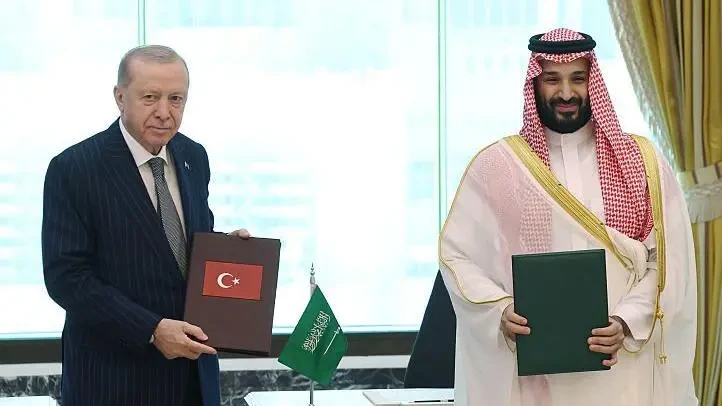
On August 7, President Erdoğan, Saudi Crown Prince Mohammed bin Salman and Pakistani Prime Minister Shehbaz Sharif signed the Mecca Joint Defence Agreement, creating a new trilateral security framework.
Turkey’s Defence Ministry said the agreement is intended to institutionalize military cooperation through high-level political and military mechanisms, joint exercises involving land, naval and air forces, and deeper cooperation in air defence, unmanned systems, electronic warfare, artificial intelligence and defence production.
The Red Sea coalition is a separate initiative, but the two developments illustrate the increasing strategic cooperation between Turkey and Saudi Arabia.
Fidan has stressed that Saudi Arabia presented the maritime initiative primarily as a matter of global trade security, rather than as a request for military assistance in Riyadh’s conflict with the Houthis.
A decision on Turkish military deployment has not been announced
For now, the clearest conclusion is that Turkey is politically and militarily involved in designing the new Red Sea security framework, but the final nature of its participation remains undecided publicly.
Ankara has attended technical and military consultations, supported discussions on maritime security and publicly argued that Turkey should have a voice in determining how the Red Sea trade corridor is protected.
Whether that eventually means assigning Turkish frigates, intelligence assets, command personnel, training teams or another form of contribution will depend on the coalition charter and future decisions in Ankara.
With the Strait of Hormuz severely disrupted and Bab el-Mandeb carrying growing volumes of energy traffic, the strategic importance of the Red Sea has increased sharply in 2026. That makes Turkey’s involvement in the emerging maritime security architecture increasingly likely to remain a major regional defence and foreign-policy issue.
WiseNewsPress.com
What's Your Reaction?
 Like
0
Like
0
 Dislike
0
Dislike
0
 Love
0
Love
0
 Funny
0
Funny
0
 Wow
0
Wow
0
 Sad
0
Sad
0
 Angry
0
Angry
0

Editor | Wise News Press — Delivering accurate, timely global news with integrity, insight, and editorial responsibility.




















Comments (0)