



Russia shifts Kyiv attack tactics as daytime drone threat grows in Ukraine
Russia’s use of faster jet-powered drones over Kyiv is extending attacks into daylight hours, disrupting transport, schools, shopping and daily life.


By Ahmet Taş | Wise News Press
KYIV, UKRAINE — Russia has changed the pattern of its air attacks on Kyiv by increasingly using fast-moving, jet-powered drones during daylight hours, disrupting transportation, schools, shopping and ordinary routines across the Ukrainian capital.
For much of the war, residents of Kyiv had grown accustomed to a grim but relatively predictable rhythm: Russian missile and drone attacks were overwhelmingly associated with the night. Warnings would begin appearing on Telegram monitoring channels late in the evening, followed by reports of drones moving toward the capital, missile launches and Ukrainian air defense activity.
That pattern has become less predictable. According to Euronews, Russia has begun using faster jet-powered drones in a way that has extended the threat beyond nighttime hours. Over the past week, attacks have increasingly taken place both during the night and in daylight, leaving residents without the previous expectation that morning would bring a return to relative normality.
Daytime attacks change Kyiv’s wartime routine
Air raid sirens are now interrupting the city repeatedly throughout the day.
Previously, civilians could often structure their routines around the expectation that the most intense threat would come after dark. Depending on the scale of an alert, residents decided whether to remain at home or move to shelters, including Kyiv’s underground metro stations.


With daytime attacks becoming more frequent, that calculation has become far more difficult.
Work commutes, shopping trips and children’s education are being interrupted by repeated alerts. The warnings also intrude on major moments of civilian life, from weddings to funerals, while the danger of casualties from strikes remains.
For many residents, the problem is no longer only fear of a nighttime attack. It is the exhaustion created by living under a threat that can restart at almost any hour.


Banks and shopping centers repeatedly evacuate customers
Businesses across Kyiv follow safety procedures when an air raid alert is issued.
Shopping centers, banks and other establishments may require customers and employees to leave buildings during an alert. A banking transaction can be interrupted in the middle of a conversation, while shoppers may find themselves entering a store, evacuating, returning after the alert and then being forced out again when another warning sounds.
Kyiv resident Volodymyr Bovsunovskyi described one such experience after taking his family to a shopping mall to buy clothes for his daughter, who is about four years old.
The family had been inside for roughly 20 minutes when an air raid alert began. They immediately left the building and saw smoke rising nearby. They eventually left without buying the clothes they had come for.
Bovsunovskyi said much had changed in just seven days.
The repeated disruption illustrates how Russia’s altered attack pattern is affecting activities that would otherwise appear routine, even in a city that has lived under wartime conditions for years.
Transport and GPS disruptions add to the pressure
The impact extends beyond shelters and building evacuations.
Train journeys that normally take several hours are taking considerably longer in some cases. Euronews reported instances in which passengers were left stranded after trains stopped and had to carry their belongings through grassy areas while repeated air raid warnings continued.
Travel inside Kyiv can also become unpredictable because of disruptions to GPS signals associated with efforts to counter drones.
Taxi applications may show vehicles in incorrect locations. A car that appears close by on a map can suddenly seem to be on the other side of the world, while estimated arrival times can jump from minutes to thousands of minutes.
The result is another layer of uncertainty for residents already attempting to plan daily life around changing security conditions.
Electronic warfare measures may be directed at hostile drones, but their side effects are visible in civilian navigation and transport systems.
Some Kyiv residents are considering leaving
For some people, the cumulative effect of repeated attacks is raising a more fundamental question: whether to remain in Kyiv.
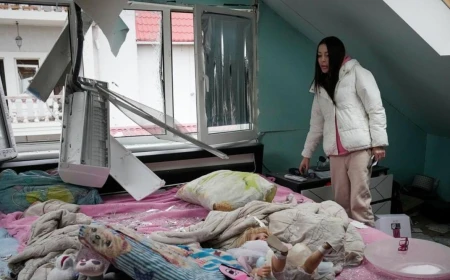
IT worker Ivan Datsiv was in his apartment in Kyiv’s Podil district when a Russian drone struck the building, according to Euronews. The impact damaged his apartment, covering walls and ceilings with soot, while a neighboring apartment was destroyed.
Datsiv said the alerts had become so frequent that repeatedly moving to and from a shelter felt increasingly impractical.
“The sirens keep going off.”
He said he had begun thinking about moving to another city where conditions might be quieter and the immediate threat less intense.
Bovsunovskyi is considering a temporary departure as well, particularly to give his family, including his pregnant wife, some relief.
His daughter’s kindergarten must move children into a shelter whenever an air raid warning is issued. The alerts have become frequent enough that he has sometimes collected her in the middle of the day rather than leaving her at school.
“There is no stability,” he said.
Homes and civilian infrastructure continue to be hit
The disruption is occurring alongside continued physical destruction across Kyiv and the surrounding region.
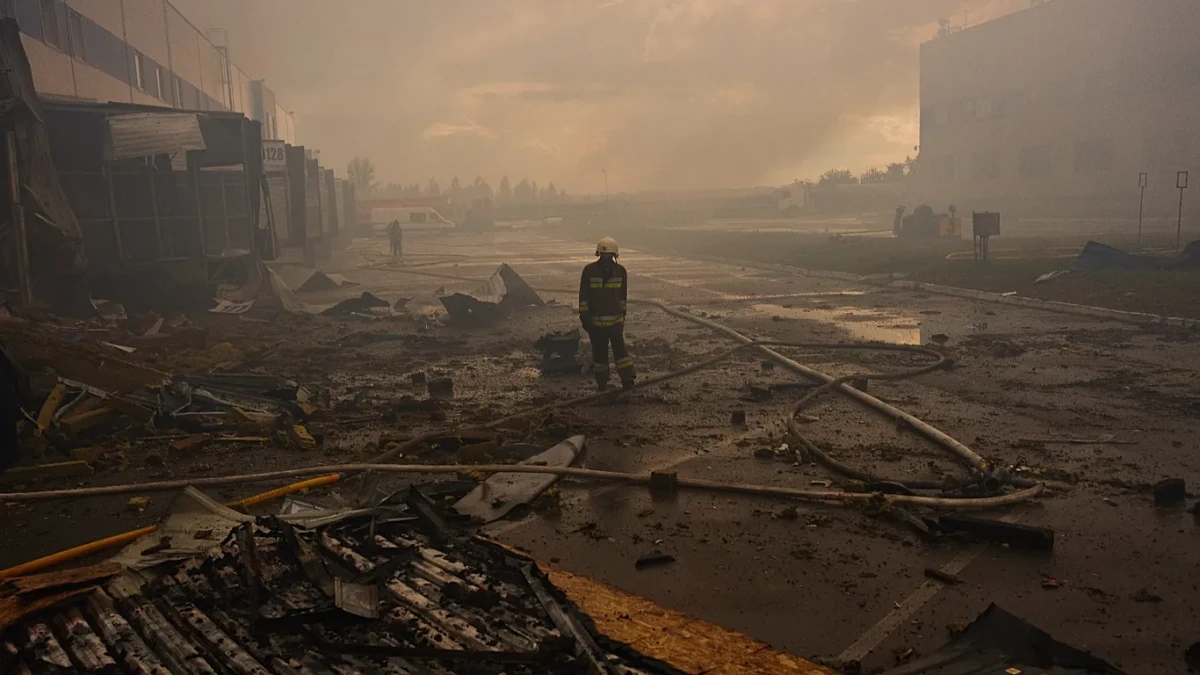
On September 3, firefighters worked at an apartment building in Kyiv’s Holosiivskyi district after it was struck during a Russian drone attack. Photographs showed emergency crews working amid the damaged residential structure.
Outside Kyiv, another Russian drone attack destroyed a pharmaceutical warehouse, where firefighters were later photographed battling the resulting fire and moving through the debris.
The images underscore how the changing timing of attacks affects more than public schedules.
Residents can hear an alert, see smoke rising over another district and receive photographs of a damaged building through Telegram channels within minutes. One or two hours later, another warning may begin.
That cycle is increasingly becoming part of daily life in the capital.
Zelenskyy expects Trump representatives in Kyiv
The intensifying attacks come as Ukraine seeks to revive diplomatic efforts aimed at ending the war.
Ukrainian President Volodymyr Zelenskyy said he hoped to receive representatives of US President Donald Trump in Kyiv in the coming days.
Zelenskyy said the representatives were expected to hold talks in both Moscow and Kyiv and that Ukraine hoped a meeting could take place soon.
Trump’s special representative Steve Witkoff and the president’s son-in-law Jared Kushner have been involved in shuttle diplomacy between Russia and Ukraine, according to the source report. Both have travelled to Moscow several times but had not previously visited Kyiv.
Zelenskyy said dates for their first visit to the Ukrainian capital had been agreed “in principle.”
The planned diplomatic visit would come as Kyiv faces an intensified wave of Russian drone and missile attacks and residents adjust to a threat that is no longer concentrated mainly in the night.
Russia’s latest tactical shift has therefore changed more than the timing of air raid sirens. For people in Kyiv, the possibility of an attack must now be considered while commuting to work, taking children to school, visiting a bank, shopping for groceries or simply trying to move across the city.
The war has long shaped life in Ukraine’s capital. The growing daytime drone threat is making that life even harder to organize around moments of relative safety.
WiseNewsPress.com
What's Your Reaction?
 Like
0
Like
0
 Dislike
0
Dislike
0
 Love
0
Love
0
 Funny
0
Funny
0
 Wow
0
Wow
0
 Sad
0
Sad
0
 Angry
0
Angry
0

Ahmet Taş is a journalist, editor and Turkey Office Manager of the Wise News Press Media Group. He works across news, digital media and international publishing, focusing on accurate, responsible and accessible journalism. He contributes to the development of media projects that bring important political, social and global developments to a wider international audience.


















Comments (0)