



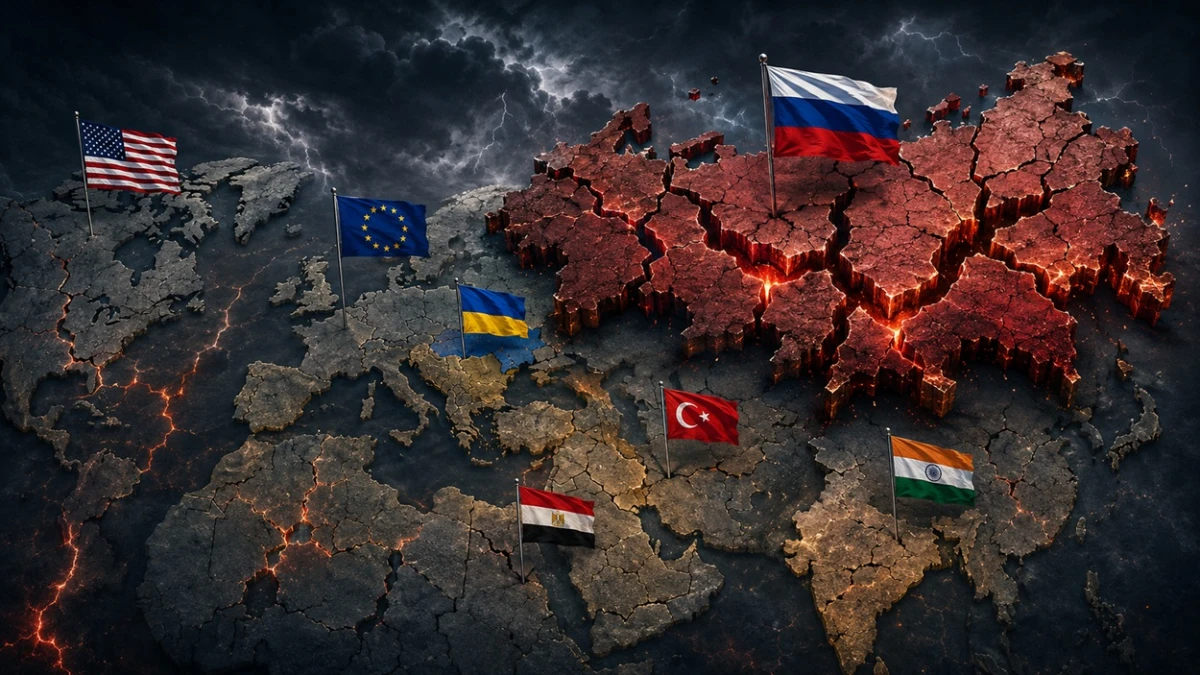
Is Russia breaking apart — or losing its grip on the global order?
Said Nursi’s century-old remarks on Russia gain new relevance as India, Central Asia and other powers test Moscow’s influence in an increasingly multipolar world.


By Yusuf İnan | Wise News Press
Journalist and Author | Political and Strategic Analyst
ANKARA, Türkiye — The most important question facing Russia may not be whether the Russian Federation will break apart tomorrow, but whether the multipolar order Moscow itself champions will gradually dismantle something almost as important: Russia’s privileged sphere of influence across Eurasia.
That distinction matters.
Russia remains a nuclear superpower with formidable armed forces, vast natural resources, a powerful security apparatus and a highly centralised political system. There is no credible basis today for declaring its territorial disintegration imminent.


Yet a different kind of fragmentation is already visible. India is increasingly autonomous from Moscow. Central Asian states are diversifying their partners. Türkiye deals simultaneously with Russia, Ukraine, Europe, the United States and Central Asia. China supports Russia strategically while pursuing interests that are distinctly Chinese rather than Russian.
In that context, the century-old words of the Kurdish-Turkish Muslim scholar Bediuzzaman Said Nursi deserve attention — not as a supernatural prediction of Russia’s collapse, but as an unusually early reflection on the impermanence of imperial systems and the future political agency of societies once dominated by them.
What Said Nursi actually said — and what he did not
According to Tarihçe-i Hayat, while travelling through Tiflis around 1910, Said Nursi encountered a Russian policeman on Sheikh San’an Hill.


The policeman questioned Nursi’s optimism about the future of the Muslim world.
Nursi replied that the authoritarian order confronting him would not last forever, saying in Ottoman Turkish that the “despotic curtain will be torn and contract.”
He then described India, Egypt, the Caucasus and Turkestan through an educational metaphor. India was portrayed as a capable child studying in the British system; Egypt as an intelligent son learning from British administration; the Caucasus and Turkestan as strong sons undergoing training within Russia.
The crucial Ottoman word is takallüs — contraction, shrinking or drawing inward.
It is tempting, particularly after the collapse of the Russian Empire and later the Soviet Union, to read the passage as a prediction of territorial fragmentation.
But the text does not say that the modern Russian Federation will divide into a specific number of states.
That boundary matters.
A historically defensible interpretation is that Nursi expected apparently permanent systems of domination to contract, while populations under imperial control could eventually acquire political agency of their own.
A claim that he specifically foresaw the breakup of 21st-century Russia would go considerably further than the source permits.
The historical record makes ‘contraction’ more interesting than ‘collapse’
What happened after Nursi’s remarks is nevertheless striking.
The Romanov monarchy fell in 1917.
A new Soviet system eventually reconstructed much of the former imperial space, but it too dissolved in 1991.
Kazakhstan, Uzbekistan, Kyrgyzstan, Turkmenistan, Azerbaijan, Georgia and other Soviet republics emerged as sovereign states.
Moscow remained powerful, but the territory directly controlled from the Russian capital contracted on a historic scale.
That makes contraction, rather than fragmentation, the more useful strategic concept.
Today the same distinction should be applied to Vladimir Putin’s Russia.
Russia does not need to lose Siberia, Tatarstan or the North Caucasus for its geopolitical position to diminish.
It would be enough for states around its perimeter to become progressively less dependent on Moscow.
In imperial history, decline often begins outside the formal borders of the core state.
The center remains intact.
What changes first is its ability to determine what neighbouring states may or may not do.
The paradox of Moscow’s multipolar world
This produces a paradox that deserves far more attention.
Russia has spent years arguing that the U.S.-led international system should be replaced by a more multipolar order.
China uses similar language. During his latest meeting with Putin, Chinese President Xi Jinping again spoke of reforming global governance and building a more equitable and orderly multipolar world.
From Moscow’s perspective, multipolarity is attractive because it limits American and European dominance.
But real multipolarity does not only constrain Washington.
It constrains Moscow as well.
If Kazakhstan is genuinely sovereign, it will not automatically follow Russian policy.
If India is genuinely a great power, it will not subordinate its foreign policy to Russian interests.
If Türkiye is an autonomous regional power, it can cooperate with Moscow in one arena and compete with it in another.
If China is a global pole rather than merely Russia’s anti-Western ally, Beijing will pursue its own interests throughout Central Asia and Eurasia.
This is therefore the central paradox:
Russia may succeed in helping create a world in which the West has less exclusive power — only to discover that Russia itself also has less exclusive power over its traditional neighbourhood.
That is potentially far more important than speculation about Russia breaking apart.
Modi’s message to Putin shows what this new order looks like
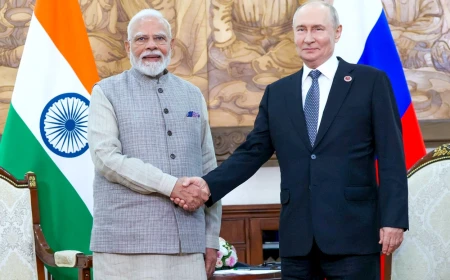
Indian Prime Minister Narendra Modi’s recent message to Vladimir Putin is a particularly revealing example.
India is not aligned with the Western campaign to isolate Russia.
It has longstanding defence ties with Moscow, imports large amounts of Russian energy and cooperates with Russia in BRICS and the Shanghai Cooperation Organisation.
Yet during their meeting in Bishkek, Modi told Putin that the Ukraine war must end for the sake of humanity and again emphasized peace, dialogue and diplomacy.
This matters precisely because Modi is not speaking as Russia’s enemy.
Washington demanding an end to the war is expected.
Brussels demanding an end to the war is expected.
Kyiv demanding an end to Russian aggression is inevitable.
India telling Putin that endless war is unacceptable carries a different strategic meaning.
It suggests that a country can reject Western bloc discipline without accepting Russian bloc discipline either.
This may become one of the defining characteristics of the new international order.
India is not moving from the Russian camp to the Western camp.
It is demonstrating that it does not consider itself part of either camp.
That is genuine multipolarity.
And for Moscow, it creates both an opportunity and a problem.
Central Asia is not abandoning Russia — but it is becoming less exclusively Russian
The same process is developing across the region Said Nursi called Turkestan, though the historical term should not be mechanically equated with today’s Central Asian republics.
Kazakhstan, Uzbekistan and other states have spent years expanding relations with China, Türkiye, the European Union, the Gulf states, the United States and Asian economies.
Recent analysis from the Carnegie Endowment describes a broader shift toward what might be called portfolio politics: states across continental Asia increasingly select different partners for different economic, diplomatic and security needs rather than aligning permanently with one bloc.
That does not mean Russia has disappeared from Central Asia.
Far from it.
Russian markets, transport routes, language, migration networks and economic connections remain deeply embedded. Carnegie has also noted that continuing wars across alternative southern trade routes have, paradoxically, kept Russia indispensable for significant parts of Central Asian commerce.
This nuance is essential.
The emerging order is not simply:
Russia out, West or China in.
It is:
Russia remains important, but Russia becomes one partner among several.
For Moscow, that represents a loss of exclusivity even where it does not represent an outright loss of influence.
And the distinction is precisely what makes the process difficult to reverse.
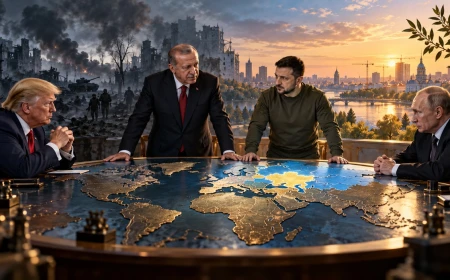
Washington, Brussels, Kyiv, Ankara and Moscow will read this differently
The same argument inevitably looks different depending on the capital from which it is read.
In Washington, the central question is likely to be whether Russia’s war has accelerated the long-term erosion of Moscow’s ability to dominate Eurasia. Said Nursi is secondary; the strategic contraction thesis is primary.
In Brussels, the argument connects directly to European security. A Russia that retains nuclear and military power but possesses less control over its neighbours presents a very different European balance from one in which Moscow can dictate political choices throughout its former imperial sphere.
In Kyiv, the most important element is likely to be the behaviour of Russia’s non-Western partners. If India and other important states increasingly press Moscow toward ending the war, Ukrainian diplomacy gains space beyond the traditional Western coalition.
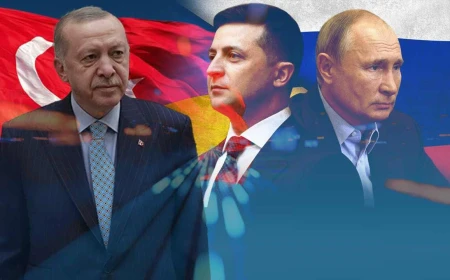
In Ankara, the analysis has another dimension. Türkiye benefits from a Eurasian system in which neither Russia nor the West possesses exclusive control. Ankara can mediate between Moscow and Kyiv, deepen ties with Central Asia, remain inside NATO and simultaneously maintain significant relations with Russia.
In Moscow, however, the argument is likely to be read most defensively.
Russian policymakers may reject any suggestion of imperial contraction and emphasize the expansion of BRICS, the SCO and Moscow’s partnerships across the non-Western world.
Yet this is exactly where the paradox returns.
A truly multipolar world gives India, Kazakhstan, Türkiye and others more independence not only from Washington, but from Moscow too.
That is not an anti-Russian interpretation of multipolarity.
It is simply the logical consequence of multipolarity itself.
Russia is under pressure, but that is not the same as imminent collapse
A serious analysis must also recognize Russia’s resilience.
Putin continues to claim that Russian forces are advancing and that Moscow has no reason to abandon its central war aims. On September 1, he again projected confidence about Russia’s battlefield position.
Nor has Russia’s state machinery ceased functioning.
The security establishment remains powerful.
Political opposition is heavily constrained.
The federal center continues to exercise considerable authority over the regions.
But long wars create cumulative pressures that may not be visible in territorial maps.
One of Putin’s own economic envoys, Boris Titov, recently warned that an economy excessively oriented toward military production risks going “berserk,” reflecting concern inside Russia about the sustainability of the balance between the defence sector and civilian economy.
The decisive strategic question is therefore not whether Russia looks capable of surviving today.
It is how several pressures might interact over time:
a prolonged war,
low civilian investment,
demographic stress,
dependence on a narrower range of external economic partners,
declining influence over neighbouring states,
elite competition,
and eventually a leadership succession.
None is sufficient on its own to break Russia.
Several converging during a political crisis could produce a very different result.
Three futures are more plausible than one dramatic prediction
There are at least three broad scenarios.
The first — and currently the most plausible — is imperial contraction without territorial breakup.
Russia remains territorially intact and militarily powerful but becomes less capable of determining political outcomes in Central Asia, the South Caucasus and other peripheral regions.
The second is internal renegotiation.
A weaker central government or a difficult post-Putin transition could encourage some Russian regions to demand greater fiscal or political autonomy without seeking full independence.
The third is systemic fragmentation.
This remains the most dramatic and least predictable scenario. It would probably require several shocks simultaneously: serious military defeat, an elite split, a leadership crisis, weakening security institutions and organised regional separatism.
There is currently insufficient evidence to describe that outcome as imminent.
That is why Said Nursi’s term takallüs is analytically more useful than the word “collapse.”
Contraction can occur economically.
It can occur strategically.
It can occur ideologically.
It can occur in the radius within which a major power can impose its preferences.
And only under much more extreme circumstances does contraction become territorial disintegration.
Perhaps it is the old world order that is really fragmenting
The larger transformation extends well beyond Russia.
The post-Cold War international system is becoming more contested and more plural.
China has emerged as a separate economic, military and technological center.
India is becoming a great power with its own strategic logic.
Türkiye, Saudi Arabia, Brazil, Indonesia and other middle powers increasingly avoid rigid alignment.
Central Asian states are cultivating multiple partnerships rather than accepting a single patron.
The United States remains extraordinarily powerful, but it no longer operates in an environment where other major states automatically accept an American-designed hierarchy.
Russia remains extraordinarily powerful in military terms, but it too faces countries increasingly unwilling to accept a Russian-designed hierarchy.
That may be the real historic shift.
When Said Nursi spoke of India learning under Britain and Turkestan gaining experience under Russia, those regions were largely objects of imperial politics.
Today they increasingly act as subjects of international politics.
India can address Putin as an equal.
Central Asian presidents can balance Russia against China, Türkiye, Europe and others.
Türkiye can compete with Russia in one theatre while negotiating with it in another.
The transformation is therefore larger than the question of whether Russia’s map will change.
The deeper question is:
Will the multipolar world Moscow has long demanded ultimately dismantle Russia’s own privileged sphere of influence?
If the answer is yes, one of the great ironies of the 21st century may be that Russia helped accelerate the decline of Western unipolarity — only to discover that the same process also limited Moscow’s ability to dominate its neighbours.
In that sense, Said Nursi’s century-old language of contraction remains a striking historical metaphor.
Not because it proves that Russia will break apart.
But because it reminds us that political orders which appear permanent are rarely permanent, and that populations once treated as the periphery of empires can eventually become independent centers of power.
Perhaps, then, the most consequential fragmentation underway is not yet the fragmentation of Russia.
It is the fragmentation of the old hierarchy of global power itself.
Yusuf İnan
WiseNewsPress.com
Yusuf İnan is a journalist, author, and political and strategic analyst. He serves as editor-in-chief of UAPresa.com, WiseNewsPress.com, SehitlerOlmez.com, SiyasetinSesi.com and YerelGundem.com. His work focuses on strategic and political analysis concerning developments in Türkiye and around the world.
What's Your Reaction?
 Like
0
Like
0
 Dislike
0
Dislike
0
 Love
0
Love
0
 Funny
0
Funny
0
 Wow
0
Wow
0
 Sad
0
Sad
0
 Angry
0
Angry
0
Yusuf İnan is a journalist, columnist, strategic analyst and head of the Wise News Press Media Group. His work focuses on international affairs, geopolitics, security and major social issues. Through his journalism, he promotes peace, dialogue, mutual understanding and responsible reporting while contributing to the development of international media projects.










Comments (0)