



Russian AI-guided drone kills three in Zaporizhzhia, raising autonomy fears
Ukrainian investigators say a Russian drone that killed three civilians in Zaporizhzhia used onboard AI to identify and approach its target without direct human control.


By Ahmet Taş | Wise News Press
ZAPORIZHZHIA, UKRAINE — A Russian drone linked to the deaths of three civilians in the southeastern Ukrainian city of Zaporizhzhia carried out its final targeting using onboard artificial intelligence rather than direct human control, according to Ukrainian military officials and forensic investigators.
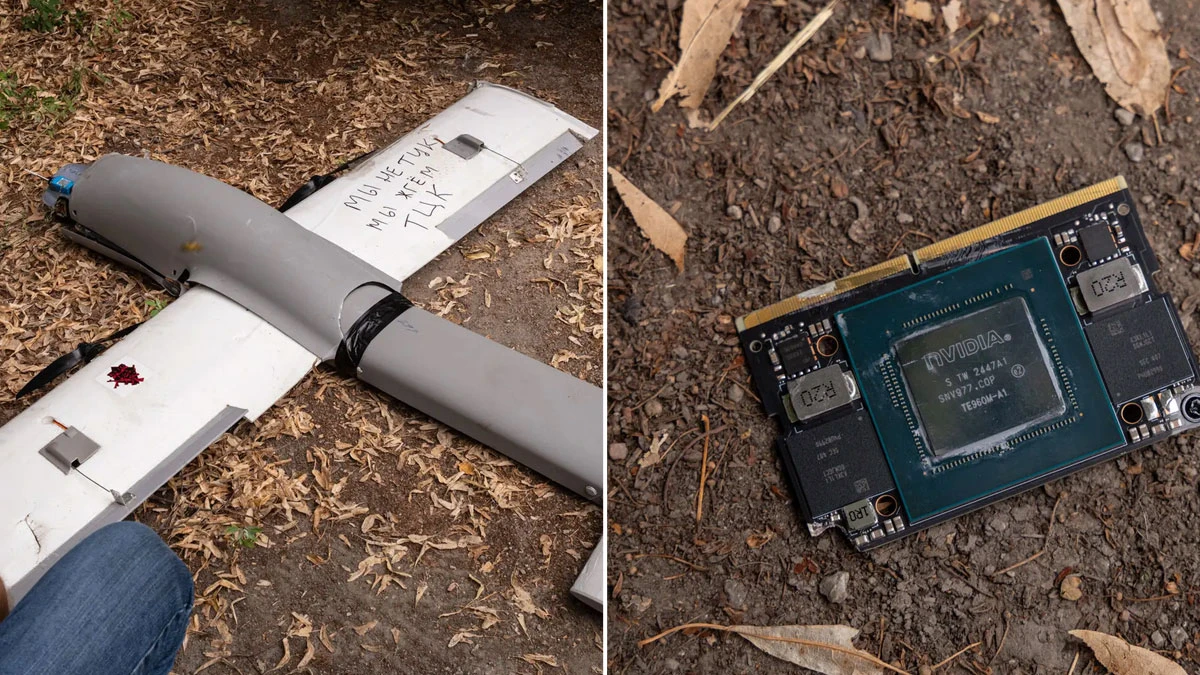
The New York Times reported on August 24 that investigators examining the July 6 attack and other Russian drones recovered in the region found Nvidia Jetson Orin computing modules capable of processing camera images directly onboard the aircraft. Ukrainian specialists concluded that the system had been trained to recognize potential targets and complete the final stage of an attack autonomously.
If that assessment is confirmed, the incident would represent one of the clearest reported examples in the Russia-Ukraine war of a lethal weapon operating with the human operator removed from the final target-recognition and terminal-guidance phase.
Three civilians died after the drone approached a gas station
The attack occurred in Zaporizhzhia on July 6.
According to the New York Times reporting, a small fixed-wing Russian drone approached a gas station after entering the city. Ukrainian investigators believe the system had been trained to recognize particular categories of targets, including fuel or propane infrastructure.


The drone did not successfully reach the object it was apparently attempting to strike. It crashed near a building and exploded, sending fragments into the surrounding area.
Three civilians ultimately died from the attack.
The distinction between what the AI system targeted and who was killed is important.


There is currently no evidence showing that the software deliberately identified the three civilians themselves as targets. Ukrainian investigators instead say the drone was apparently searching for an infrastructure object, with the civilians killed as a result of the strike.
The New York Times reported that Ukrainian air-defense officials and forensic specialists reached their autonomy assessment after examining the wreckage of this and other drones used around Zaporizhzhia between May and July.
How an autonomous strike differs from a conventional FPV drone
Most conventional FPV attack drones still depend heavily on a human pilot.
An operator watches a live camera feed, steers the aircraft toward the target and normally remains involved until the final moments of the attack.
Artificial intelligence has already changed that model.
Some modern drones allow an operator to identify or “lock” a target and then hand over the final approach to a computer-vision system. That makes the weapon more resistant to electronic warfare because it no longer needs an uninterrupted radio connection during the last part of its flight.
The system described by Ukrainian investigators appears to go further.
According to their assessment, the Russian drone could receive a broader mission or operating area and then use its onboard cameras and AI software to identify a target fitting predetermined criteria before making the final approach without continuous operator control.
The New York Times reported that investigators found both Nvidia computing hardware and evidence suggesting the onboard software had been trained for target recognition. The apparent absence of the communication architecture normally needed for continuous remote piloting was also considered significant.
That does not necessarily mean a machine independently decided to begin a military operation.
A human command structure may still have selected the area, mission, target category or launch parameters.
The critical difference is that the specific target recognition and terminal engagement could have been delegated to the onboard system.
Nvidia Jetson Orin found inside Russian drones
At the center of the technical investigation is Nvidia’s Jetson Orin family of compact computers.
Nvidia markets Jetson products for robotics, computer vision, autonomous machines and other “edge AI” applications, in which artificial intelligence processes information directly on a device rather than sending data to a remote server.
That capability makes such computers highly useful for robots that must analyze camera and sensor feeds in real time. Nvidia says its Jetson Orin systems can support advanced computer vision, perception and multi-sensor AI workloads.
Those same characteristics can also have military applications.
Ukrainian forensic examiners showed New York Times journalists damaged but identifiable Jetson components recovered from Russian drone guidance systems.
Nvidia told the newspaper that Jetson Orin computers are consumer-grade products intended for students, developers, startups and civilian applications and were not designed as military systems.
The company also said it does not sell the products in Russia.
However, the modules are widely available through global resale markets, making their eventual end users difficult to trace once products have passed through multiple intermediaries.
Ukraine had already documented AI targeting in Russia’s V2U drone
The Zaporizhzhia findings did not emerge in isolation.
Ukraine’s Defence Intelligence agency previously documented an advanced Russian loitering munition known as the V2U.
In its technical examination published in June 2025, the agency said the weapon was capable of autonomously searching for and selecting targets using artificial intelligence.
The V2U’s computing system included an Nvidia Jetson Orin module installed as the central AI processor within a Chinese-made onboard computer.
The Washington-based Center for Strategic and International Studies later examined Russia’s broader development of autonomous drone systems.
In an April 2026 report, CSIS assessed that Russia had likely fielded a fully autonomous unmanned system in combat.
Researchers pointed to later versions of V2U drones recovered without the external communications equipment needed for continuous operator control. Instead, they appeared capable of using onboard cameras, terrain data and AI-based object recognition to navigate and search for targets independently.
CSIS nevertheless emphasized an important technical caution: finding sophisticated processors and sensors inside a weapon does not, by itself, prove that the weapon operated autonomously during a particular attack.
Software, communications architecture and observed battlefield behavior must also be examined.
The same Nvidia technology has appeared in other Russian weapons
Ukraine has also reported finding Jetson Orin hardware in other Russian weapon systems.
On August 12, Defence Intelligence said specialists had identified an Nvidia Jetson Orin computer module inside the new Russian S-71 Monochrome air-launched cruise missile.
The agency said the component could indicate the use of artificial intelligence for functions such as image processing or guidance. It did not claim that discovery of the computer alone proved the missile autonomously selected its targets.
Ukrainian intelligence has previously documented Nvidia Jetson technology in upgraded Shahed-136 drones as well.
The repeated appearance of commercially available AI hardware in Russian weapons highlights one of the most difficult challenges facing export controls.
The same compact computer capable of powering a warehouse robot, inspection camera or autonomous delivery system can potentially provide the computing power required for military computer vision.
Autonomous drones could weaken electronic warfare defenses
The military attraction of greater autonomy is closely connected to electronic warfare.
Radio-controlled drones are vulnerable to jamming.
If electronic warfare systems interrupt the video feed or command link between the operator and the drone, the pilot may lose control before reaching the target.
An autonomous weapon does not necessarily have that weakness.
Once its mission data, visual recognition model and navigation information are stored onboard, it can potentially continue operating even if the radio connection disappears.
CSIS says Russia’s evolving drone architecture reflects precisely this battlefield pressure: electronic warfare, GPS denial and heavy drone losses have created incentives to develop systems capable of functioning independently at the tactical edge.
That shift could force Ukraine to adapt its defenses.
Signal jammers may remain effective against many remotely controlled drones, but a weapon operating without a control signal may need to be physically intercepted or defeated through other methods, including camouflage, anti-drone nets, interceptors or techniques designed to confuse machine-vision systems.
The battlefield shift raises a larger question over human control
The Russia-Ukraine war has accelerated drone innovation at a speed rarely seen in modern military history.
Both sides increasingly use computer vision, automated navigation, target tracking and artificial intelligence to overcome jamming and shorten the time between detection and attack.
But allowing software to determine which object to strike introduces a fundamentally different problem.
The issue is no longer simply whether artificial intelligence can help a human operator fly a drone.
It is whether a machine should be allowed to perform critical elements of the lethal targeting process after launch without a person confirming the specific object that will be attacked.
The Zaporizhzhia case still requires careful qualification.
The conclusion that the drone performed its final targeting autonomously comes from Ukrainian military officials, forensic experts and investigators who examined the recovered systems. Independent public verification of the complete software and mission chain remains limited.
What is much less disputed is the broader technological trend.
Russia is putting increasingly powerful onboard computers, machine-vision systems and autonomous navigation capabilities into weapons deployed against Ukraine. Ukrainian intelligence has documented that evolution, while independent researchers at CSIS have concluded that Russia is moving from remotely piloted drones toward systems capable of functional independence on the battlefield.
If the findings from the July 6 attack are confirmed, the deaths in Zaporizhzhia will mark more than another tragic episode in Russia’s war against Ukraine.
They will underscore a new question confronting militaries, governments and international law:
How much human control must remain before a machine is permitted to complete a lethal strike?
WiseNewsPress.com
What's Your Reaction?
 Like
0
Like
0
 Dislike
0
Dislike
0
 Love
0
Love
0
 Funny
0
Funny
0
 Wow
0
Wow
0
 Sad
0
Sad
0
 Angry
0
Angry
0

Ahmet Taş is a journalist, editor and Turkey Office Manager of the Wise News Press Media Group. He works across news, digital media and international publishing, focusing on accurate, responsible and accessible journalism. He contributes to the development of media projects that bring important political, social and global developments to a wider international audience.


















Comments (0)